


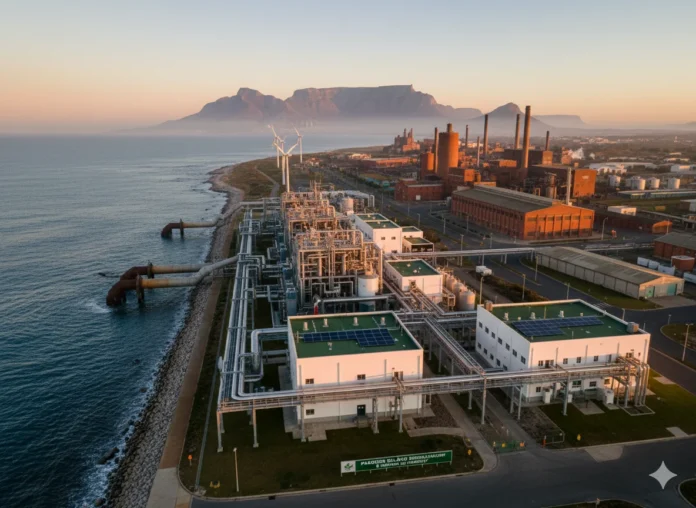
Seven years after Cape Town nearly ran dry during the infamous “Day Zero” drought, the city is betting R5-billion on a desalination plant to ensure factories never face a production shutdown due to water scarcity again.
The Paarden Eiland plant is a permanent facility designed to treat seawater and provide a reliable, climate-resilient supply.
The initiative is part of a larger R120-billion infrastructure vision through 2026, positioning the city as a premier industrial hub in South Africa.
The Paarden Eiland plant aims to use seawater reverse osmosis technology to produce between 50 and 70-million litres per day, directly supporting water-intensive industries such as food and beverage, chemicals, and manufacturing.
Several projects in the pipeline
By comparison, Cape Town’s largest dam Theewaterskloof supplies roughly 450-million litres a day at full capacity, meaning this single plant will cover up to 15% of peak urban-industrial demand independent of rainfall.
The plant is expected to come online by 2030, following the completion of statutory Section 78 studies and a public-private partnership model covering design, financing, construction, operation, and maintenance.
While tariffs for the additional supply may increase water bills by an estimated 6.6% over the first two years, proponents argue that the trade-off is a secure and predictable water supply for industrial operations.
“Reliable water is the backbone of industrial competitiveness,” said the mayor of Cape Town, Geordin Hill‑Lewis.
“The Paarden Eiland plant ensures that Cape Town’s economic engines keep running even in drought years.”
The desalination project is only one piece of Cape Town’s R120-billion infrastructure pipeline for 2026, which aims to bolster industrial growth and economic resilience.
Key water projects include the R5.2-billion Potsdam Wastewater Treatment Works expansion and an R600-million Montague Gardens sewer upgrade, which improve feasibility for new factories.
For energy security, there are planned additions of 650MW of independent power expected to reduce reliance on Eskom and municipalities while avoiding load-shedding.
R3bn investment in Atlantis SEZ
There is also R3-billion in investment in the Atlantis Special Economic Zone (SEZ), with more than 800 jobs already generated, supported by incentives such as the SEZ-specific 15% corporate tax rate and duty-free import of renewable components.
The R120-billion infrastructure vision targets 15 000 jobs and sector-specific investments exceeding R6.4-billion, spanning manufacturing, textiles, marine, and renewable energy sectors.
By combining water, energy, and transport upgrades, Cape Town aims to create a resilient industrial ecosystem, attracting both local and multinational firms.
Companies like SAB, Rhodes Food Group, and Peninsula Beverages rely heavily on a consistent water supply and the desalination commissioning plant will reduce the risk of production interruptions during dry water spells in the regions, while the broader infrastructure programme strengthens transport, sewerage, and energy networks.
Vaal scholar transport driver drops bail bid as charges converted to murder


