


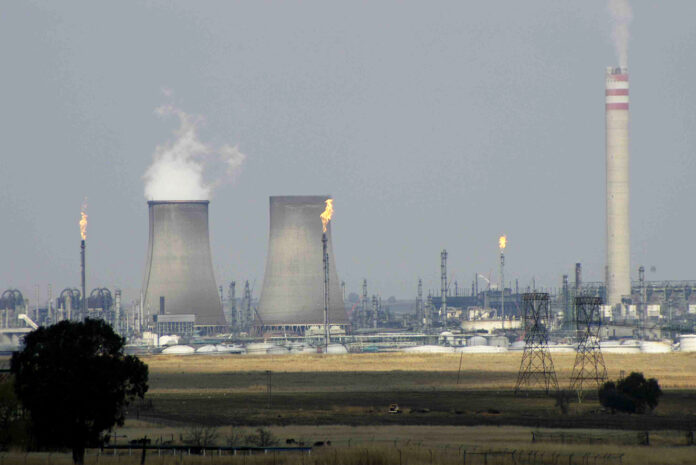
South Africa’s carbon tax is under renewed threat as government weighs whether to suspend the tax temporarily, delay the implementation of its stricter second phase, or revise its structure. This sparked warnings from academics and civil society that weakening the tax could undermine economic competitiveness, environmental protection and billions of rands in future growth.
The debate intensified after reports that electricity and energy minister Kgosientsho Ramokgopa is considering suspending the tax following pressure from fossil fuel interests. The debate comes as National Treasury prepares for the second phase of the carbon tax implementation, due for an increase this year.
Shareholder advocacy organisation, Just Share, and the University of Cape Town (UCT) argue such a move would be “short-sighted” and driven by narrow industrial interests rather than economic priorities.
The Department of Electricity and Energy has argued that any changes to carbon tax policy would aim to balance decarbonisation with economic stability, particularly in energy-intensive sectors critical to growth and employment.
At its core, the carbon tax is based on the “polluter pays” principle, which increases the cost of carbon-intensive activities to incentivise emissions reductions and shift investment toward cleaner technologies.
When it was introduced in June 2019, companies were charged R120 per tonne of carbon dioxide emissions, although tax allowances reduced effective rates for many emitters to between R6 and R48 per tonne.
Despite its relatively low effective rate, the tax generates approximately R1.5-billion annually. The government aims to recycle this tax revenue to help offset the unequal impacts of climate change.
Tracey Davies, executive director of Just Share, and Professor Harald Winkler of the University of Cape Town, argued that carbon pricing is grounded in a simple economic principle: “If polluters don’t pay for the impacts of their emissions, the rest of us will.””
Sustained lobbying by major emitters, such as Sasol and Eskom, which account for most of South Africa’s emissions, have successfully secured concessions and exemptions. In Eskom’s case, its carbon tax liability has been largely offset by existing electricity levies and renewable energy mechanisms, meaning electricity tariffs have not yet reflected the tax’s cost.
Major carbon emitters have argued that carbon tax increases could raise costs and threaten investment in energy-intensive sectors such as mining, chemicals and manufacturing, which remain central to South Africa’s economy and employment.
Meanwhile, senior climate and energy researchers at UCT, including Britta Rennkamp, Andrew Marquard, Mark New and several others, warn that failing to reduce emissions could cut gross domestic product by up to 3.6% annually compared with a lower-warming scenario. Over the next 35 years, climate-related economic damage could cost the country R259-billion without mitigation policies.
UCT also warns that South African exporters could face rising costs under international carbon pricing regimes, particularly the EU’s Carbon Border Adjustment Mechanism, which taxes imported goods based on their carbon intensity.
South Africa exported more than R200-billion worth of goods to the EU in 2024, including steel, aluminium, cement and chemicals, which all fall under the EU’s carbon border tax. Without domestic carbon tax, these exporters risk paying billions of rands in carbon tariffs to Europe instead of investing those funds into South Africa’s Just Energy Transition.
Over R220-billion in concessional climate finance, including funding under the Just Energy Transition Partnership, are contingent on the country maintaining credible emissions reduction policies. – ESG Now


