


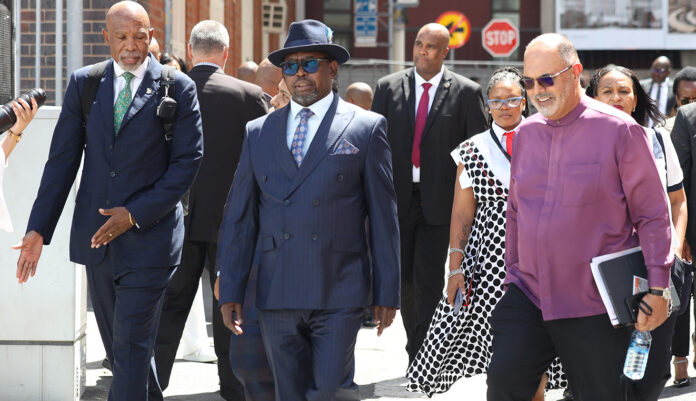
Finance Minister Enoch Godongwana has come under fire after the Medium-Term Budget Policy Statement (MTBPS) failed to spell out how government intends to unlock funding to deal a decisive blow to South Africa’s unemployment crisis and widening inequality.
Economists said that while National Treasury’s commitment to reducing debt was understandable, greater emphasis should be placed on infrastructure investment to stimulate economic growth and create jobs.
There is broad agreement that fiscal sustainability is important, although the economists are divided on whether Treasury has struck the right balance between stabilising public finances and stimulating the economy.
The criticism comes after Godongwana’s announcement that government will continue pursuing fiscal consolidation by maintaining a growing primary surplus over the medium term.
A primary surplus occurs when revenue exceeds non-interest expenditure and is used to help meet debt-servicing obligations.
The efforts come as the country’s unemployment rate rose to 33.6% in the second quarter of this year, from 32.7% in the first quarter, leaving about 8.5-million people, out of a labour force of 25.2-million, without work.
Government projects gross debt will reach R6.352-trillion this year, while debt-service costs are expected to total R441.5-billion, or roughly R1.2-billion a day. More than R1-trillion has been allocated to infrastructure over the next three years.
Economist Duma Gqubule said government’s focus on maintaining a primary surplus was coming at the expense of much-needed infrastructure investment.
He said public infrastructure spending had declined since 2009 and that had contributed to South Africa’s weak growth performance and high unemployment. Infrastructure investment had failed to keep pace with inflation and population growth, resulting in a continuous decline in real per-capita spending.
Gqubule warned that despite government’s commitment to spend more than R1-trillion on infrastructure over the next three years, real investment levels were expected to fall when adjusted for inflation and population growth.
He said sustained investment in roads, rail, energy and other public assets was essential if the economy was to lift its long-term growth rate and create jobs.
National Treasury reported that stronger-than-expected revenue collection helped the main budget primary surplus reach R80.8-billion, or 1% of GDP, exceeding the projected 0.8%.
The budget deficit also narrowed to 4.3% of GDP.
Treasury expects the primary surplus to increase from 1.7% of GDP this year to 2.9% by 2029/30, a development it views as key to stabilising public finances and reducing debt.
Dr Simphiwe Madikizela, an economist at the Unisa School of Business Leadership, said Treasury faced a difficult balancing act between reducing public debt and supporting economic growth.
Madikizela said strengthening the primary surplus was economically justifiable given the country’s high debt burden and escalating debt-service costs.
Lower borrowing requirements and reduced interest payments could eventually free up resources for essential services and development priorities. However, he cautioned that fiscal consolidation carried risks if it was achieved by cutting productive expenditure.
South Africa, he said, remained trapped in a low-growth environment that was failing to make a meaningful dent in unemployment and poverty. If government curtailed infrastructure spending or other growth-supporting expenditure to generate larger surpluses, it could further weaken economic activity and limit job creation.
Rather than abandoning fiscal consolidation, Madikizela said government should focus on improving the quality and composition of spending.
He said there was a strong case for protecting and expanding investment in electricity generation, water systems, transport networks, logistics infrastructure and municipal services.
Such investments created jobs during construction and could support small businesses, improve productivity, reduce operating costs and attract private-sector investment.
Madikizela warned that increased spending alone would not guarantee success. Infrastructure projects had to be properly planned, transparently procured and executed efficiently. Without stronger implementation capacity, larger budgets might fail to translate into improved economic outcomes.
Black Business Council deputy president Gregory Mofokeng questioned whether government’s infrastructure commitments were translating into real economic activity.
He said the construction sector continued to lose jobs despite repeated announcements of major infrastructure programmes, suggesting that many projects were either delayed or failing to move beyond the planning stage.
Mofokeng said the gap between government announcements and implementation reflected deeper problems, including budget constraints and weak execution capacity in the departments responsible for delivering infrastructure.
While government often highlighted investment commitments in budget speeches, he said, the conditions on the ground told a different story – many projects were failing to generate the expected economic benefits or employment opportunities. He said some departments tasked with infrastructure delivery lacked the capacity required to implement large-scale projects effectively.
The Institute for Economic Justice echoed the concerns, saying the MTBPS demonstrated government’s emphasis on fiscal stability, improved credit ratings and investor confidence at the expense of public services and infrastructure investment.
The organisation said rising unemployment and hunger were outcomes of a fiscal strategy that prioritised debt stabilisation above broader developmental objectives.
- Finance Minister Enoch Godongwana's Medium-Term Budget Policy Statement did not clarify how government will secure funding to reduce unemployment and inequality in South Africa.
- National Treasury aims to maintain a growing primary surplus over the medium term to stabilise public finances and reduce debt, with debt projected to reach R6.352-trillion this year.
- More than R1-trillion has been allocated to infrastructure over the next three years, but economists warn that real investment may decline when adjusted for inflation and population growth.
- Critics highlight concerns about delayed or ineffective infrastructure projects that fail to create jobs, citing weak execution capacity in government departments responsible for delivery.
- The Institute for Economic Justice and other economists argue that government prioritises fiscal stability and debt reduction over public services and infrastructure, contributing to rising unemployment and poverty.


