


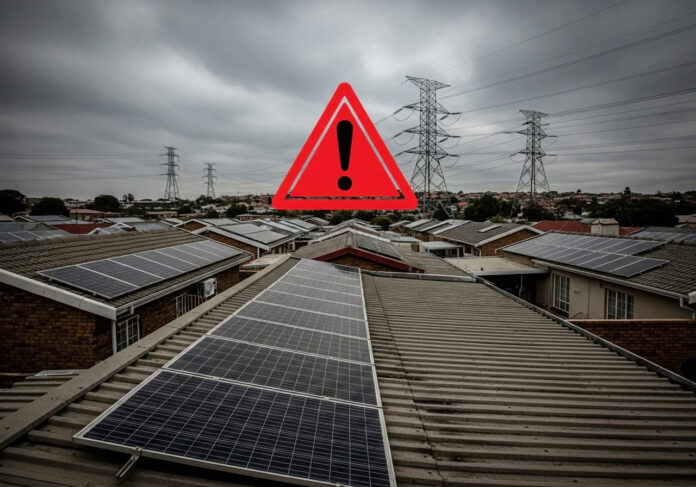
South Africa’s rooftop solar revolution has delivered one of the most meaningful interventions in the country’s energy crisis. This expansion unfolded against an unprecedented electricity crisis, with South Africa experiencing load shedding on more than 300 days in a single year, while Eskom’s energy availability factor fell below 60% between 2023-2024, accelerating the shift towards private generation
Yet, Eskom’s renewed push to force registration of household solar systems risks undermining that success. Despite incentives and regulatory concessions, the campaign is increasingly being viewed as destined to fail. Not because regulation is unnecessary, but because it is being applied in a system already strained by distrust, fragmentation and policy inconsistency.
Eskom has warned that it can now identify unregistered rooftop solar installations using satellite imagery and may act against non-compliant households. The utility insists that all grid-connected systems, even those that do not export electricity, must be registered.
Rooftop and embedded solar capacity has surged from less than 1.5 GW in 2019 to an estimated 5.5-6.2 GW today, according to the South African Photovoltaic Industry Association (Sapvia).
Most of this growth occurred after 2022, driven by record levels of load shedding.
At peak times, private rooftop systems are estimated to have removed as much as 2 000 MW from national demand, providing critical relief to Eskom’s overstretched generation fleet.
Sapvia estimates that around 30 000 rooftop systems were installed outside formal registration processes, often during periods when Eskom and municipal approval pathways were unclear, backlogged or dysfunctional. Homeowners did not ignore regulation out of defiance, but simply because of the urgency of energy security, it said.
Customers have until March 31 to regularise installations, with Eskom waiving registration-related costs of between R6 000 and R12 000 per household, including smart or bidirectional meters.
The utility has also eased technical requirements, allowing registered electricians (rather than only ECSA-certified engineers) to sign off compliance documentation.
Questions still persist over Eskom’s authority to enforce registration for behind-the-meter systems that do not export power. This has emboldened civil society groups and encouraged a “wait-and-see” approach among households, further depressing compliance.
The Just Energy Transition Investment Plan – a multi-year strategy to transition from coal-based power to cleaner, renewable energy by 2030 – depends heavily on private capital and decentralised generation. Rooftop solar has so far reduced 10 million tonnes of CO2 annually, improved system resilience and cushioned the economy against grid failure.
It’s feared that penalising early solar adopters, many of whom invested significantly, risks repelling future investors and further delaying the pace of decarbonisation.
Countries with far higher rooftop solar adoption, such as Germany and Australia, rely on simplified digital registration systems and financial incentives rather than high registration fees and punitive laws to achieve compliance.
Rooftop solar adoption has largely been driven by middle- and upper-income households able to absorb upfront costs.
Additional compliance burdens risk widening existing energy divides, while lower-income households remain exposed to rising tariffs and unreliable supply with few alternatives.


