


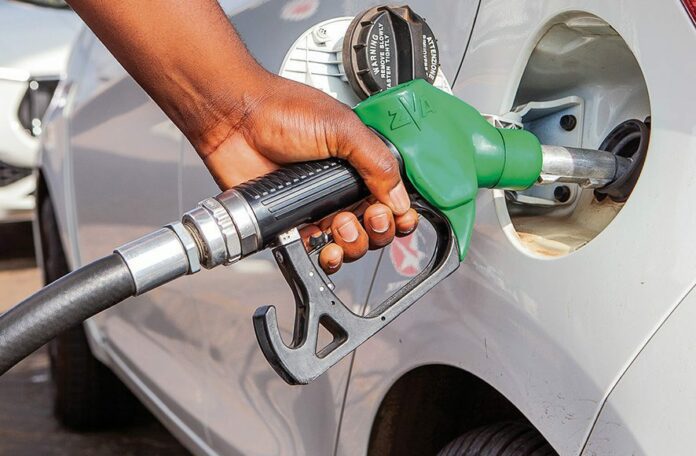
South Africans are bracing for what could be the biggest fuel price hike in the country’s history, as global oil prices surge past $100 (R1 690) a barrel amid escalating tensions in the Middle East.
Early projections from the Central Energy Fund paint a grim picture for April, with petrol and diesel increases expected to hit hard.
Forecasts suggest a jump of about R4.27 a litre for 93 unleaded, R4.74 for 95 unleaded, and a staggering R7.83 for diesel.
As the pressure mounts on already strained household budgets, industry experts say the case for electric vehicles (EVs) has never been stronger.
Electric vehicles in South Africa cost between R339 000 and R6-million.
Tristan Klement, a product specialist and technical strategist at Specno, believes the looming fuel shock could accelerate South Africa’s transition to electric mobility.
“With increases of this magnitude, the economic argument for EVs becomes obvious,” he says.
Klement recently led the development of a nationwide digital platform for an EV charging network set to roll out across hundreds of locations.
The project, he explains, highlighted just how quickly South Africa’s EV ecosystem is evolving and where it still needs to improve.
“Early systems focused on making charging possible and reliable. Now the focus must shift to making the experience effortless for everyday users.”
Dilemma of charging stations
Unlike Europe, where EV infrastructure is widespread and abundant, South Africa faces a different reality.
Charging stations are fewer, trips require more planning, and many motorists are still unfamiliar with EV usage.
“In Europe, platforms are built to filter options because there are so many chargers,” Klement explains.
“Here, it’s about accessibility and simplicity. Users need to quickly find a charger and get going without unnecessary steps.”
He adds that improving user experience is critical to driving adoption. Many current systems require multiple apps, pre-loaded wallets, or complicated payment processes, barriers that discourage potential users.
To address this, Klement and his team focused on what he calls “radical simplicity”.
“Our approach was ‘Find and Pay’. A user opens the app, sees available chargers in real time, and taps a single button to start charging,” he says.
The platform integrates seamless payment options like Apple Pay and Google Pay, eliminating the need for cards or manual top-ups.
“It’s about removing friction. If you want people to move away from petrol, the alternative must feel easier, not harder,” he adds.
The shift comes at a crucial time for the continent. Africa’s EV charging market, valued at just over $31-million in 2022, is expected to grow rapidly to more than $256-million by 2030.
Cost savings for motorists
For local motorists, the financial benefits are already tangible. Estimates suggest that city drivers could save about R14 000 annually by switching to an electric vehicle.
Beyond cost savings, the long-term vision ties into South Africa’s renewable energy ambitions.
With independent power producers investing heavily in solar and wind, particularly in the Northern Cape, experts say EV networks could soon be powered by cleaner, locally generated energy.
This would reduce the country’s dependence on volatile global oil markets within the next five years.
However, Klement warns that technology design will play a decisive role in this transition.
“Across industries, we’re seeing more features being added, but not always better user experiences,” he says. “The real opportunity is to simplify how these systems work for ordinary people.”
He stresses that simplicity should not be mistaken for a lack of innovation.
“Simplicity is the result of deeply understanding the problem and doing the hard work behind the scenes so the user doesn’t have to.”


