
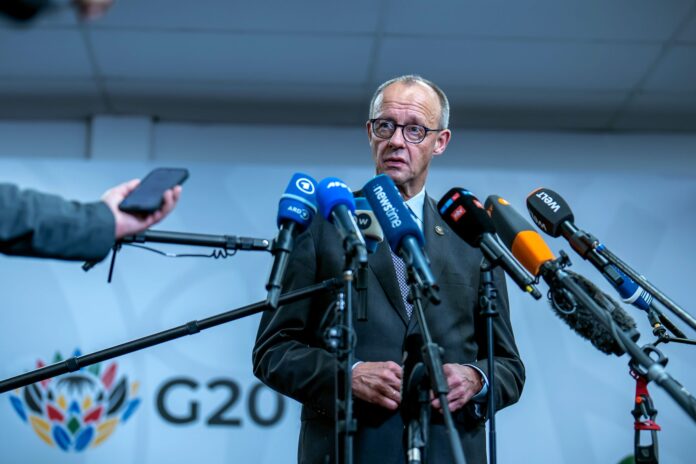
When Germany’s new chancellor, Friedrich Merz, publicly acknowledged that the country’s nuclear phase-out was a “strategic mistake”, it marked more than a domestic policy reckoning.
It reopened a question that many climate plans, especially in developing economies, have quietly taken off the table. What role, if any, should nuclear energy play in a credible, just transition?
Germany shut down its last nuclear reactors in April 2023, eliminating a source that once supplied roughly 25% to 30% of its electricity. The decision was framed as a moral and environmental victory.
Yet in the years that followed, electricity prices surged, coal generation rebounded, and gas imports, at times accounting for more than 20% of power generation, became a strategic vulnerability.
Merz’s admission reflects a growing consensus that removing firm, low-carbon power made decarbonisation harder, costlier, and more fragile.
Contrary to a persistent belief, the Paris Agreement does not prohibit or discourage nuclear power. It is explicitly technology-neutral, focusing on emissions outcomes rather than prescribing energy sources.
The Intergovernmental Panel on Climate Change consistently classifies nuclear as a low-carbon technology, with lifecycle emissions comparable to wind and lower than solar PV.
Countries such as France, the United Kingdom, China, South Korea, and the United Arab Emirates all count nuclear power within Paris-aligned decarbonisation pathways.
Where nuclear is absent from national plans, it is typically due to domestic policy choices, not international climate constraints.
Climate commissions and just transition frameworks often deprioritise nuclear for reasons that have little to do with emissions.
Nuclear projects are capital-intensive, with upfront costs that can exceed $6,000 per kilowatt, long construction timelines of 10–15 years, and complex regulatory requirements, according to the International Atomic Energy Agency.
Africa’s energy reality differs from Europe’s
By contrast, utility-scale solar and wind can be deployed in 18–36 months at a lower upfront cost, financed gradually, and scaled incrementally.
This planning bias toward other forms of energy is reinforced by climate finance flows.
Bloomberg NEF reported that global investment in the energy transition topped almost $2-trillion in 2024, led overwhelmingly by renewables, grids, and storage, while emerging technologies like nuclear, hydrogen, and carbon capture collectively accounted for a much smaller share (about $155-billion compared to $1.93-trillion in established renewables, grids, EVs, etc.).
Africa’s energy reality differs sharply from Europe’s, with more than 600-million people still lacking access to electricity, according to the World Bank.
In this context, nuclear can form part of a just transition and the energy mix, but not necessarily the backbone.
Large nuclear plants do little to address energy poverty, create fewer jobs per dollar invested than renewables, and risk crowding out faster solutions.
For many African countries, solar, wind, storage, and grid expansion remain the most effective tools for near-term access and affordability. Yet excluding nuclear entirely is also a mistake.
Africa’s only nuclear plant
South Africa already operates Africa’s only nuclear plant, Koeberg, which supplies around 5 percent of national electricity and avoids an estimated 4-5-million tonnes of CO₂ annually.
Extending Koeberg’s operating life to 2044 is widely seen as one of the lowest-cost decarbonisation options available.
Looking further ahead, small modular reactors could support industrial hubs, mining regions, or green hydrogen production if governance and financing frameworks improve.
For other African economies, nuclear may eventually make sense in select cases such as Egypt, which is building the 4.8GW El Dabaa plant to underpin industrialisation alongside renewables.
Germany’s reversal does not mean Africa should “double down” on nuclear. It means nuclear should not be ruled out by ideology or assumption. Energy transitions are system challenges, not technology contests.
Removing firm, low-carbon power from the option set increases reliance on fossil backup, raises system costs, and weakens energy security.