
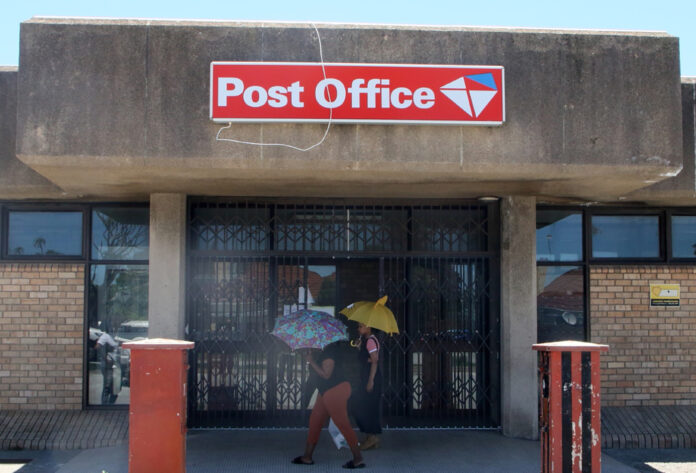
The government has given reassurances that any liquidation of the South African Post Office will not affect over 3-million social grant beneficiaries who receive their grant payments via Postbank.
Business rescue practitioners (BRPs) of the Post Office have threatened to apply for liquidation of the state-owned company due to lack of adequate funding from the department of communications and digital technologies to manage the day-to-day operations.
In a letter addressed to Communications and Digital Technologies Minister Solly Malatsi and his deputy Mondli Gungubele, dated March 13, lawyers representing the business rescue practitioners warned that the business rescue process could only continue if the post office remained in a commercially solvent position and was adequately funded by the government.
They gave Malatsi and Gungubele until 5pm on February 27 to respond, failing which they would go the liquidation route. They warned that liquidation would have an adverse impact on Postbank’s infrastructure and place in danger grant payments to millions of recipients.
However, the BRPs’ claims were on Friday shot down by Malatsi’s department, which said the communication “may create unnecessary uncertainty for customers, particularly those who rely on Postbank services”.
In the letter, the BRPs’ lawyers further caution that Postbank, which was this week registered as a licensed financial services provider, would be affected as the state bank relies on the post office’s infrastructure to run its operations. They cited the enterprise resource planning (ERP) system, which integrates business processes such as human resources, finance and supply chain, among other things.
“Any disruption of Sapo’s ERP system would also impede Postbank, which utilises Sapo’s ERP system. Postbank must be in readiness for a transition into an independent ERP system. Furthermore, Sapo processes Postbank’s payroll, which will further come to an end,” wrote the lawfirm’s Haroon Y Laher.
“In addition, Sapo currently holds an FSP licence, which enables the facilitation of certain financial transactions, including services connected to Postbank operations conducted through Post Office branches. Upon liquidation, that licence could be revoked. This may have serious consequences for members of the public who rely on those facilities and may create the potential for public dissatisfaction or unrest if not carefully managed.
“It may be important to indicate that Sapo disburses approximately R78-million per month on behalf of Postbank to beneficiaries nationwide.
“If Sapo is unable to accept cash from Postbank, these beneficiaries will not receive their entitled payments. Additionally, Sapo receives approximately R18-million in deposits on behalf of Postbank at any given time, and this service would also have to be discontinued. Postbank further relies on Sapo’s FSP licence and switching services, which, if suspended or withdrawn, would severely curtail Postbank’s operations,” said Laher.
Responding to the BRPs, communications and digital technologies department spokesperson Tlangelani Manganyi said the department was working with all the stakeholders to avoid liquidation.
Manganyi stated that Postbank and Sapo have been legally separated since 2019, and since then the two entities operate separately, with each company having its own balance sheet, board and management.
She said the state-owned bank was currently executing a five-year, three-phased turnaround strategy aimed at “transforming the institution into a fully-fledged commercial bank that delivers on its mandate of advancing financial inclusion, particularly for customers who rely on government services”.
Manganyi said Postbank has historically operated within the regulatory framework applicable to its mandate as a state-owned banking institution, primarily providing deposit-taking and transactional banking services.
“These activities, in terms of the applicable regulations in this instance, did not require an FSP licence, as the (licence) relates specifically to the provision of financial advice and intermediary services under the Financial Advisory and Intermediary Services Act, 2002. The recent approval of Postbank’s FSP licence, therefore represents an enhancement of its regulatory capability, enabling it to formally provide regulated advice and intermediary services in relation to certain financial products under the oversight of the Financial Sector Conduct Authority.
She assured grant recipients and other Postbank customers that their money is safe.
“Furthermore, for all Sassa grant recipients paid through Postbank, cash withdrawals through our retail partners guarantee 100% of their grant value. Beneficiaries do not pay a fee when withdrawing their funds.”
Communications and digital technologies portfolio committee chairperson Khusela Diko said Postbank has been actively implementing a Sapo de-risking programme for over two years in anticipation of potential risks associated with reliance on its infrastructure.
A Sapo rescue plan was approved by creditors in December 2023, premised on a commitment from the government, stated in court by then-communications minister Mondli Gungubele, that it would provide R3.8-billion to fund the turnaround. This was on top of R2.4-billion allocated for retrenchments and stabilisation. However, nearly three years later, the promised R3.8-billion has never been paid.
Visit SW YouTube Channel for our video content


