
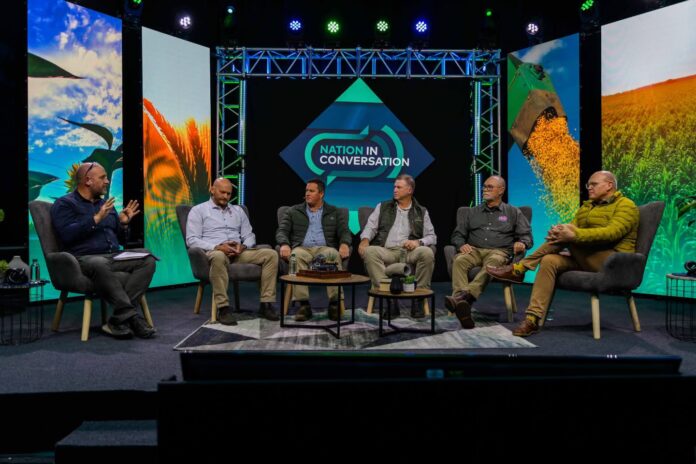
Minister of Agriculture John Steenhuisen and South Africa’s leading agricultural banks gathered at NAMPO Park in Bothaville on Wednesday as concerns mounted over the growing financial pressure facing the country’s grain producers.
The high-level engagement, led by Grain SA and chaired by its chairperson Richard Krige, formed part of ongoing discussions at the 2026 edition of the NAMPO Harvest Day – the largest agricultural exhibition in the Southern Hemisphere.
Mobility remains deeply intertwined with South Africa’s agricultural economy, with the sector heavily dependent on bakkies, trucks, tractors and specialised machinery to sustain food production and logistics across the country. Some automotive brands have maintained a strong presence at NAMPO 2026 with more expected to exhibit in 2027.
Concern over rising costs
Discussions between Grain SA, government and financial institutions focused on the widening gap between production costs and producer profitability, amid rising fertiliser, fuel and financing costs.
According to Grain SA, fertiliser and fuel now account for nearly 45% of production costs on many grain farming operations, with fertiliser prices in some instances having surged by as much as 80%.
“Producer profitability remains under severe pressure,” said Krige. “Input costs, financing costs and logistics pressures continue to squeeze margins at a time when grain prices remain under pressure.”
Representatives from Absa Group, FirstRand, Nedbank Group, Standard Bank Group and Land Bank attended the engagement, alongside the African Farmers’ Association of South Africa (AFASA).
One of the major concerns raised was the impact of the D11 directive and how debt restructuring requirements are placing additional pressure on farmers already operating in a low-margin environment.
Need for practical financing models
The parties agreed to continue discussions with National Treasury on developing more practical financing models that better recognise the cyclical and seasonal realities of farming.
Steenhuisen described agriculture as one of South Africa’s “most bankable opportunities” and reiterated government’s commitment to expanding international market access for local agricultural products.
“There is growing international demand for our agricultural products, and we are working very hard as a department to open up those markets,” Steenhuisen said.
Grain SA also used the platform to advocate for improved rail and port efficiencies, stronger export competitiveness and the removal of phytosanitary barriers limiting access to global markets.
‘Grain on legs’ strategy
A major talking point was Grain SA’s “grain on legs” strategy – a plan aimed at growing local livestock, feed and protein industries to convert grain into higher-value products before export.
The organisation further highlighted biofuels as a potential long-term growth avenue capable of creating additional demand for locally produced grain while supporting industrial development and energy diversification.
Krige said stronger collaboration between agriculture, financial institutions and government would be essential in securing the long-term sustainability and competitiveness of South Africa’s grain sector.
- South African agriculture faces rising financial pressures due to increased costs of fertiliser, fuel, and financing, with fertiliser prices rising up to 80%, significantly impacting grain producers’ profitability.
- A high-level meeting at NAMPO Harvest Day 2026 included government, Grain SA, agricultural banks, and AFASA to address these challenges, focusing on the impact of debt restructuring and cost pressures.
- Participants agreed to work with National Treasury on more practical, seasonally-aware financing models to support farmers operating within tight profit margins.
- The government emphasized expanding international market access for South African agricultural products and improving infrastructure like rail and port efficiencies to boost exports.
- Grain SA promoted its “grain on legs” strategy to develop livestock and protein industries, and biofuels as growth areas, aiming to add value locally and enhance sector sustainability through collaboration with banks and government.
Minister of Agriculture John Steenhuisen and
Mobility remains deeply intertwined with
Discussions between Grain SA, government and financial institutions focused on the widening gap between production costs and producer profitability, amid rising fertiliser, fuel and financing costs.
“Producer profitability remains under severe pressure,” said Krige. “Input costs, financing costs and logistics pressures continue to squeeze margins at a time when grain prices remain under pressure.”
Representatives from Absa Group, FirstRand,
One of the major concerns raised was the impact of the D11 directive and how debt restructuring requirements are placing additional pressure on farmers already operating in a low-margin environment.
Steenhuisen described agriculture as one of
“
Grain SA also used the platform to advocate for improved rail and port efficiencies, stronger export competitiveness and the removal of phytosanitary barriers limiting access to global markets.
A major talking point was Grain SA’s “grain on legs” strategy – a plan aimed at growing local livestock, feed and protein industries to convert grain into higher-value products before export.
Krige said stronger collaboration between agriculture, financial institutions and government would be essential in securing the long-term sustainability and competitiveness of