


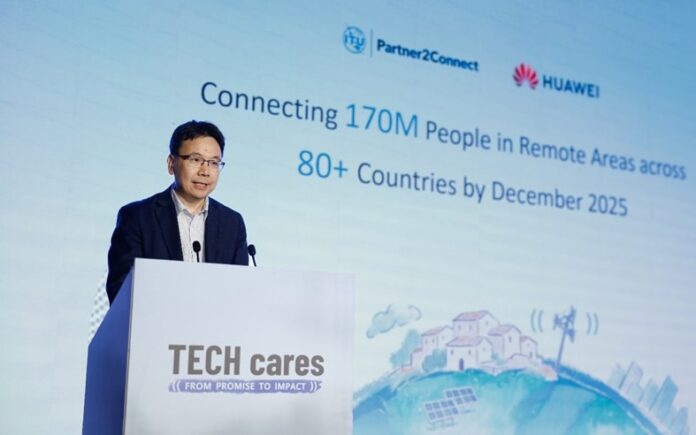
Chinese technology giant Huawei has exceeded its global digital inclusion pledge by connecting 170-million people in remote communities in over 80 countries. This is 50-million more than it originally committed to under the International Telecommunication Union (ITU) Partner2Connect Digital Coalition.
CEO of Huawei ICT Business Group, Yang Chaobin, announced the milestone in Barcelona, Spain, during the company’s TECH Cares Forum.
In 2022 Huawei pledged to connect 120 million people in underserved areas by 2025.
Concern over global digital divide
The achievement comes when the global digital divide remains a pressing concern, particularly in developing regions such as Africa, where millions still lack reliable internet access.
Yang said high-speed digital networks and computing capacity are critical foundations for inclusive participation in the fast-growing artificial intelligence (AI) era.
“Despite rapid AI advancement, the digital divide risks widening further. Connectivity is essential for access to healthcare, education and financial services,” he said.
Need for innovation, sustained investment and strong partnerships
The ITU welcomed the progress. Cosmas Zavazava, Director of the ITU Telecommunication Development Bureau, commended Huawei’s contribution to expanding rural connectivity, stressing that meaningful access requires innovation, sustained investment and strong partnerships.
For Africa, connectivity is increasingly seen as core economic infrastructure. MTN Group Sustainability Executive Marina Madale said expanding rural coverage and improving device affordability are key to unlocking growth on the continent.
“Connectivity is not a privilege – it is foundational infrastructure for Africa’s growth,” she said.
Focus on infrastructure and skills development
Huawei has focused on both infrastructure and skills development. Through its Skills on Wheels initiative, launched in 2019, the company has delivered mobile digital training to more than 130,000 people in 21 countries, targeting youth, women, older people, and underserved communities.
In terms of infrastructure, Huawei’s Rural Series solutions aim to lower the cost of deploying networks to sparsely populated regions. Its RuralCow solution, launched in November 2025 with support from MTN Nigeria, extends mobile coverage to villages of about 1,500 residents.
Industry stakeholders at the forum agreed that bridging the digital divide in the AI era will require joint efforts from governments, telecom operators and the private sector.
And as digital transformation accelerates globally, the focus now shifts from simply connecting communities to ensuring they have the skills and tools to participate meaningfully in the digital economy, particularly across Africa.


