


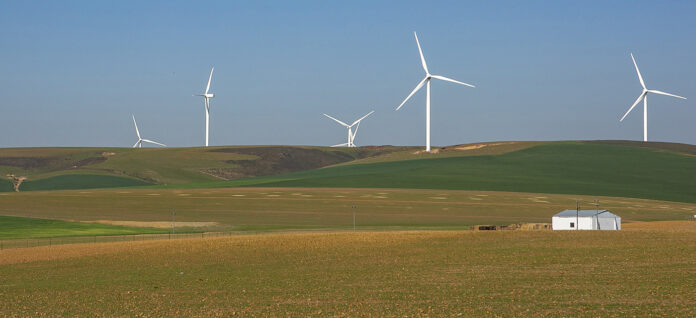
A R3.4-billion private wind farm built to supply clean electricity to mining giant Sibanye-Stillwater has fallen into financial distress after the mining company rejected a force majeure claim tied to construction delays.
The 108 MW Witberg Wind Farm, located near Touws River in the Western Cape, was expected to begin commercial operations in November 2025 under a 15-year power purchase agreement (PPA) to supply 103 MW of electricity directly to Sibanye-Stillwater’s mining operations.
The Witberg project reached financial close in December 2023. It is financed by Rand Merchant Bank and the Development Bank of Southern Africa (DBSA). But delays have prevented the project from generating revenue, triggering mounting financial pressure on the developer, Red Rocket.
IPP declared force majeure
The independent power producer (IPP) declared force majeure. It argued that circumstances beyond its control had delayed construction. Force majeure is a legal clause in a contract that protects a party from liability when extraordinary events beyond their control prevent them from fulfilling their obligations. In energy projects, a force majeure claim allows a developer to avoid penalties or delays if such external factors prevent construction or electricity delivery on time.
However, Sibanye-Stillwater formally rejected the claim earlier this month. This removed a key legal protection that could have shielded Red Rocket from contractual penalties and financial losses.
Without revenue from electricity sales, the project is now under severe financial strain. Red Rocket has reportedly sought emergency financial support from shareholders. This while lenders increase pressure amid rising debt obligations.
Miner ahead of energy cost-saving
Sibanye-Stillwater has already reported energy cost savings of R93.2-million and avoided more than 316,000 tonnes of carbon dioxide emissions through its renewable energy projects. Its broader renewable portfolio, expected to reach 765 MW, could deliver annual cost savings exceeding R1-billion from 2028.
Renewable energy offers mining companies protection against Eskom’s escalating tariffs, which have surged by 134% over the past decade. They rose from R1.08 per kWh in 2016 to R2.53 per kWh in 2025. But the Witberg dispute underscores the financial complexity behind these private energy deals.
The Witberg project’s financial model depends heavily on predictable cash flow from its 15-year power purchase agreement, which provides predictable revenue streams that allow Red Rocket to repay loans and generate returns.
But with construction delays preventing electricity generation, the project currently has no operating income. While debt servicing obligations continue. Industry sources indicate Red Rocket has approached shareholders for emergency financial support. It did so highlighting the severity of its liquidity pressure.
Red Rocket is one of South Africa’s largest independent renewable energy producers. It has more than 5.3 GW of wind, solar, and hydro projects in operation, under construction, or awarded preferred bidder status across Africa. It also has a massive development pipeline of 2.8 GW of wind and 1.5 GW of solar projects.
Agreements vulnerable during construction
The Witberg case illustrates that while long-term power purchase agreements provide financial stability once operational, projects remain highly vulnerable during construction. Thus transferring significant financial and operational risk to private developers and investors.
Despite the financial strain, the project is not necessarily at risk of cancellation. Possible outcomes include shareholder capital injections, debt restructuring with lenders, or revised project timelines.


