


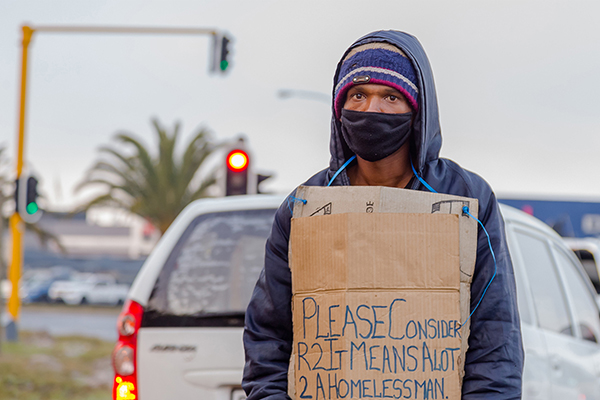
South Africa’s eight billionaires, all of them men, have a combined fortune of R730-billion, while more than 23-million people live below the national poverty line, a new Oxfam South Africa report has found.
The report, Hoarded Wealth, Dignity Denied, describes a country where the gap between the haves and the have-nots has grown wider over three decades of democracy, not narrower.
According to Oxfam, the country’s richest billionaire alone owns more than twice the combined wealth of the poorest 70% of the population. On average, someone in the bottom 90% would need 345 years to build the wealth held by the typical person in the richest 1%.
The fortunes are growing fast. Last year the country’s then-seven billionaires added the equivalent of R382m to their wealth every day. Their combined real wealth has grown by 130% since 2020.
In 1994 the richest 1% held just under half of the national wealth. By 2024 that share had climbed to 54.9%. Over the same period, the bottom half of the population slid deeper into the red. Their debts now outweigh everything they own.
Since 2019 the richest 1% have captured 56% of all new wealth created in the country. The bottom 90% got just 14%.
The divide remains starkly racial. Black households own, on average, just 5% of the wealth of white households. Black South Africans make up 82% of the population but 93.6% of those live below the poverty line.
Almost two-thirds of households are food insecure.
Official unemployment has climbed from 25% in 2015 to 33.6% in the second quarter of this year, against a G20 average of about 6%.
The report notes that one of the country’s highest-paid CEOs earns in less than four hours what a domestic worker on the minimum wage earns in a whole year.
Even the wealthy are uneasy. A 2025 survey of South African dollar millionaires found that 65% believe extreme wealth threatens democracy and 64% support higher taxes on the very rich. Oxfam says a moderate net wealth tax alone could raise an extra $9.15bn (roughly R150bn) a year. It wants government to introduce a wealth tax, raise taxes on dividends and close tax breaks that mostly benefit high earners.
Among its five key demands is a National Inequality Reduction Plan with time-bound targets to cut the income Gini coefficient to 0.3. By most estimates, South Africa’s Gini is the highest in the world.
The plan also calls for a universal basic income, more investment in health, education and care work and putting women at the centre of economic policy.
The report is critical of the grant system. The Social Relief of Distress grant reaches only about 8.5-million people and is worth less than half the food poverty line.
Oxfam insists inequality is not inevitable. It is, the report argues, “the result of policy choices” and it can be reversed with political will.
- South Africa's eight male billionaires have a combined wealth of R730-billion, while over 23 million people live below the poverty line.
- The richest billionaire owns more than twice the combined wealth of the poorest 70% of the population, and the richest 1% hold 54.9% of the national wealth as of 2024.
- Black households own just 5% of the wealth of white households, making up 82% of the population but 93.6% of those living in poverty.
- Since 2019, the richest 1% have captured 56% of all new wealth created, while the bottom 90% received only 14%, and unemployment rose to 33.6% in mid-2024.
- Oxfam recommends a moderate net wealth tax to raise R150bn annually, a National Inequality Reduction Plan, a universal basic income, and more investment in social services to address inequality.



It was the job of The Government to bring people out of poverty, not the 8 billionaires. Can the gvt raise money elsewhere? Yes, it should. Unfortunately, the money will be squandered somewhere buy the politicians. There’s no guarantee that after taxing the rich, the money will reach the intended beneficiaries.
It is paradoxical considering we are living in a capitalized economy. Citizens are made to believe that their efforts are rewarded based on hard work, creativity and loyalty, when the opposite is true. Greed, monopolizing wealth generation and outright criminal methods to achieve goals are the standard. When socialism is mentioned as the cure, it is rather demonized by the gluttons of industries. Go figure.
There is a lack of infrastructure education sanitation safety in the marginalised communities people are eating out of dustbins children are running around without supervision because the parents are working
The drug problem is huge.
The policing is poor and crime is rapidly increasing .
Daily gang violence with children often caught in the crossfire.
The government is funding ridiculous projects to safeguard the tourist fom.seeing the rot ..yet the taxpayers money is either stolen or mismanaged. ..
Even the president is out of touch with the needs of the people.
He too has become richer.
…a couch 🛋 nevertheless no access