


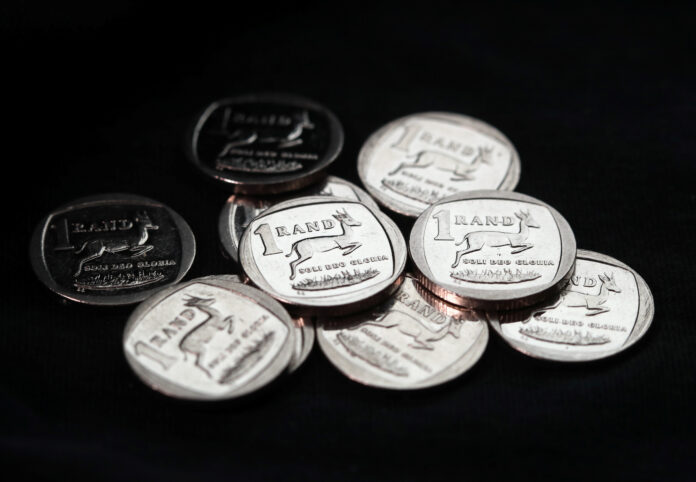
South Africa’s rand and government bonds started the week on the back foot ahead of the release of domestic inflation data, as reports that the Strait of Hormuz had again been closed sent oil prices higher and weighed on appetite for risk assets.
• At 08:39 am, the rand traded at R16.40 against the dollar, 0.6% weaker than its previous close.
• Oil prices jumped more than 5% on Monday, on fears that the ceasefire between the United States and Iran could collapse after the U.S. seized an Iranian cargo ship, while traffic through the Strait of Hormuz stayed largely halted.
• Statistics South Africa will release March inflation data on Wednesday, with analysts polled by Reuters expecting it to inch up to 3.1% year-on-year from 3.0% in February.
• As a net fuel importer, South Africa is heavily exposed to the spike in global energy prices.
• Its currency has been at the mercy of global market sentiment since the US and Israel started the war at the end of February and Iran retaliated.
• The South African Reserve Bank will publish a Monetary Policy Review document on Tuesday, which could shed light on its rate-setting trajectory this year.
• South Africa’s benchmark 2035 government bond was flat in early deals, with the yield at 8.195%.
Oil prices skyrocket as ceasefire could collapse
Meanwhile, oil prices jumped more than 5% on Monday on fears that the ceasefire between the United States and Iran could collapse after the US seized an Iranian cargo ship, while traffic through the Strait of Hormuz stayed largely halted.
Brent crude futures advanced $4.81, or 5.32%, to $95.19 (R1 554) a barrel and US West Texas Intermediate was at $88.81 a barrel, up $4.96, or 5.92%.
Both contracts tumbled by 9% on Friday, their largest daily declines since April 18, after Iran said passage for all commercial vessels through the Strait of Hormuz was open for the remaining ceasefire period and U.S. President Donald Trump said Iran has agreed to never close the strait again.
“Within 24 hours of Friday’s ‘completely open’ announcement, there were already tankers that were fired upon by the Islamic Revolutionary Guard Corps (IRGC), leading to more fears from the shippers on attempting to leave,” said June Goh, a senior oil market analyst at Sparta Commodities.
“Market fundamentals are getting worse, as 10-11 million barrels per day of crude oil remains shut in,” Goh said, referring to losses in oil production.
Capturing Iranian cargo ship
The United States said on Sunday that it had seized an Iranian cargo ship that tried to run its blockade while Iran said it would retaliate amid growing worries of a resumption of hostilities.
Tehran also said it would not participate in a second round of negotiations that the U.S. had hoped to kick off before its two-week ceasefire with Iran expires this week.
The United States has maintained a blockade of Iranian ports, while Iran has lifted and then re-imposed its own blockade of the Strait, which handled roughly one-fifth of the world’s oil supply before the war began almost two months ago.
“Oil markets continue to gyrate in response to oscillating social media posts by the US and Iran, rather than the realities on the ground which remain challenging for oil flows to resume in a rapid fashion,” Saul Kavonic, MST Marquee’s head of research, said.
“The announcement of the Strait opening proved premature,” Kavonic said.
“Ship owners will be twice shy about heading towards the Strait again without receiving much more confidence that any announced passage is real.”
More than 20 ships passed the strait on Saturday carrying oil, liquefied petroleum gas, metals and fertilizers, Kpler data showed, the highest number of vessels crossing the waterway since March 1.
- South Africa's rand weakened by 0.6% to R16.40 against the dollar due to rising oil prices and risk aversion ahead of domestic inflation data release.
- Oil prices surged over 5% amid fears of a ceasefire collapse between the US and Iran after the US seized an Iranian cargo ship and Strait of Hormuz traffic remained mostly halted.
- Analysts expect South Africa’s March inflation to rise slightly to 3.1% year-on-year, with inflation data due Wednesday.
- South Africa, as a net fuel importer, faces economic pressure from higher global energy prices, compounded by ongoing regional conflicts affecting its currency and bonds.
- The South African Reserve Bank will publish a Monetary Policy Review on Tuesday, potentially indicating future interest rate directions amid market uncertainty.


