


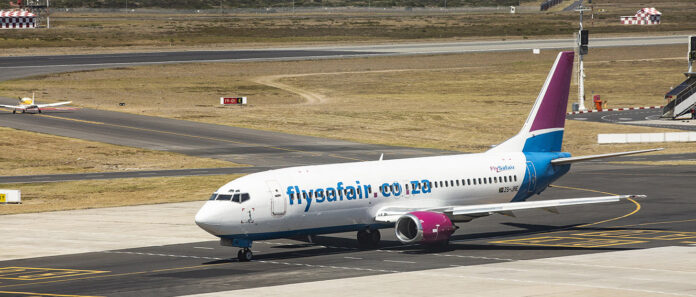
Aviation expert Guy Leitch has warned that any harsh ruling by the National Consumer Tribunal against local carrier FlySafair for overselling tickets and overbooking passengers, could reshape both pricing and investment dynamics in the airline industry.
The National Consumer Commission (NCC) referred the matter to the tribunal after finding that FlySafair had contravened parts of the Consumer Protection Act in its booking practices. The commission is seeking a fine equivalent to 10% of turnover as a penalty should the tribunal rule against the airline.
Hardin Ratshisusu, NCC acting commissioner, said the investigations ran between November 2024 and January 2025 and found that the overbooking system was “systematically implemented by FlySafair” and that at least 5 000 people were overbooked during the period, attracting large revenue for the airline.
Leitch expressed concern that the matter has been escalated to the tribunal despite it being what he called “standard procedure” in the airline industry, and recognised in section 47 of the Consumer Protection Act and by the Consumer Goods and Services Ombud.
According to the ombud, overselling or overbooking is a deliberate strategy based on the idea that not everyone will always pitch for their flight. It is then considered a method to ensure that all available capacity is used and to maximise profit.
The ombud further acknowledges that if most customers do show up, some may be left without what they had paid for.
Leitch, however, warned that the potential consequence of an adverse ruling could extend beyond a single airline, saying it would knock investor confidence.
He highlighted the FlySafair recent sale of a 25% stake to Qatar Airways as evidence of renewed international interest in the local airline industry.
It would also impact airline economics and ticket pricing as overbooking allows carriers to compensate for the reality that not all passengers who buy tickets actually board flights. “Secondly, the thing is, an airline will seldom ever be able to pull an aircraft by selling every seat simply because people don’t pitch, can’t make the flights, get late for them… and that would mean less revenue per flight, and that would make seats more expensive.”
Responding to the NCC finding, FlySafair said overbooking was allowed and that it was recognised by both the Consumer Protection Act and the ombud.
“FlySafair believes that it operates one of the more conservative overbooking policies in the market, with overbooking levels maintained below historical no-show rates. During the period under review, more than 99.98% of FlySafair customers travelled successfully as booked. While approximately 5 000 customers were on overbooked flights during the period assessed, the vast majority travelled exactly as booked, because the anticipated no-shows materialised as expected.”
The passengers that could not board due to the issue were, according to the airline, cushioned with accommodation, refunds or other forms of compensation.
Katherine Whelan, Airlink chief commercial officer, explained that since the establishment of the airline, they instead manage the risk through their no-show policy, which directs that a passenger who missed their flight without alerting the airline beforehand forfeits their ticket entirely.
“Airlink’s route network of 47 destinations across 15 countries, demands a diverse fleet of aircraft that are smaller and have fewer seats than the planes that have typically been operated by the carriers that focus heavily on serving the main domestic trunk routes.
“Airlink has always found that a strict no-show policy is a more effective risk management instrument than overbooking and potentially disappointing some customers.”
Cilliers Jordaan, chief commercial officer at LIFT, also confirmed that their airline does not practice overbooking but has a flexible booking system.
This means passengers can change their flights without any penalty until at least 24-hours before flight departure but there would be a difference in fare.
“Should a traveller miss their flight, it is unfortunately considered a ‘no-show’ and the ticket will be forfeited,” Jordaan said.
- The National Consumer Commission (NCC) accused FlySafair of systematically overbooking flights, impacting at least 5,000 passengers, and referred the case to the National Consumer Tribunal seeking a fine of 10% of turnover.
- Aviation expert Guy Leitch warned that a harsh tribunal ruling could harm investor confidence, impact airline economics, and lead to higher ticket prices as overbooking compensates for passenger no-shows.
- FlySafair defended its overbooking policy as conservative, compliant with the Consumer Protection Act, and compensated passengers affected by overbooking with accommodation, refunds, or alternatives.
- Competitors like Airlink and LIFT avoid overbooking, instead using strict no-show policies or flexible booking systems as alternative risk management strategies to minimize customer disappointment.
- The case highlights tensions between regulatory enforcement and standard airline industry practices, with potential implications for pricing models, investment, and passenger experience in South Africa's aviation sector.


