


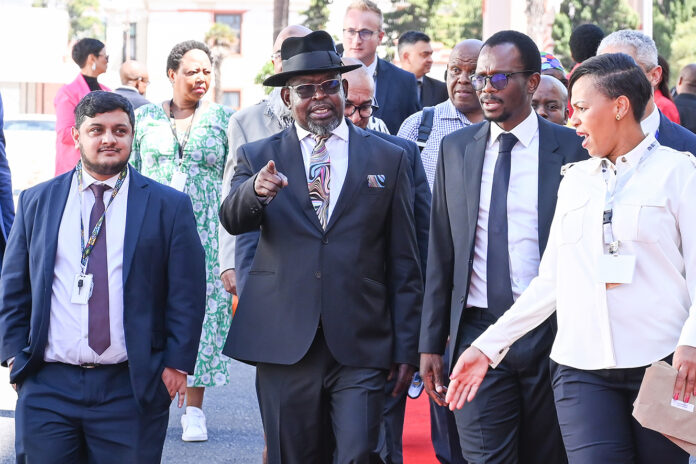
The government’s R6-trillion debt and the amount of funds National Treasury allocates to infrastructure projects will come under scrutiny when finance minister Enoch Godongwana delivers the 2026 Budget Speech on Wednesday.
Economists who spoke to Sunday World on Friday believe that the government needs to find a way of reprioritising spending to stimulate economic growth by aggressively pumping more funds towards infrastructure projects that would result in
job creation.
Godongwana last year announced a R1-trillion infrastructure budget over the medium term.
The government’s debt-service costs currently amount to R426.3-billion, the single largest government expenditure item, per annum.
This means the government spends about R1.7-billion a day towards servicing debt.
Economist Duma Gqubule said the high debt service costs and low infrastructure expenditure would continue to serve as an economic growth hurdle should government not change its expenditure patterns.
He brought President Cyril Ramaphosa into the picture after he recently boasted about the economy turning the corner.
Gqubule believes there was no evidence to back the head of state’s assertion.
This is due to the Treasury and the Reserve Bank forecasting GDP growth for this year at 1.5% and 1.4%, respectively.
“There is a relationship between GDP growth and jobs. With 1.5% GDP growth, we are not going to create enough jobs for the people who need them.”
Ramaphosa in his recent State of the Nation Address, also bragged of the R1-trillion infrastructure budget.
Gqubule said R1-trillion was too little to stimulate economic growth, adding that Godongwana needed to raise the stakes to R2.4-trillion to create jobs.
He pointed out the budgeted R1-trillion was less than half of the 10% National Development Plan target.
“Government should be spending 10% of the GDP on infrastructure, and the shortfall is about R1.4-trillion. This will contribute towards stimulating the economy, which needs a stimulus because we have grown by 1.1% (on average per annum) for the past 17 years.”
Another economist, Mandla Maleka, concurred with Gqubule, adding that the government profoundly lacked clarity on the tools needed to be deployed or employed to achieve desired GDP growth.
“For a country that has accepted an unemployment rate at over 31% as a new normal, we lack a strategy to create real sustainable jobs and move the majority out poverty…”
“There is R320-billion in a year dedicated to social protection (grants and pensions).
“We have over 21-million people dependent on government. Why don’t we use the R426-billion to create jobs and release [social grant recipients] from government dependency?”
Maleka suggested that potential high-growth areas would be water and electricity reticulation projects.
“South Africa has no problem with dams, in fact our dams are 100% full. We have problems with piping and delivering to the door of the end user (consumer).
“It is the same with the electricity; we have a problem of delivering the electricity to the consumer.
“We don’t have a problem with the overhead infrastructure,” he said, emphasising that’s where the infrastructure budget should focus.
- The government’s R6-trillion debt and the amount of funds National Treasury allocates to infrastructure projects will come under scrutiny when finance minister Enoch Godongwana delivers the 2026 Budget Speech on Wednesday.
- Economists who spoke to Sunday World on Friday believe that the government needs to find a way of reprioritising spending to stimulate economic growth by aggressively pumping more funds towards infrastructure projects that would result in job creation.
- Godongwana last year announced a R1-trillion infrastructure budget over the medium term.
- The government’s debt-service costs currently amount to R426.3-billion, the single largest government expenditure item, per annum.
- This means the government spends about R1.7-billion a day towards servicing debt.


