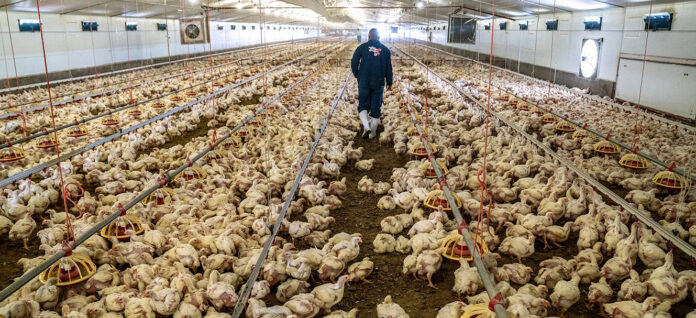
South Africa’s poultry industry is the second most cost-effective producer in the world, only trailing behind Brazil and outperforming the traditional heavyweights, USA and European markets.
The country recorded the lowest feed conversion ratio among competitor markets. This means local producers require less feed to produce a kilogram of chicken than their global competitors.
The poultry industry sits at the heart of South Africa’s agricultural economy.
Chicken is the country’s most commonly eaten meat and remains the cheapest source of animal protein for many households.
The sector also leads agriculture in terms of value, bringing in more than R68-billion in 2024, and employs at least 50 000 people.
In addition, broiler production drives demand in the feed industry, using roughly half of all animal feed produced in the country.
The 2025 Competitiveness Benchmark report compiled by the Bureau for Food and Agricultural Policy, in collaboration with Dr Peter van Horne from Wageningen University and Research in the Netherlands, has attributed the shift in South Africa’s position to sustained efficiency improvements, strong technical capability and targeted investment across the value chain.
According to the report, chicken production in South Africa increased by 11.8% over the past decade, growing faster than consumption, which increased by 8.8%, although production expanded more slowly than in the previous ten-year period.
The growth followed investment linked to the Poultry Industry Masterplan and came despite global disruptions, loadshedding and drought.
The South African Poultry Association (Sapa) said the industry has remained resilient despite years of pressure from cheap imports, drought, rising feed prices, energy constraints, and a highly pathogenic avian influenza.
Sapa Broiler Organisation CEO Izaak Breitenbach said the country’s rise to become the second most competitive poultry producer globally deserves recognition and urged ministerial intervention to help facilitate exports in order to strengthen the industry’s competitiveness.
The study was concentrated on the Netherlands, Germany, Poland, the USA, Brazil and South Africa.
Local feed conversion rates have shown 2.1% improvement between 2023 and 2024 regardless of the 0.8% increase in carcass weight over the same period.
The production cycle now averages 31.5 days as compared to 34 days in 2015 and is also the shortest among the studied countries. Carcass weights have increased by 4.5% in the same period.
Considering the past decade, feed conversion improved by 14.1%, while carcass weights increased by 4.5%
According to the report, feed conversion efficiency improvement has been supported by advances in genetics, management practices and production
technology.
Although feed prices have increased sharply, the impact on production costs has been contained by these efficiency gains.
“Input costs account for approximately 70% of the cost of rearing a bird; as such, feed costs remain the dominant driver of overall production costs, but the report highlights that efficiency gains have mitigated much of the impact of price volatility,” said Breitenbach.
Raw materials such as maize and soybeans shape the overall cost structure, and fluctuations in supply have had a direct impact on producers.
South Africa benefited from bumper maize and soybean harvests earlier in the decade, which helped moderate feed costs.
The country also moved from being a soybean deficit market in 2015 to reaching a surplus production by 2023, while expanded local processing has made soybean meal more affordable and reduced reliance on imports.
The sector has not been immune from shocks, including loadshedding which pushed up milling and hatchery costs.
In 2024, drought disrupted maize and soybean production, driving feed prices above export parity levels even as global prices declined.
The 2023 outbreak of highly pathogenic avian influenza forced the culling of 3.5 million broiler breeder birds, tightening supply and temporarily raising the price of day-old chicks.
Higher interest rates and a weaker rand further increased capital and imported input costs.
Despite these setbacks, the industry maintained production growth and preserved its competitiveness.
Local poultry production has grown faster than consumption, according to Sapa, indicating a sector that is building capacity and improving productivity.
As domestic demand stabilises and the scope for replacing imports narrows, future growth will increasingly depend on export competitiveness.
Breitenbach said material prices began easing in the second half of 2025, while broader economic conditions, including easing inflation, interest-rate relief and improved financial stability, are expected to support consumer demand and investment.
He said the country’s progress reflects years of structural reform and sustained investment under difficult conditions.
The next phase will hinge on stronger export support and the rollout of bird flu vaccination programmes to safeguard production.
Visit SW YouTube Channel for our video content