


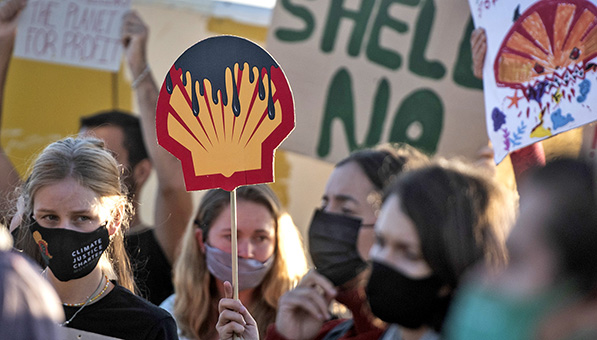
Energy giant Shell has suffered a significant legal setback after the Constitutional Court ruled against plans to explore for oil and gas off South Africa’s ecologically sensitive Wild Coast, finding that the exploration rights and permissions for seismic surveys were granted unlawfully.
The dispute centred on offshore exploration rights held by Shell and Impact Africa, which had planned seismic surveys along the Wild Coast in search of oil and gas reserves. Environmental groups and local communities challenged the approvals, arguing that affected residents had not been adequately consulted and that the exploration posed risks to livelihoods, cultural heritage and the marine environment.
Long legal battle reaches final chapter
The case dates back to May 2022, when the Makhanda High Court ruled that the exploration rights were unlawful due to shortcomings in the public consultation process. The court found that communities likely to be affected by the project had not been properly engaged before approvals were granted.
Shell, Impact Africa and Mineral Resources and Energy Minister Gwede Mantashe subsequently appealed the ruling.
In May 2025, the Supreme Court of Appeal (SCA) agreed that the consultation process had been flawed but allowed the companies an opportunity to rectify those failings retrospectively. The court held that the consultation deficiencies could potentially be corrected after the fact.
However, environmental organisations and community groups challenged that aspect of the judgment, taking the matter to the Constitutional Court.
Court rejects retrospective fix
In its judgment delivered on Friday, the Constitutional Court sided with the applicants, ruling that an unlawful decision could not simply be repaired after the fact.
The court found that allowing the companies to return and conduct consultations retrospectively would not have addressed other fundamental shortcomings in the original application process. It also recognised concerns that continued exploration activities could infringe on communities’ constitutional right to an environment that is not harmful to their health and wellbeing.
The ruling effectively brings to an end the legal validity of the exploration rights in their current form.
Environmental groups hail landmark judgment
Environmental justice organisation Natural Justice welcomed the ruling, describing it as a major victory for communities along the Wild Coast.
Executive Director Farida Aliwa said the judgment reinforced constitutional protections and confirmed that communities cannot be sidelined when developments threaten their livelihoods, culture and environment.
“The ruling marks an important step forward for environmental justice in South Africa,” Aliwa said.
Delme Cupido, Natural Justice’s Southern Africa director, said the case highlighted the need to safeguard coastal communities, the environment and the rule of law for future generations.
The organisation argued throughout the proceedings that public participation is a fundamental constitutional right rather than a procedural hurdle.
“The court affirmed that the right to public participation is not just about following a procedure and ticking boxes, but rather that it is about placing the dignity of our people at the centre of developmental decisions,” said Robinson.
Harsh offshore conditions add to exploration challenges
The legal difficulties come against the backdrop of significant technical and economic challenges facing offshore oil and gas exploration in South Africa.
According to a technical report on the sector, proposed exploration activities in the Orange and Outeniqua basins involve water depths ranging from 1 000 to 3 000 metres, presenting major operational difficulties.
The report notes that deep-water drilling in these regions is complicated by large swells, rough sea conditions and frequent interruptions caused by wave action. Offshore rigs are particularly vulnerable to heavy swells, which can halt drilling operations and substantially increase costs.
“Oil rigs are remarkably vulnerable to big wave action. Drilling in extremely deep water, the leverage effect of even swell rise can require the operation to cease,” the report states.
It adds that previous deep-water gas discoveries were abandoned because the technical complexity and costs associated with operating in such challenging conditions proved prohibitive.
Significance beyond the Wild Coast
The Constitutional Court’s ruling is likely to have implications far beyond the Wild Coast, setting a precedent for how future resource extraction projects engage with affected communities. The judgment underscores the principle that meaningful public participation is not optional and that environmental and constitutional rights must be considered alongside economic development objectives.
- The Constitutional Court ruled that Shell’s oil and gas exploration rights off South Africa's Wild Coast were unlawfully granted due to inadequate public consultation.
- The case began in May 2022 when the Makhanda High Court found exploration rights unlawful for failing to properly engage affected communities.
- The Constitutional Court rejected the idea of retrospective consultations, stating that unlawful decisions could not be fixed after the fact.
- Environmental group Natural Justice hailed the ruling as a victory for community rights and environmental protection along the Wild Coast.
- Offshore oil and gas exploration in South Africa faces additional challenges such as deep-water drilling difficulties, heavy swells, and high operational costs.


