


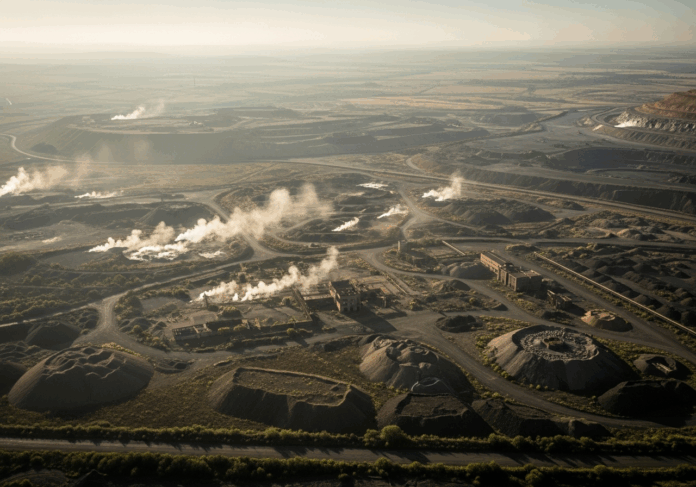
South Africa’s coal mines are releasing methane into the atmosphere at levels that remain unmeasured, unregulated, and largely invisible to policymakers.
Researchers from the University of Cape Town warn that the country cannot manage what it does not monitor, raising new questions about South Africa’s climate commitments and the pace of its just energy transition.
Methane traps more than 80 times more heat than carbon dioxide over 20 years and is responsible for nearly a third of global warming since the Industrial Revolution.
Yet in South Africa, methane from coal mining remains a blind spot. Unlike the power sector, where Eskom’s emissions are tracked in detail, no national system measures methane leaking from active or abandoned mines.
Undocumented mine sites
Research by Professor Brett Cohen and Jesse Burton reports that scientists do not know how much methane South Africa’s coal sector emits each year.
The problem is not unique, but it is unusually large for the world’s seventh-largest coal producer and the backbone of Africa’s most carbon-intensive economy.
Methane escapes during mining when pockets of gas trapped underground are released. Abandoned shafts continue leaking long after operations stop, often for decades.
South Africa has hundreds of old and undocumented mine sites. Many of these mine sites have flooded or collapsed, rendering inspection impossible.
Without proper measurement, policymakers are unable to estimate risks, enforce mitigation strategies, or incorporate climate costs into their planning.
Globally, the International Energy Agency estimates that coal mining contributes about 40% of methane emissions from the energy sector.
China captures methane for electricity, while the United States requires reporting from underground mines, and Australia uses satellite detection to verify operator data. South Africa, on the other hand, has no equivalent rules or monitoring.
Data does not exist
The timing is critical. South Africa has committed to cutting emissions under its Nationally Determined Contribution and is negotiating billions in climate finance through the Just Energy Transition Partnership.
Methane reductions are one of the fastest, cheapest ways to slow warming.
The United Nations says a 30% cut by 2030 could prevent thousands of climate-related deaths and avoid extreme weather losses.
Yet South Africa did not sign the Global Methane Pledge at COP26. Officials argued that the country needed better data before making commitments.
Three years later, the data still does not exist. Without measurement, methane remains invisible in national inventories.
That masks the real contribution of coal beyond carbon dioxide and delays solutions, from methane capture to mine-closure planning.
Environmental authorisations focus on land rehabilitation and water contamination, not methane leakage. This allows mining companies the freedom not to report methane emissions.
The Department of Mineral Resources and Energy has no methane-specific standard.
Least-understood climate challenge
Meanwhile, the Department of Forestry, Fisheries and Environment acknowledges the data gap but has not established mandatory monitoring.
Captured methane can be used for on-site power, lowering diesel use and reducing underground explosions.
In countries that have adopted methane recovery, projects generate royalties, carbon credits and jobs. South Africa’s failure to measure means it is also failing to monetise.
Methane leakage from coal mining is South Africa’s least-understood climate challenge and one of its most urgent.
Until the country knows how much methane is escaping, it cannot manage its transition, protect communities, or capture economic value.
- South Africa’s coal mines are releasing methane into the atmosphere at levels that remain unmeasured, unregulated, and largely invisible to policymakers.
- Researchers from the University of Cape Town warn that the country cannot manage what it does not monitor, raising new questions about South Africa’s climate commitments and the pace of its just energy transition.
- Methane traps more than 80 times more heat than carbon dioxide over 20 years and is responsible for nearly a third of global warming since the Industrial Revolution.
- Yet in South Africa, methane from coal mining remains a blind spot.
- Unlike the power sector, where Eskom’s emissions are tracked in detail, no national system measures methane leaking from active or abandoned mines.


