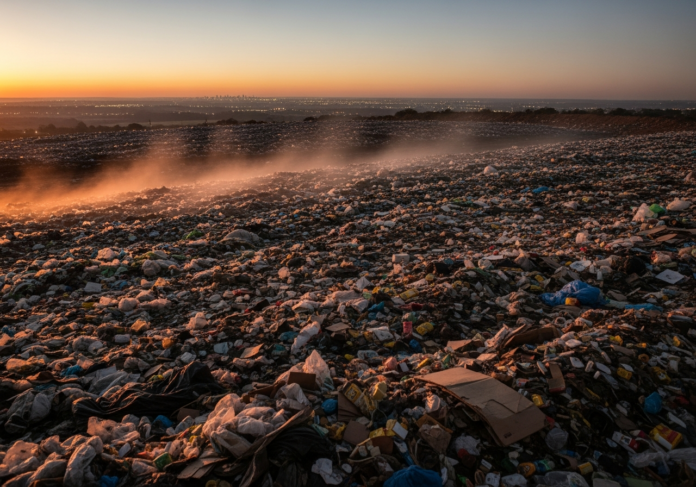
South Africa is throwing away more than 10-million tonnes of food every year, yet millions of households struggle to access sufficient nutrition.
With the festive season driving higher household spending, bulk food purchases, and social gatherings, food waste typically spikes at year-end.
Excess cooking, oversized portions, and poor storage mean that more food than usual ends up in black bags rather than on plates.
This seasonal surge adds pressure to already overstretched landfill sites, amplifying methane emissions at precisely the time when South Africa’s waste system is least equipped to absorb them.
Despite the scale of the problem, food waste remains under-addressed in South Africa’s climate and waste policy landscape.
Greenhouse gas emissions
Organic waste is the single largest component of general waste disposed of in landfills in South Africa, accounting for around 27% of the total, according to research by Anne Fitchett assessing The Potential For Diverting Food Waste From Landfill in South Africa.
Food waste alone makes up roughly one-third of that organic fraction.
Once buried, organic waste decomposes without oxygen and produces methane, one of the most potent greenhouse gases.
Globally, food waste accounts for an estimated 8–10% of all greenhouse gas emissions and around 12% of methane emissions. Methane is considered to be over 80 times more potent than carbon dioxide over 20 years.
Historical estimates put the cost of wasted food across the supply chain in SA at roughly R61.5-billion annually, equivalent to about 2.1% of the country’s gross domestic product (GDP).
A 2025 analysis of food waste disposal and loss, by Anton Nahman, places the total societal cost at R32.5-billion per year, equivalent to around 1.2% of GDP when resource inputs and landfill externalities are fully valued.
At the household level alone, food waste disposal and lost food value have been estimated at R21.7-billion annually (0.8% of GDP), despite household waste representing a small proportion of total food losses.
This shows the scale of costs across the system.
The composition of food waste also shows inefficiencies upstream. According to the World Wildlife Foundation, nearly half of total food loss occurs during production and processing, well before food reaches retail shelves or refrigerators.
That level of waste is especially stark in a country where roughly one-fifth of households lack adequate access to food, and millions of people face chronic hunger.
Yet food loss and waste reduction remain largely absent from key national climate commitments.
Black Soldier Fly processing
Several alternative treatment and recovery pathways have measurable climate and socio-economic benefits.
There are aerobic and vermicomposting methods that divert food waste from landfills and generate soil amendments useful for agriculture.
Meanwhile, anaerobic digestion produces biogas for energy while significantly reducing methane emissions compared with landfill.
We also have Black Soldier Fly processing, which converts food waste into high-protein insect biomass for animal feed and residual fertiliser.
It possesses the highest net social benefit among the options studied.
The recent research by Annie Fitchett suggests that a blended approach of combining anaerobic digestion for wet waste and insect processing for suitable food streams offers the strongest overall outcome for South Africa.
These alternative pathways capture value, reduce greenhouse gas emissions, and create local economic opportunities.
Despite these benefits, uptake of alternative food waste solutions is slow due to various factors.
There is also a lack of integrated policies that link waste management with climate mitigation and food security goals.
On the other hand, South Africa lacks infrastructure and investment incentives to scale alternative processing technologies.
Addressing food waste is one of the most cost-effective climate intervention points, offering co-benefits for public health, jobs, energy resilience, and food access.
Transforming South Africa’s food waste system requires a shift away from landfill dependence toward circular organic resource management that recognises food waste not as waste but as a strategic asset.
- South Africa is throwing away more than 10-million tonnes of food every year, yet millions of households struggle to access sufficient nutrition.
- With the festive season driving higher household spending, bulk food purchases, and social gatherings, food waste typically spikes at year-end.
- Excess cooking, oversized portions, and poor storage mean that more food than usual ends up in black bags rather than on plates.
- This seasonal surge adds pressure to already overstretched landfill sites, amplifying methane emissions at precisely the time when South Africa’s waste system is least equipped to absorb them.
- Despite the scale of the problem, food waste remains under-addressed in South Africa’s climate and waste policy landscape.