


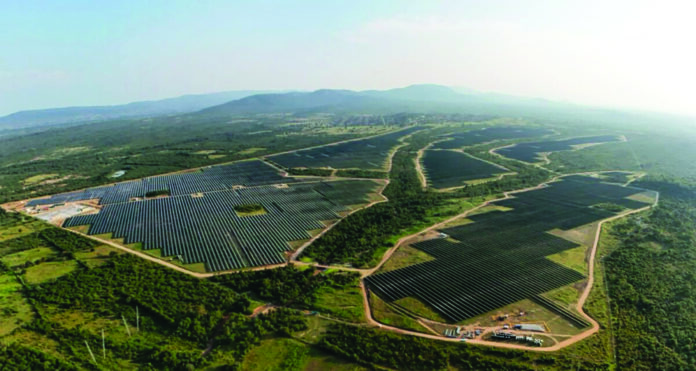
Richards Bay Minerals (RBM) is betting on the sun in Limpopo to wheel 148MW of solar-powered electricity through Eskom’s transmission lines to power its smelters 900km away in northern KwaZulu-Natal.
The company is leaning on a new wave of renewable energy deals as it pushes ahead with the restart of its long-delayed Zulti South project, RMB acting general manager Wilhemina Ngcobo told Sunday World at the launch of the Bolobedu Solar PV Project last week.
Situated in the Modjadji Tribal Authority near Tzaneen, the solar farm covers 347 hectares of land where 218 250 solar panels will have a production output of 300GWh of clean energy, removing 237 000 tonnes of CO2 emissions a year.
The Bolobedu plant, built by international developer Voltalia to supply RBM’s smelters, is the miner’s first renewable energy offtake. It has two other projects in construction — a 130MW plant in Kangela and a 230MW plant in Overberg, both in the Western Cape. They are due to reach commercial operation in November 2026 and July 2027 respectively.
Electricity accounts for 32% to 35% of RBM’s operating costs.
“With these 500MW, we should be able to reduce that 30% to 32% cost,” Ngcobo said.
Ngcobo, a mining engineer who has worked underground and open-cast at South32’s Witbank coalfields, African Rainbow Minerals’ Northern Cape iron ore and manganese operations and Harmony Gold’s Target mine in the Free State, joined RBM in last year — as the titanium and zircon producer was moving to secure its future.
Zulti South was halted in 2019 after violent unrest linked to organised crime and so-called “project hijackers”, including the assassination of a former RBM general manager.
Getting the project moving again, Ngcobo said, meant going back to basics with RBM’s four host communities.
“We had to go again and define the governance around the trust that we’re having with the community,” she said, pointing to the appointment of independent trustees empowered to sign off on how community funds are spent. “In 2025, we had closed off those litigations and we are operating without any issues.”
As proof of that stability, RBM built a smaller 120-tonnes-per-hour plant, SCM120, in the southern community before Zulti South was approved.
“It was just to prove that we can do some construction in the southern community without any violence and without any interruption,’ Ngcobo said.
She said around R200 million in contracts had gone to local businesses, with roughly 300 people from the four host communities employed on the project — a number she expects to climb as construction ramps up. “Everybody understands that if the violence continues, we won’t be able to build a mine that is contributing towards the community,” she said.
Parent company Rio Tinto’s approval of an estimated $470m investment in Zulti South, Ngcobo said, reflected confidence that the instability of the past has been dealt with.
The Bolobedu project has not been without friction either. A dispute between tribal authorities over royalties saw a last-minute withdrawal of traditional leaders and provincial government representatives from the launch event on Thursday.
Ngcobo, however, pointed to community upliftment work Voltalia had done in the area, including hiring about 800 people in the construction phase of the solar farm, 56% of them youth and more than 20% women — as evidence of the project’s community benefits. She declined to comment on the royalty dispute.
Louise Paulsen, country manager at Voltalia, said it was unfortunate there was no representation by the traditional leadership at the launch event on Thursday, despite the extensive community consultations and work done to uplift communities.
“This project has a 20-year lifespan. It’s in nobody’s interest to not have this work.”
Voltalia holds a 65% stake in the Bolobedu solar farm, with the remaining 35% held through black ownership by Renewable Solutions (Pty) Ltd, which has a 21% stake, and Growth Arm (Pty) Ltd holding the other 14%.
To incorporate the local leadership into the project, a trust was set up encompassing the three host communities in the Modjadji Traditional Authority: Ga-Ramoroka, Shawela-Modjadji and Mohlabaneng.
Paulsen said residents were upskilled with “on the job” training on engineering support, solar panel installation as well health, safety, environmental and social awareness. “For many — young adults and the older men and women — this offered their first formal job, giving them a sense of economic independence and channel of hope for sustainable livelihoods.”
Construction of the solar farm also supported a value chain of businesses including transport and accommodation providers.
Paulsen said the site was chosen because of abundance of sunlight in the area.
“The yields from the sun here are magnificent.”
- Richards Bay Minerals (RBM) will use 148MW of solar power from Limpopo's Bolobedu Solar PV Project to supply electricity to its smelters in northern KwaZulu-Natal via Eskom's transmission lines.
- The Bolobedu solar farm covers 347 hectares, has 218,250 solar panels, produces 300GWh of clean energy annually, and reduces CO2 emissions by 237,000 tonnes per year.
- RBM has two additional solar projects under construction: a 130MW plant in Kangela and a 230MW plant in Overberg, expected to be operational in November 2026 and July 2027 respectively.
- RBM aims to reduce its electricity costs, which currently account for 32-35% of operating costs, by using these renewable energy projects totaling 500MW.
- Voltalia holds a 65% stake in the Bolobedu solar farm, with Renewable Solutions (21%) and Growth Arm (14%) holding the remaining shares, and the project includes community trust participation from three Modjadji Traditional Authority communities.


