



JSE-listed Super Group delivered a sharp increase in earnings for the year ended June 30 2026, with profit growth significantly outpacing revenue expansion as operational improvements, acquisitions and stronger performances across key divisions boosted margins.
At the same time, the group’s latest remuneration disclosures highlight a substantial gap between executive pay and the earnings of its lowest-paid employees.
Profit before tax rose 33.5% to R1.77-billion from R1.33-billion a year earlier, while operating profit increased 26.6% to R2.37 billion. Revenue grew a more modest 6.2% to R45.83 billion, indicating that margin expansion and efficiency improvements played a major role in earnings growth. Headline earnings per share climbed 36% to 334.6 cents, while cash generated from operating activities increased 24.3% to R2.44 billion.
The strongest contribution came from the group’s diversified operating businesses. The supply chain division increased revenue by 6.1% to R20.47-billion, with operating profit up 20.8%.
READ MORE: Women deserve more opportunities in logistics and freight sector
Fleet Solutions delivered particularly strong growth, with revenue rising 30.1% and operating profit increasing 54.3%. In South Africa, the dealerships’ business lifted revenue by 12.3% and operating profit by 5.5%, while the UK dealerships’ operation grew operating profit by 74.5% despite a 1.7% decline in revenue, reflecting improved efficiency and strong sales of newer Chinese vehicle brands.
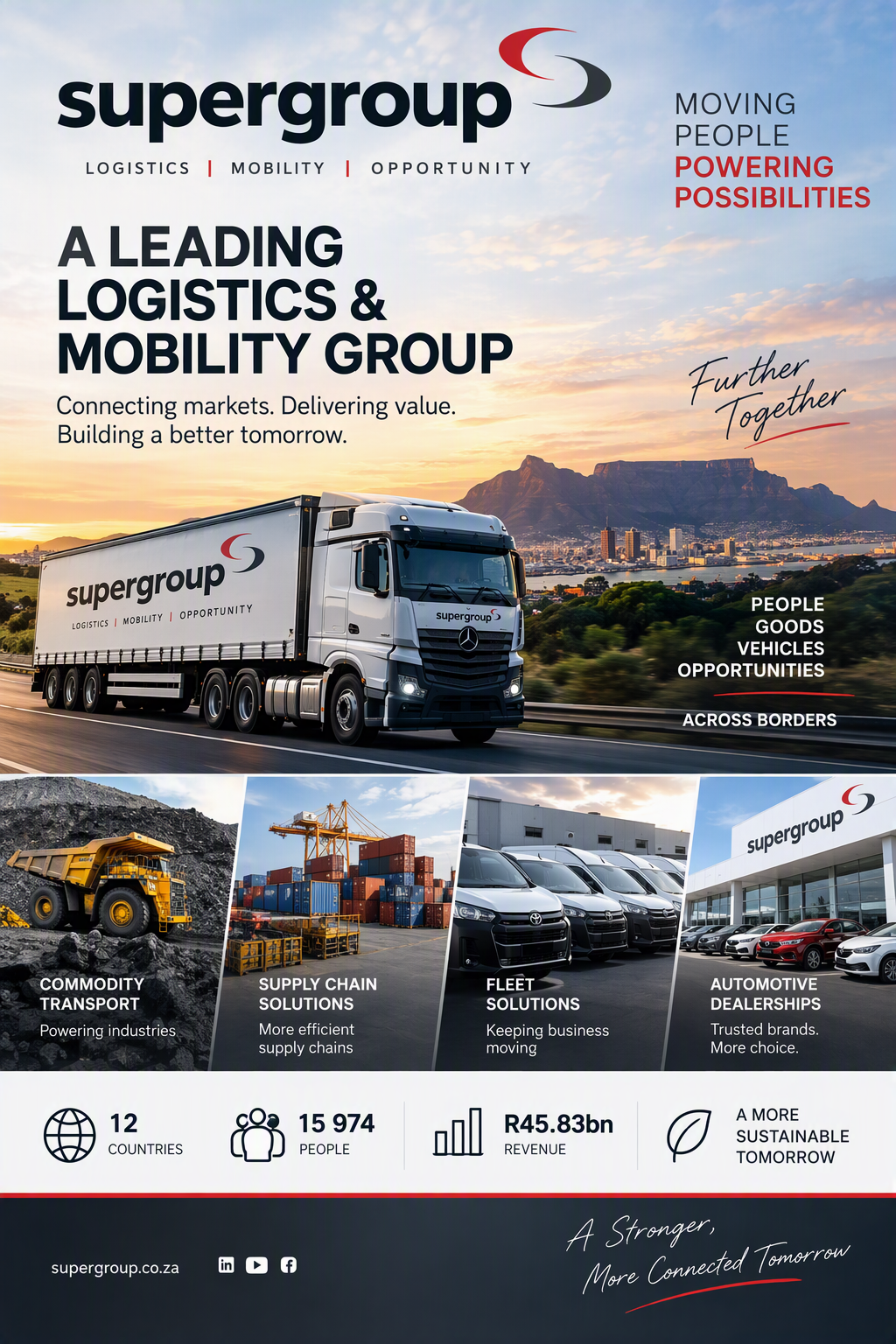
Management attributed the performance to robust demand in industrial supply chains, higher activity in commodity transportation, including coal and copper, a strong vehicle replacement cycle at Fleet Africa, and contributions from acquisitions.
The company also continued to streamline its portfolio by disposing of non-core businesses, including SG Fleet, inTime and AMCO, while acquiring businesses such as DIG and Gestservi in higher-margin segments.
READ MORE: Super Group seals acquisition of RSC Consulting Services
Chief executive Peter Mountford said the group entered the new financial year with strategic clarity, strong cash flows and resilience despite inflationary pressures and geopolitical uncertainty.
Executive pay remains under scrutiny
The remuneration report shows that Mountford, who at 68 is one of the oldest accounting officers of JSE-listed companies, received a total remuneration of R26.03-million during the year, compared with R27.04 million in 2025. Chief financial officer Colin Brown earned R12.97-million, up from R10.61-million the previous year.
In contrast, the group’s lowest-paid permanent employee earned R63,538 for the year. Average employee remuneration was R457,762, while median remuneration stood at R361,540. The company disclosed a CEO-to-average-worker pay ratio of 38:1, while employees in the top 5% of earnings received 16.5 times more than those in the bottom 5%.
The remuneration committee noted that senior executive pay remains below the median of comparable listed companies and that executive increases were kept below inflation. The latest remuneration disclosures, however, show that, despite moderation in Super Group’s executive pay, a significant gap remains between the earnings of top executives and those of the group’s lowest-paid workers.
The group’s permanent workforce declined to 15,974 employees across 12 countries, down from 18,842 a year earlier, reflecting portfolio changes and restructuring initiatives. Total employee remuneration amounted to R5.7 billion. The company maintained its Level 2 B-BBEE status, with black employees representing 87% of the workforce and 81% of management positions.
Driving industries
The logistics and mobility group operates across South Africa’s vast mining regions, serving mining companies through specialised commodity transport services. The business strengthened its presence even further with the acquisition of the DIG plant-hire operation, extending its reach across 19 mining sites throughout the country.
Beyond the mines, the group played a vital role in supporting large corporate organisations. Through its Fleet Africa business, it helped corporate fleet customers keep their operations moving by providing vehicle fleet solutions, funding, maintenance services, and comprehensive fleet management support. For many companies, Fleet Africa became a trusted partner, ensuring that vehicles remained reliable, efficient, and cost-effective throughout their lifecycle.
The company’s influence stretched into the world of consumer goods, retail, and industrial manufacturing. Through integrated supply chain solutions, warehousing facilities, and extensive distribution networks, it connected products with businesses and consumers alike, resulting in the organisation becoming an essential link in the flow of commerce.
Its reach did not end there. In the automotive sector, the group built a strong presence through dealership networks operating in both South Africa and the United Kingdom, benefiting from the rise of Chinese vehicle brands primarily through its dealership business rather than transport operations.
The company’s UK and South African dealerships have rapidly expanded their representation of Chinese brands including Chery, Omoda, Jaecoo, Geely, GWM and Jetour, helping drive vehicle sales growth and profitability.
Read more: Super Group seals acquisition of RSC Consulting Services
- Super Group's profit before tax rose 33.5% to R1.77 billion for the year ended June 30, 2026, while revenue grew 6.2% to R45.83 billion.
- Operating profit increased by 26.6% to R2.37 billion, driven largely by margin expansion and efficiency improvements across key divisions.
- The supply chain division grew revenue by 6.1%, operating profit by 20.8%, and Fleet Solutions recorded revenue growth of 30.1% with operating profit rising 54.3%.
- CEO Peter Mountford earned R26.03 million in total remuneration, compared to R63,538 earned by the lowest-paid permanent employee, with a CEO-to-average-worker pay ratio of 38:1.
- Super Group’s permanent workforce declined from 18,842 to 15,974 employees, maintaining Level 2 B-BBEE status with black employees representing 87% of the workforce and 81% of management.


