



What began as a discussion about fuel is no longer just about fuel. It has become something far bigger.
Over the past week, global events have collided in a way that exposes South Africa’s economic position more clearly than at any point in recent years. Oil prices have surged on the back of escalating tensions involving Iran and the broader Middle East.
The rand has weakened as global investors pull back from risk. At the same time, commodity prices – including gold – have softened, removing an important layer of support for the currency. And in the background, South Africa finds itself increasingly strained in its relationship with the US – the world’s largest economy and one of our most important trade partners.
And now, the domestic policy response is beginning to reflect that pressure.
The South African Reserve Bank’s (SARB) decision to hold the repo rate at 6.75% speaks directly to the constraints facing the economy. In more stable conditions, the conversation may have been about rate cuts to support growth. But this is not a normal environment. Rising fuel prices and a weaker rand are feeding directly into inflation risk, forcing SARB into a defensive position. Interest rates are now being held not to stimulate the economy, but to protect it – to anchor expectations in the face of what is rapidly becoming an externally driven shock.
This is the reality of South Africa’s current position.
These are not separate issues. They are converging. And that convergence is where the real risk lies.
South Africa is a net importer of fuel. That simple fact sits at the centre of everything. As global oil markets tighten and prices rise, the impact on the domestic economy is immediate and unavoidable. Fuel costs filter through to transport, food prices, production, and ultimately the cost of living. Critically, refined diesel powers the South African economy – from logistics and mining to agriculture and backup electricity generation. In an economy already struggling with low growth and high unemployment, rising diesel costs act as a direct brake on activity.
But the fuel shock is only one side of the equation. The second is the currency. The rand is not only reacting to higher oil prices – it is reacting to global uncertainty. In times of geopolitical tension, capital flows toward safety, strengthening the US dollar and placing emerging market currencies like the rand under pressure. South Africa is now caught in that cycle. And because we import fuel in dollars, the effect is compounded. A higher oil price combined with a weaker rand does not simply add pressure –it multiplies it.
Historically, gold and other commodities have often supported the rand during periods of global stress. But that buffer is now less reliable. With commodity prices pulling back, the country is more exposed to rising energy costs and external shocks than it has been in some time.
Overlaying these economic pressures is a more complex and increasingly important factor – geopolitics.
South Africa’s relationship with the US has come under visible strain. Trade tensions, foreign policy differences, and diverging global alignments have all contributed to a cooling of what has historically been a critical economic relationship. At the same time, South Africa has maintained engagement with countries such as Iran, reinforcing its position as a non-aligned player in global affairs.
Individually, these positions may be defensible. Collectively, they carry consequences. Because global markets do not separate politics from economics – they price both, simultaneously.
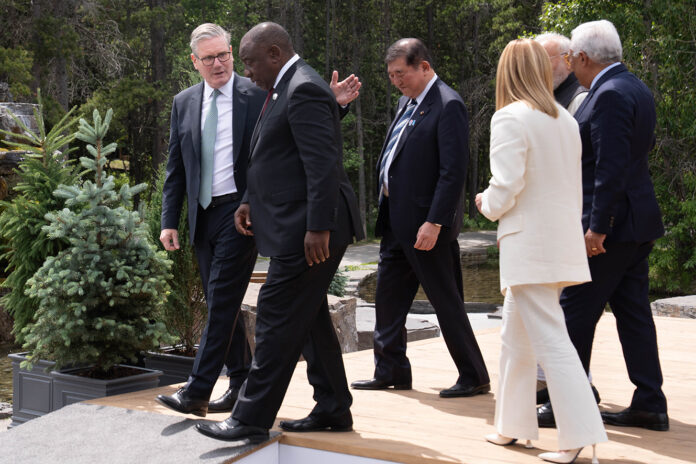
Perhaps the clearest signal of this shift is South Africa’s absence from key global economic platforms such as the G7 engagement. This is not merely symbolic. These forums shape economic dialogue, influence and alignment. Being at the table matters. Being absent raises questions – and in global markets, uncertainty is translated into risk.
What is emerging is not a single crisis, but a pattern. Rising oil prices. A weakening currency. Reduced commodity support. Tighter monetary conditions. Strained relations with major trading partners. And growing geopolitical ambiguity.
Each of these factors on its own is manageable. Together, they begin to reinforce one another, creating a more fragile economic environment.
The Reserve Bank’s position reinforces this reality. By holding rates at 6.75%, it is effectively signalling that inflation risk – driven by fuel and currency weakness – now outweighs the need to stimulate growth. The result is a difficult trade-off: protecting price stability while growth and employment remain under pressure.
The question, then, is not whether South Africa is in crisis; it is whether the country is doing enough to position itself against one. There is a strong case to be made for greater economic pragmatism at this moment. Trade matters. Access to global capital matters. Currency stability matters. And in a world that is becoming increasingly polarised, strategic alignment – or at the very least strategic clarity –matters more than ever.
This does not require abandoning principle. But it may require a more deliberate effort to balance principle with economic reality.
South Africa remains a country with significant strengths – deep financial markets, established institutions, and a globally relevant resource base. These are not small advantages. They provide a foundation from which to respond. And that is where the opportunity lies.
South Africa is not without options. Re-engaging key trading partners, reinforcing investor confidence, strengthening energy security, and adopting a more proactive economic stance are all within reach. None of these require a fundamental shift in identity – only a sharpening of focus.
The risks are real. But so is the opportunity to respond.
Because in the end, economies do not grow in isolation. They grow through trade, investment, and confidence. And those are still very much within South Africa’s reach.
- Van Doesburgh is head of economics at CPUT, a former financial director of JSE-listed companies, and a regular commentator on eNCA and CapeTalk


