


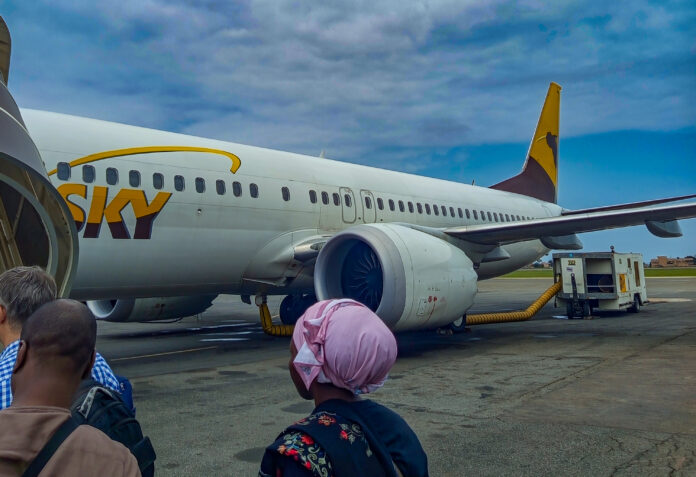
West Africa is bracing for a jump in air travel demand as its heads of state prepare to cut taxes and fees that make up nearly half of a flight ticket, starting January 2026.
The heads of state and government in the region approved the measures at their December 2024 summit in Abuja, aiming to dismantle the cost barriers that have made West Africa one of the world’s most expensive regions for air travel.
Under the new Supplementary Act on Aviation Charges, Taxes and Fees, all the Economic Community of West African States (Ecowas) member countries will eliminate air transport taxes and reduce passenger and security charges by 25%.
Ecowas hopes the reforms will strengthen domestic and regional airlines, expand mobility and accelerate economic integration.
“The citizens of West Africa can travel freely, enjoy affordable air tickets, and the regional integration agenda that we seek will happen,” Ecowas’ director of transport, Chris Appiah, told journalists in Nigeria.
The bloc projects that if fares fall by between 30% and 40%, intra-regional passenger numbers could climb to between 12-million and 15-million annually within three years, based on modelling from the Ecowas commission and the African Airlines Association’s (AFRAA) 2024 market outlook.
Air transport liberalisation
“Many people will start traveling, many traders will start moving, and this is revenue for the government because they’ll pay more taxes,” said Appiah.
A return ticket from Accra to Dakar averages $650 (R10 894) to $900, while an Accra to Lagos flight, which is barely an hour long, frequently sells for about US $350 to $450, according to fare data compiled from IATA and major West African carriers.
Pan African Sky, a portal developed by Nelson Amenya, a strategy consultant who exposed the controversial $2-billion Adani-JKIA airport deal in Kenya, leading to its cancellation, is also advocating for lower air transport expenses across Africa.
According to the portal, the return ticket from Accra to Dakar would cost at least $215, with a maximum price of $537, while the Accra to Lagos flight would range from $41 to $101, resulting in savings of up to 80% on ticket costs.
Amenya argues that Africa’s skies will only open when the continent matches the global Southwest’s operational discipline with political choices “that stop punishing people for the simple act of crossing their continent.”
“If we want a continent where a young Kenyan can affordably attend a conference in Lagos, where a Tanzanian entrepreneur can regularly fly to Kinshasa, and where regional tourism flourishes beyond a tiny elite, then we must stop pretending,” said Amenya on the portal.
He pointed to Europe’s air transport liberalisation between 1992 and 2000 as a powerful case study, noting that fares fell by more than 15% while flight frequencies surged 88%.
Over the same period, the number of routes expanded by 75%, and available seats more than doubled.
Reforms pushed fares down
In Africa, he cited Morocco’s full airline market liberalisation, institutionalised in 2006, which opened domestic and international routes, including to European carriers.
The reforms intensified competition, pushed fares down by about 7%, and expanded route networks, delivering significant gains for national carrier Royal Air Maroc and low-cost airlines such as Ryanair and EasyJet.
The increased connectivity helped lift tourist arrivals in the country by an average of 6% annually.
Similarly, he argued that the adoption of low-cost carrier models in South Africa transformed the market, with FlySafair expanding its capacity by nearly 800% between 2018 and 2024, underscoring the growth potential unlocked by liberalised skies.
The immediate effect on the anticipated reduction in flight ticket costs across West Africa is expected to first take effect in active Ecowas members, which include Benin, Cape Verde, Ivory Coast, The Gambia, Ghana, Liberia, Nigeria, Senegal, Sierra Leone, and Togo.
It is not yet clear if countries suspended due to a coup, including Guinea-Bissau and Guinea, and those that no longer participate due to military takeovers, like Niger, Mali, and Burkina Faso, will immediately enjoy the lower airfares.
Despite a population of more than 420-million, West Africa reaches only half of North Africa’s (about 280-million) approximately 40% of the continent’s air traffic, according to AFRAA.
“It’s been established that our region is the most expensive when it comes to air transport services,” said Appiah, noting that government-imposed taxes and charges by aviation authorities and airport operators are key drivers.
Jet fuel expensive
Similar sentiments are shared by Amenya in his PanAfrica Sky portal, which shows West Africa charges an average of $110 per passenger in taxes for international departures, compared to just US$10 in the European Union.
Fuel taxes in Africa, according to the portal, make jet fuel 17% pricier than the global average and account for 40% of operating expenses compared to 25% globally.
“The taxes levied by governments and the charges collected by civil aviation authorities and airport companies are a big part of the ticket cost,” Appiah said.
A new regional air transport economic oversight mechanism, Appiah said, will track implementation, monitor fare changes and publish regional comparisons to ensure the measures are adhered to by member countries.
Lagos and Abuja airports rank at the bottom of Africa’s top 10 airports by passenger traffic, each handling fewer than two million passengers in 2024, according to AFRAA.
Only one regional corridor, Accra to Lagos, made it into the top 10 busiest intra-African routes last year.
- West Africa is bracing for a jump in air travel demand as its heads of state prepare to cut taxes and fees that make up nearly half of a flight ticket, starting January 2026.
- The heads of state and government in the region approved the measures at their December 2024 summit in Abuja, aiming to dismantle the cost barriers that have made West Africa one of the world’s most expensive regions for air travel.
- Under the new Supplementary Act on Aviation Charges, Taxes and Fees, all the Economic Community of West African States (Ecowas) member countries will eliminate air transport taxes and reduce passenger and security charges by 25%.
- Ecowas hopes the reforms will strengthen domestic and regional airlines, expand mobility and accelerate economic integration.
- “The citizens of West Africa can travel freely, enjoy affordable air tickets, and the regional integration agenda that we seek will happen,” Ecowas’ director of transport, Chris Appiah, told journalists in Nigeria.


