


Nigeria’s growing natural hair industry includes enterprising professionals like Happiness Okorie, who recently styled Chimamanda Adichie’s hair. For years, Okorie had suffered from burns on her scalp due to using harsh relaxers. Then one day, she said, “No more”!
Happiness Okorie’s dream came true in July 2025 when global literary icon Chimamanda Adichie travelled to Enugu and visited Okorie’s salon to get her hair done. Okorie packed Adichie’s coiled tresses into a crown-like updo. Adichie smiled, turning her head from side to side to look at what Okorie had created.
After the session, Okorie showed Adichie a copy of Adichie’s book, “Half of a Yellow Sun.” In the back, Okorie had written, five years before: “Dear Chimamanda, this is to let you know that someday, I will style your hair.”
The moment of the two women embracing each other after Okorie’s final touches to Adichie’s chignon was captured in a video that has since gone viral.
Okorie entered the natural hair sector after damaging her scalp with chemical relaxers used to straighten hair, the practice of millions of Black women around the world. Like many women, she endured pain but accepted it as a necessary cost for achieving beautiful hair.
“Every time I go for relaxers, I come back with a burnt scalp. And I kept thinking it was just a normal thing; your scalp has to get burnt until the whole natural hair movement started, and I saw a few women with natural hair, but I just didn’t understand it,” Okorie said.
One day, she realised she did not have to choose between beauty and comfort. She recalled the time she raised the issue with her former stylist.
“So, at the time, I asked my hairstylist to think about the natural hair thing, which looks like it is becoming very popular. But he was like, ‘No, never. Women will never want to wear their natural hair.’”
Okorie didn’t let the dismissal stop her. She turned to YouTube, teaching herself how to nurture and embrace her natural coils.
Her commitment quickly turned her into a sensation at the multinational telecommunications company where she worked. Her creativity astounded her colleagues.
Health risks
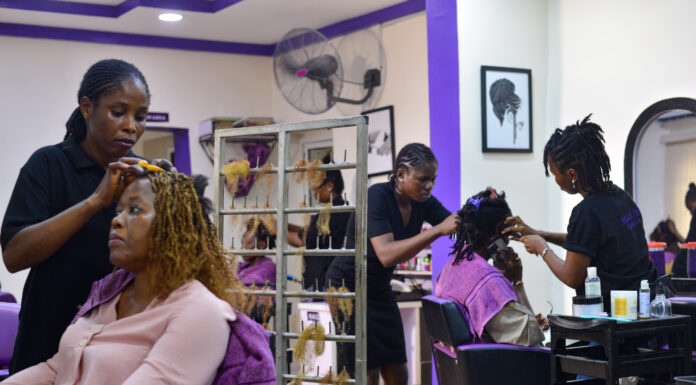
Today, that passion project has evolved into FhuzoHairport, her 18-seater hair spa in Enugu.
The salon buzzes with activity, run by a 99% female workforce. It’s a success story within the Nigerian beauty and cosmetics industry, valued at about $10.7-billion (R180-billion) in 2025, according to a report by Beauty West Africa.
The rush to FhuzoHairport isn’t just about a new look. It’s driven by a growing awareness of health risks. Ifeoma Ezechukwu, a client, spoke for a generation of Nigerian women who refuse to put their health at risk for the sake of beauty.
“I don’t see myself perming my hair because I also get to sit down and read about the chemicals. Now I am also into healthy things as well. Mmm-mmm. I’m not going to perm my hair,” Ezechukwu said.
You can see this shift happening far beyond the luxury salons. Even in the bustling stalls of Ogbete Main Market—one of West Africa’s largest open-air markets, established in 1917—the conversation around hair texture and health is complex.
For many, relaxers are still a pragmatic choice because stylists find the texture easier to plait and manipulate. Yet, appreciation for the versatility of natural hair is steadily growing.
“If they ask me, natural hair is beautiful in its own way. If women keep it clean, it’s beautiful,” said a local hair stylist in the market.
“Relaxed hair is disturbing because of the chemicals. It breaks, weakens, and changes the colour of the hair.”
These concerns aren’t unfounded; science is backing them up. A major study by the U.S. National Institutes of Health found that women who used chemical hair straighteners frequently—more than four times in the previous year—were more than twice as likely to develop uterine cancer compared to those who did not.
As of late 2025, more than 10,000 lawsuits were pending against major manufacturers regarding these risks.
But for many in Nigeria, going natural comes with a steep price tag. At Gossip Cosmetic Stores, CEO Obianuju Okechukwu pointed out that while the health risks are frightening, maintaining natural hair with imported products has become incredibly expensive.
Macroeconomic factors drove a sharp rise in prices in 2024, putting international brands out of reach for many.
Preservation of history and tradition
“We hear stories about relaxers causing some forms of cancer and being unhealthy.
“So my advice to them, or what I can suggest, is that they go for hair care products that are reasonable and cheaper,” Okechukwu explained.
“They should come back home. Things like shea butter. They are very cheap, and they’re very easy to come by.
“But you see those internationally sourced ones? They are costly. Here in Nigeria, you can actually make do with what we have and produce healthy and very good hair care products.”
Using local products is about more than just economics. It’s about embracing heritage. At the Centre for Memories, Okorie, programme manager Ifeoma Nnamani, and assistant programs officer Anuli Iwoba pore over photographs of traditional hairstyles.
The centre preserves the histories and traditions of southeastern Nigeria, where natural hairstyles were donned and celebrated in the past before chemical relaxers became the norm. Conscientious Nigerians, like Chimamanda Adichie, who hails from Nigeria’s southeast, are among those revitalizing those hairstyles.
Iwoba agreed that the shift to natural hair empowers women to take ownership of their identity while boosting the local economy.
“I think there’s that nexus between economy and what people can do with their own hair, and people are keying into it because it helps them also tell their own story,” Iwoba added.
Changing the narrative
For Okorie, her business is an act of cultural preservation.
“We are changing the narrative, right? We’re trying to bring back those hairstyles that typically a young girl will not want to wear because, ‘oh, my God, I want to look a certain way.’
“So we’re revolutionising how women see certain hairstyles, because truly if our mothers wore these hairstyles, there’s nothing wrong with us preserving that heritage,” Okorie said.
Today, as Okorie and her team film content for social media, they stand as the face of a booming sector: female entrepreneurship.
According to a 2025 Mastercard study, 83% of Nigerian women consider themselves entrepreneurs.
Okorie has employed and empowered over 100 women, contributing to a small and medium-sized enterprise sector that accounts for nearly 50% of Nigeria’s gross domestic product and 84% of employment.
Okorie transformed a market gap, her toxic hair practice, and a global health crisis into a model of African entrepreneurship, proving that a hobby once dismissed as “not cool” can become one of southeastern Nigeria’s most successful hair companies all because she dared to be different and embrace her natural hair.
- Nigeria’s growing natural hair industry includes enterprising professionals like Happiness Okorie, who recently styled Chimamanda Adichie’s hair.
- For years, Okorie had suffered from burns on her scalp due to using harsh relaxers.
- Then one day, she said, “No more”.
- Happiness Okorie’s dream came true in July 2025 when global literary icon Chimamanda Adichie travelled to Enugu and visited Okorie’s salon to get her hair done.
- Okorie packed Adichie’s coiled tresses into a crown-like updo.


