


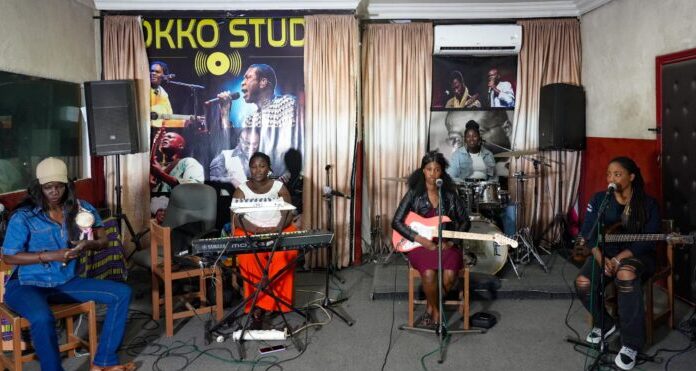
At Jokko Studio in Dakar, five instrumentalists play out original tunes steeped in a vibrant fusion of reggae, salsa, hip-hop, blues, jazz, rock and mbalax, the neo-traditional pop music of Senegal.
They are Khady Dieng, pianist; Amina Sarr, the lead vocalist; Aissatou Dieng, the percussionist; Ndeye Cisse, the sambar and djembe player; and Evora Vas, the bassist.
Together, they are Orchestra Jigeen Ñi, which in Wolof means the women orchestra.
The all-female band was formed in 2018 by cultural entrepreneur Samba Diaité, with a mission to champion the rights of women in Senegal and to be an inspiration for girls who aspire to become music artists.
“We are fortunate, in Senegal, to have an orchestra made up almost entirely of women who represent Senegal on the international stage every year,” Diaité told bird.
The band’s songs speak to the experiences of women, highlighting the discrimination, prejudice, and systemic barriers that women in Senegal face.
New chapter in Senegal’s musical history
The journey of the pioneering band opens a new chapter in Senegal’s musical history.
“The connection was made by my late friend Joe; since he was my friend, he told me about this idea. He was his twin brother, and he told me about his friend Samba.
“The idea of actually starting an orchestra—actually (…)—was a dream. My older sister Korka Dieng and I went to the office. So he brought up that idea,” Dieng, the founder and pianist, told bird.
“Without thinking, I told him, “Why not?” Then he asked if there were any other female musicians in Senegal. I told him yes.
“Then there was Aïssatou Dieng, the older sister, who was there and played the drums and everything. After Aïssatou, one by one, Evora came along, and then there was Rima Diop.
“There were so many women! It was there that we discovered a wealth of talent in Senegal.
Each of the women rose from their own personal struggles to be a part of the band and to be recognized as musicians.
Khady Dieng’s father, Safihou Dieng, was a music pioneer in Senegal, integrating local rhythms with salsa, which was the rage in the 60s and 70s.
He, too, was a pianist. She joined by invitation from Diaité, who manages the band.
Amina Sarr recalled that it was her father who encouraged her to join.
“He’s my mentor. His name is Papis Ndiaye,” she told bird. “He called me at the studio to tell me he wanted to bring me into a women’s group called Orchestre Jigeen Ñi.”
Each musician came to the group, bringing their styles, styles cultivated under the guidance of mentors and role models. Each of them speaks highly of them.
“As a drummer, I’d say Queen Cora, who was Beyoncé’s drummer, because we used to go to Phil Collins’ concerts—he’s both a singer and a drummer,” said percussionist Aissatou Dieng.
Defying social expectations
The musicians are breaking barriers and defying social expectations of the role of women in Senegal, a conservative society.
“Here in Senegal, girls who make music are generally looked down upon,” said journalist Fadel Lo. He authored a book titled If the Jigeen Ñi Orchestra Could Tell Its Story.
“What motivated me to write this book was, first and foremost, to introduce the general public to the remarkable work accomplished by the orchestra and the producer.”
Ndeye Cisse mastered the sabar and djembe drums. She admits that being a woman in the music industry comes with its own challenges.
“Because there are so many trends, there’s a lot of, how should I put it, gossip,” she revealed. “For us, that’s how we make a living.”
She is determined to let the public understand that the music profession is legitimate and worthy of being recognised.
Well-known to the Senegalese public, the Jigeen Ñi orchestra still face enormous financial challenges. They also encountered false perceptions around women.
“In our performances here in Senegal, we face many challenges. Some people think we’re difficult to work with.
“But that’s not the case—we just ask for feedback, good sound, and so on. Actually, that’s our main challenge,” said Vaz, the band’s bassist.
“Aside from that, when it comes to the international trips we’re taking and have already taken, we’re facing financial difficulties.
“So it’s complicated for us—flying is complicated, and getting around is complicated.”
Initiatives planned for France
Despite the difficult working conditions and stereotypes, the manager spares no effort in moving the projects forward.
“Thanks to Jigeen Ñi, a new world of possibilities is opening up for all those who, until recently, were hesitant to take the plunge.
“Within the group, each member creates her own musical track and shares it with the others before any orchestration takes place,” said Diaité, the band’s manager.
“The outlook for 2026—which, by the way, has been announced since 2025—includes a series of initiatives planned for France.”
The band will also collaborate with artists who will be traveling to Senegal from Slovenia. Then, they will go on tour, with a stop in Slovenia, to play at a festival.
Off the stage, the band members continue to chart paths for girls and women. Khady Dieng co-founded a women’s music school. At the school, music students learn to master instruments and to understand concepts.
It’s part of a greater mission to blaze a trail for more Senegalese women to thrive in the professional music industry.
- At Jokko Studio in Dakar, five instrumentalists play out original tunes steeped in a vibrant fusion of reggae, salsa, hip-hop, blues, jazz, rock and mbalax, the neo-traditional pop music of Senegal.
- They are Khady Dieng, pianist; Amina Sarr, the lead vocalist; Aissatou Dieng, the percussionist; Ndeye Cisse, the sambar and djembe player; and Evora Vas, the bassist.
- Together, they are Orchestra Jigeen Ñi, which in Wolof means the women orchestra.
- The all-female band was formed in 2018 by cultural entrepreneur Samba Diaité, with a mission to champion the rights of women in Senegal and to be an inspiration for girls who aspire to become music artists.
- “We are fortunate, in Senegal, to have an orchestra made up almost entirely of women who represent Senegal on the international stage every year,” Diaité told bird.


