


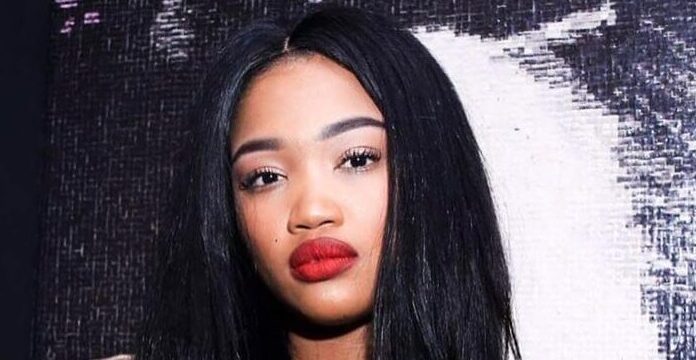
Model and former girlfriend of the late rapper Kiernan AKA Forbes, Nicole Nyaba, has opened up about a deeply personal and painful journey marked by identity struggles, unresolved family trauma and ongoing mental health challenges.
Born in Durban, Nyaba says her life began under difficult circumstances that shaped her sense of belonging from an early age.
“My biological mother didn’t have an ID at the time, and my father was living in another township. I was born in town by luck,” she says.
Had no sense of belonging
Nyaba, a South African citizen, grew up navigating life between two families, the Ndlovu and Nyaba households. This as her parents never married. Although she took her father’s surname, she says belonging to two families never translated into feeling protected or grounded.
“I’m a member of both families, but I never felt like I truly belonged anywhere. I took my father’s surname because he did have a hand in my upbringing. But that didn’t mean life was stable.”
Raised mainly between Clermont and Umlazi, Nyaba describes a childhood dominated by fear and silence.
“I grew up curious but very afraid. I was always scared of getting myself into trouble, even as a child at home,” she recalls.
Living with childhood trauma
“There are things that happened to me that I’m only now realising were not okay or normal.”
She says her struggles followed her into her education and adulthood.
“Learning was always a challenge for me. Not because I wasn’t capable, but because I lacked something fundamental, that sense of safety and grounding. I felt like I was missing what connects you to life and to other people.”
Within her extended family structures, Nyaba says her pain was often minimised.
“In the Ndlovu family, it was just me and my mother. In the Nyaba family, people went on with life as long as what happened to me didn’t affect them,” she says. “I was made to feel like being left behind was normal.”
A particularly painful chapter in her life remains the death of her uncle, Nkosinathi Emmanuel Ndlovu. He was born in 1977, and his death was reported as a suicide.
“That loss left too many unanswered questions,” she says. “It affected more than just one person, it affected the entire family.”
Mental health issues deteriorating
Since late 2024, Nyaba says her mental and emotional health has deteriorated sharply.
“I’ve been trying to hold myself together since November 2024, because that’s when everything got worse,” she says.
“I feel weak at times. I live in fear, fear of my death, fear of what comes after, and fear of being attacked emotionally and mentally.”
Nyaba believes years of emotional neglect and lack of protection left her vulnerable.
“My mistakes were used against me. Even though I didn’t fully understand what was happening to me at the time,” she says.
“I wasn’t guarded or protected enough. And some of the harm came from people I trusted, family, friends and communities.”
Her distress became visible publicly in December. Nyaba shared a troubling post on social media describing what she called a state of desperation and overwhelming pressure.
A cry for help
In the post, she said she had been “suffering in silence” for years. And she said she had created a new account because she felt limited in how many people she could speak to. She appealed to women’s organisations locally and internationally for help, saying she felt alone and unsafe.
“I fear being in this country and what the authorities and political powers, as well as the general public, are [going to] do to me,” she wrote, adding that she felt she was “running out of time”.
Nyaba also urged her followers not to judge her based on her past, asking instead to be heard in the present.
“Please try not to look at my past and listen to me now,” she wrote.
The post alarmed many followers and underscored the depth of her mental and emotional distress. These are concerns she says are rooted in years of unresolved trauma and a lifelong sense of vulnerability.
Nyaba says the weight of her experiences has also shaped how the public perceives her. And often through a lens she feels is incomplete and unfair.
“People see fragments of me and think they know my entire story,” she says.
Lifetime of unanswered questions
“They don’t see the years of confusion, fear and unanswered questions that shaped my reactions and decisions.”
She acknowledges that being linked to a high-profile figure brought heightened scrutiny. But she insists her struggles long predate fame or public attention.
“This didn’t start with celebrity or relationships. This started in childhood — in the home, in the silence, in the things that were never addressed,” she explains.
She adds that the trauma has affected not only her but also her parents and her sense of self.
“This has brought a great deal of suffering to my parents and to me,” Nyaba says.
“My higher self suffers in silence.”
Now choosing to speak publicly, Nyaba says breaking the silence is about survival, not attention.
“I didn’t know anything, and I wasn’t allowed to know,” she says.
Painful journey of healing
“But I’m trying to pick myself up where I can. Staying silent nearly destroyed me.”
She says she is now slowly learning to confront her trauma rather than suppress it. Though the journey remains painful and uncertain.
“Healing is not linear. Some days I feel strong; other days I feel like I’m starting from nothing again,” she says.
“But I’m trying to be honest with myself for the first time.”
“There are so many people carrying pain they were never taught how to process. Especially women — we are taught to endure, to keep quiet, to survive at all costs.”
As she continues to rebuild her sense of self, Nyaba says her greatest wish is not sympathy but understanding.
“I just want peace and the chance to live without fear.
“And I knew life in South Africa wasn’t easy,” Nyaba adds. “I just never knew how much harder it could get.”


