


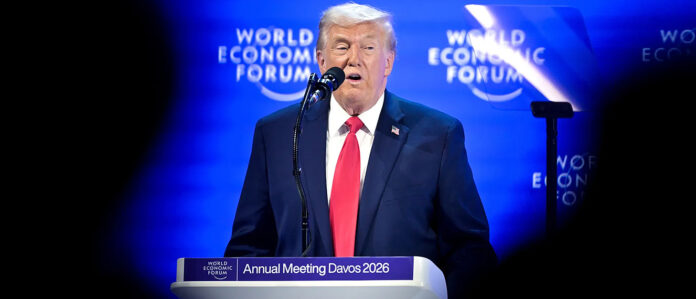
In chaos theory, a minute localised change happens in a complex system and then has large effects elsewhere. This is what we are observing with Donald Trump’s seemingly small and minute changes in the international order having catastrophic large effects on the global system.
If Davos is the litmus test, then we have a lot to do to survive this new global disorder. Greater cooperation and a clear emphasis on multilateralism, it seems, must be the order of the day if we are to survive.
In international relations, we are guided by various theories created by theorists – the master of these remains Thucydides.
One of his most famous quotes, “The strong do as they want whilst the weak suffer what they must,” is very relevant today in global affairs.
This is the way of the Trump administration with its Maga and “America First” malarkey.
The bandwagon at Davos thus suggests that we must all now dissect and truthfully analyse the so-called “international rules-based order”.
I remember as a young lad in Cambridge, whenever I pointed out the hypocrisy and double standards of how this system gets implemented globally, as Canadian Prime Minister Mark Carney put it, depending on who’s the victim and who’s the perpetrator, I was called polemic.
How we have come full circle. I wonder what some of those Cambridge academics say now, with the transparent acknowledgement by the Canadian prime minister about exactly that: the double standards and selective application of international rules and laws over the last 80 years and beyond.
But the problem statement that French President Emmanuel Macron, Carney and others have laid bare is hardly new for us in the Global South. We have understood this reality for decades, if not centuries. Whether it be through the slave trade, the scramble for Africa, settler colonialism or apartheid.
The real question now is, what do we do about it, now that we are faced with a madman in the Oval Office? A man with the mightiest military in the world, the largest economy, albeit falling apart, and a hegemonic status that is rapidly ending up in the trash can. In other words, a desperate man and its desperate people. Anyone can be its target at any moment. How do we respond to such uncertainty, chaos and anarchy?
Suddenly, “voluntarily” giving up our nuclear weapons in the early 1990s does not seem so altruistic. How do we secure our national security if tomorrow Trump comes for us?
We require a national security strategy, and not one that only speak to the next six months but the next 25 years.
“We must increase expenditure on all our armed forces – army, navy and air force – plus our intelligence services. We need a complete rethink about our security architecture, and coupled with that, how to respond to the socioeconomic and material conditions of our people on the ground.
This too will be used as a weapon to destabilise us internally.
A SADC-wide engagement is needed to talk about a coherent approach to the US with regards to trade, commerce and security concerns. In addition, South Africa must seek mutual security pacts with Brics partners, something akin to Nato’s Article 5.
An attack on one is tantamount to an attack on all.
Trump may be the most inconsequential president the US has ever had, but he is certainly unpredictable, and I’m sure you would agree, and is ignored at our peril.
It seems to me that with all these different theories, chaos, game and realist theory, the chessboard of international affairs is once again demanding international relations grandmasters. Let us hope that our president can be our Kenny Solomon against a Trump who is a Bobby Fischer.
• Dr Van Heerden is a senior Research Fellow at the Centre for African Diplomacy and Leadership at UJ


