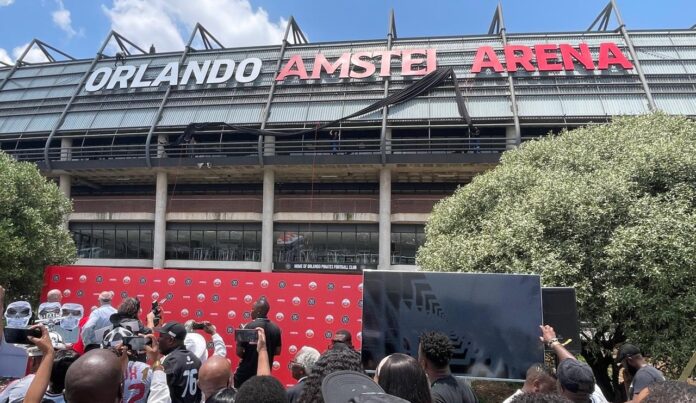

Everything was smooth as butter when Orlando Pirates announced their thirst-quenching and groundbreaking deal with Amstel at a glitzy event at Orlando Stadium.
Bucs legends were taking selfies with die-hard supporters, charlatans, and hangers-on who were expropriating and emptying the Amstel fridge with the Pirates choir in the background unleashing soothing and spine-tingling choral tunes in the marquee tent.
Old-school and veteran sports writers were out in full force, all grey but not showing any signs of slowing down – except for grumbling about the so-called influencers and content creators who have become a nuisance.
The tiny finger-lunch dishes, too, were being passed around with aplomb – in the manner that Oswin Appollis, Relebohile Mofokeng, and Sipho Mbule have been doing nonchalantly in that deadly midfield combination. And also, the DJ’s choice of hit songs was as peppered as Evidence Makgopa and Tshepang Moremi in the 18 area.
This was until the biggest moment, the unveiling of the curtain came. Well, one can say the Soweto and the Orlando gods were not invited to the party, as the wrap got stuck and refused to open, leaving some of the guests and the hosts scrambling around.
It took one brave person to rescue the situation, saving the Buccaneers from their blushes.
But nonetheless, the event was spectacular and one of the most stylish I have ever attended. We welcome any sponsor, donor or funding in the thriving local diski economy, which was once in the doldrums and feeding off scraps, with players getting paid from the boot of cars.
But having a beer company emblazoned all over the stadium, one of Soweto’s iconic high-rise landscapes, does somehow leave a bitter taste in the mouth.
In a country grappling with alcohol abuse, underage drinking, and a spiralling number of driving under the influence cases, I am sure there could have been better ways to lay out the deal’s new programmes and to draft the partnership’s upcoming initiatives.
In its current form, the new deal could somehow be interpreted as a mere, suspicious attempt to push consumption of its products to new consumers.
The UK had a similar conundrum, and Sir Ian Gilmore, chair of the Alcohol Health Alliance (AHA) and special advisor on alcohol to the Royal College of Physicians, recently argued and wrote: “Alcohol brands already dominate sporting events that attract children as well as adults, creating automatic associations between alcohol brands and sport that are cumulative, unconscious and built up over years.
“It is morally wrong for huge multinational alcohol companies to target our children and young people through sport.”
AHA argues that there is strong evidence that exposure to alcohol marketing leads children and young people to drink more and to drink at an earlier age.
The article raises concerns that linking alcohol and sport through sponsorship deals allows alcohol producers to communicate a legitimacy and status to their products that masks the significant health and social harms associated with their use.
Perhaps we will see frenetic campaigns around alcohol abuse, underage drinking, and maybe offer bursaries for kids keen to study biotechnology and other related courses.
The beer company will have to be more involved and also play their role in those communities and surrounding areas.
If handled carefully and considerately, this sponsor and arrangement, besides the obvious return on investment, can have massive spinoffs for the community. It can assist in curbing abuse and also be of benefit to young scholars eager to get to tertiary.
Well, the chairman of Pirates, Irvin Khoza, is an astute administrator, and it will not be the first time he’s handled such a sensitive matter. He handled sports betting, which can have parallel and similarly harmful effects, with the required care and attention.
He has mentioned that he went to the UK to study the sports-betting model and its effects, and now the groundwork has been laid out.
- Everything was smooth as butter when Orlando Pirates announced their thirst-quenching and groundbreaking deal with Amstel at a glitzy event at Orlando Stadium.
- Bucs legends were taking selfies with die-hard supporters, charlatans, and hangers-on who were expropriating and emptying the Amstel fridge with the Pirates choir in the background unleashing soothing and spine-tingling choral tunes in the marquee tent.
- Old-school and veteran sports writers were out in full force, all grey but not showing any signs of slowing down – except for grumbling about the so-called influencers and content creators who have become a nuisance. The tiny finger-lunch dishes, too, were being passed around with aplomb – in the manner that Oswin Appollis, Relebohile Mofokeng, and Sipho Mbule have been doing nonchalantly in that deadly midfield combination.
- And also, the DJ’s choice of hit songs was as peppered as Evidence Makgopa and Tshepang Moremi in the 18 area.
- This was until the biggest moment, the unveiling of the curtain came.