


The 3rd Students’ General Council was held at the St Peter’s Catholic Seminary in Hammanskraal in July 1972. That turned out to be a significant year for the nascent South African Students’ Organisation (Saso), the torchbearer for the Black Consciousness Movement (BCM).
Meeting at Hammanskraal, the membership of Saso was in a militant mood. Reading the mood of the members, a group of students led by Keith Mokoape from the UNNB (Medical School at Natal University) boldly moved a motion that Black Consciousness had reached a stage where it should consider the imperatives of revolution and adopt a policy of armed struggle. The Turfloop delegation was led by Aubrey Mokwena and among the leaders was Mosiuoa “Terror” Lekota
I had known Lekota for some two years before this event. He was clearly occupying a place of influence among the students at Turfloop. He had a boisterous personality, often light-hearted and argumentative. He was popular, I gathered, because he was a sportsman with the likes of Jimmy Maroba in football. From his soccer exploits he earned the moniker “Terror”.
Terror was visible and voluble among any gathering of students. He spoke loudly, and with confidence though at times he was playful. A boisterous personality, yet he had a good grasp of the issues and he was hard-working. A polyglot, he was intolerant of mischievous ethnicity. He endeared himself to us because he was almost ubiquitous and he took part with his direct views that he never shied away from expressing.
In 1973 the BCM was hit by a string of banning orders. On February 2, 1973, eight leaders and activists associated with the BCM were served with banning orders. That meant that we were dispersed to different parts of the country. It also meant that we were no longer allowed to take part in political activities. Up stepped a new breed of leaders, among whom was Lekota, Muntu Myeza, Nkosazana Dlamini (among others). In one year alone there was a wave of banning orders that affected about 30-40 comrades. At this time, a succession of Saso members went to exile. Lekota was among those who faithfully remained to organise campuses and refining or radicalising BCM ideology. He was the permanent organiser of Saso when it embarked upon its most ambitious and risky project, the Viva Frelimo rally to mark the liberation of Mozambique in 1975.
The security police had read the signs of the times and decided that it was time to pounce. The arrests that followed eventually led to the Saso/Black People’s Convention show trial, S v Cooper & Others. Lekota was among those who stood trial, found guilty and sent to Robben Island.
I had the joy of an encounter and reunion with Terror years later in Pietermaritzburg. He was then active in the UDF and his spirit was undimmed. At this time, he was in the leadership of the provincial structures of the ANC.
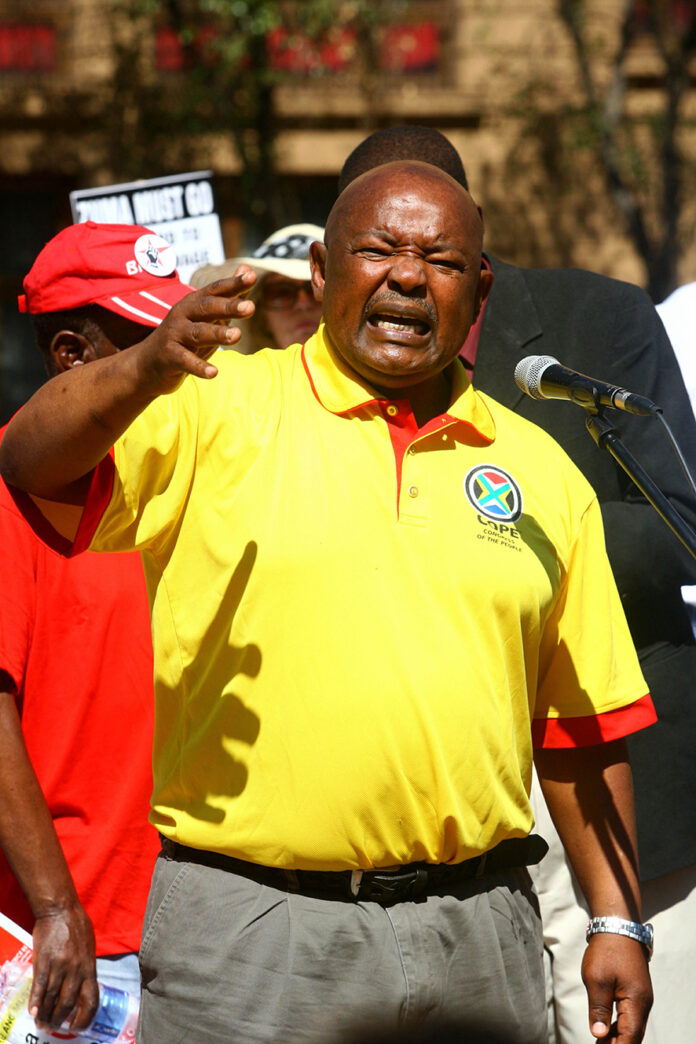
Years later he had served “divorce papers” on the ANC on account of the election of Jacob Zuma as president at the 2007 Conference. Lekota was convinced that the election of Zuma, while popular within the ANC, was in fact the undoing of the ANC. He invited me to speak at the
Convention in Sandton that was called to assess a future political strategy.
He was very anxious that a truly South African, non-racial party be set up, centrist in character but reaching out to as many of the people of the country as possible. His love for South Africa transcended all boundaries of language, culture, and religion. He was a man-of-all-seasons.
With Mbhazima Shilowa, they gave hope to the people about reclaiming the mantle of the ANC and avoid the mistakes of the governing party. Cope failed in that it became overconfident, and did not strategise the revolutionary identity it sought for itself.
Lekota remained in the leadership of a crumbling party, and clearly in the leadership stakes he failed. But Lekota must be remembered as a great South African patriot.
- Pityana is chairperson of the board of the National Lotteries Commission and a former president and secretary general of the South African Students’ Organisation (1970-1973).


