


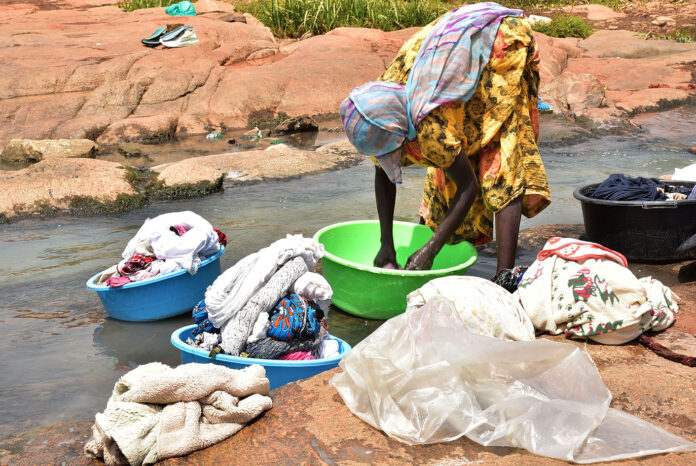
Women’s Day celebrates women’s resilience. It is not enough. We need to do more than praise resilience; we need to make a difference in women’s lives by changing gender norms, especially those around care.
Every day in South Africa, millions of women get children ready for school, plan how to feed their family, think of whose birthday it is, who needs to receive what medication, mediate household needs and moods, navigate unreliable transport to get children to school and still get themselves to work on time, worry about their children’s safety, help with homework, ensure there are clean clothes for the next day. The list goes on. Much of this care labour remains invisible, unpaid and undervalued. It is simply expected that women will do this work.
Unpaid care labour is essential infrastructure in sustaining society. Families, workplaces, and economies depend on it. Without it, children cannot live or learn, organisations cannot function, and communities cannot thrive. Yet, care is treated as insignificant, a private family responsibility that is disproportionately delegated to women.
The problem is not that women care more, it is that society teaches them from an early age that caring is women’s work. The media uses women in appliance adverts, schools imagine the contact parent to be the mother or other female guardian. In this way, boys are excused from caring responsibilities while girls are encouraged and praised for taking on caregiving at an early age. This gives rise to what we call The Motherload – the disproportionate and unfair gendering of the burden of care.
The Motherload, a University of Cape Town-led project, which works collaboratively with low-income mothers and fathers and with government and community partners, seeks to find ways to recognise and reduce women’s care work, transform gender policy and create care economies. The project is funded by IDRC as part of their Scaling Care Innovations initiative. Our research shows that care work is mainly absorbed by women, particularly low-income mothers, and has significant costs to their economic security, safety and wellbeing.
Fathers in our project recognised the disparities in care work but initially attributed it to biology. Later, they began to see how men could play a role in reducing the burden. Reflecting on their early childhoods and how they came to imagine care work as women’s work, they began to recognise the role of social norms in distributing care.
They also realised how much they enjoyed caring and began to reshape their own roles to be more active in care. Their recollections and the appreciation of invisible care work contributed to their insistence that addressing unpaid care work requires shifting gender norms at an early age and should be part of school curriculum in life orientation.
The Motherload project took the fathers’ call to focus on young people seriously. We partnered with the School of Hard Knocks (SoHK), an NGO that works to strengthen emotional well-being through sport, play and mentorship, and which rolls out programmes to support over 1 000 learners. The Motherload research team worked with SoHK coaches to co-create life orientation lessons on care aimed at Grade 7 and 9 learners.
Using innovative participatory methods, we explored what kinds of gender norms shape learners’ lives, and then developed a set of lessons that could help learners recognise the value of care and the problem of its inequitable distribution. The lessons focus on understanding different forms of care, recognising invisible care, understanding how gender norms influence care, imagining a society where everyone cares and thus redistribiting the motherload.
These core ideas have been distilled into lively co-operative lesson plans that will allow children to recognise care as labour, to ask questions about care in a supported environment, to challenge existing stereotypes about who should care and why, and to see care as a general responsibility.
This term, SoHK began rolling out these sessions in six schools in the Western Cape. While it is still early days, the response from learners has been encouraging. Young people engaged enthusiastically in discussions about visible and invisible care, emotional and mental care, and the often-overlooked responsibilities they experience within their own families and communities. These conversations reinforce our belief that young people are not only ready to engage with questions of care, but can play an important role in challenging and reshaping the gender norms that determine who cares and who benefits from that care.
If we are serious about building a more gender-equal future, we need to start early – teaching the next generation that care is not women’s work, but all of society’s work.
• Jaga is Professor of Organisational Psychology and Commerce Faculty’s Deputy Dean of Transformation and Inclusion at the University of Cape Town. She leads The Motherload Project.
• Ross is Professor of Anthropology at the University of Cape Town and is a co-lead of The Motherload Project.
• Rolfe is CEO of School of Hard Knocks South Africa
- Women’s Day celebrates women’s resilience.
- It is not enough.
- We need to do more than praise resilience; we need to make a difference in women’s lives by changing gender norms, especially those around care.
- Every day in South Africa, millions of women get children ready for school, plan how to feed their family, think of whose birthday it is, who needs to receive what medication, mediate household needs and moods, navigate unreliable transport to get children to school and still get themselves to work on time, worry about their children’s safety, help with homework, ensure there are clean clothes for the next day.
- The list goes on.


