


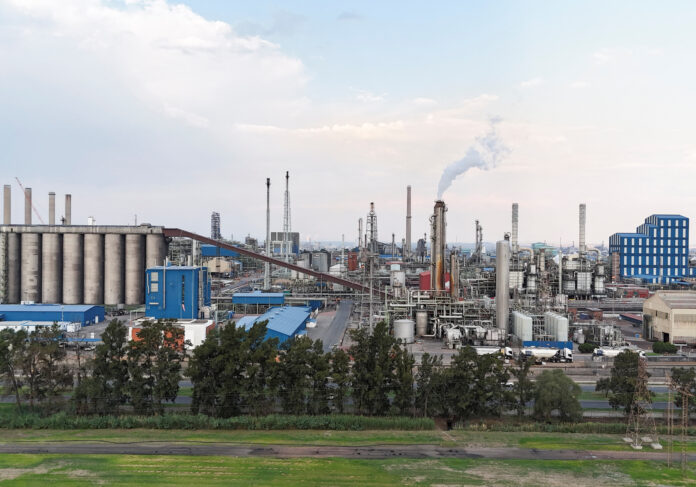
Petrochemical company Sasol has received certification from a German agency for its sustainable aviation fuel (SAF), paving the way for it to start exports to the European Union, a senior company executive said on Thursday.
Sasol’s SAF which is produced using cooking oil and vegetable oil at the company’s 108,500-barrel-per-day Natref plant, was granted ISCC Plus sustainability certification from Germany’s TUV SUD agency. The agency also certified sustainable chemicals produced at Sasol’s sister Secunda complex, Sasol said.
“South Africa has a lot of used cooking oil, which is being collected, taken to Durban, and exported to Rotterdam in the EU and they make it (SAF) there,” Sarushen Pillay, Sasol’s executive VP of strategy and technology, told Reuters. “Now, we will be able to make it in South Africa,” he said.
He did not say when Sasol hoped to start exports to the EU, which mandates a SAF blending ratio of 6% for planes using European airports by 2030 before rising to 70% by 2050.
The U.S.-Israeli war with Iran has severely crimped jet fuel supplies globally, with the EU among the worst hit regions as skyrocketing prices and dwindling stocks hit airlines ahead of a potentially catastrophic summer tourism season.
Depending on customer demand, Natref, which is converting into a hybrid bio-refinery, is targeting one to two million litres this year, around 16 million in 2027 and up to 100 million litres by 2030 as Sasol aims to reduce its carbon footprint and readies for new cleaner fuel specifications.
“If we include Secunda then we are looking at 200 million litres of SAF by 2030,” Pillay said.
Sasol, one of Africa’s worst industrial polluters, has also partnered with Anglo American and De Beers to use plants such as Solaris crops, which have high oil yield, to develop a biolipid feedstock for its overall SAF production portfolio.
EU a tough market
According to WWF research, South Africa has the potential to produce between 3.2 and 4.5 billion litres of SAF annually, mainly using alien plant vegetation as feedstock.
“This is for them a first step,” James Reeler, WWF climate specialist, said of Sasol. “Essentially what Sasol is trying to do here is test the waters to see what price differential they can get for this product and so its very important for them in this respect.”
However, he said the EU remained a tough market for Sasol’s proposed synthetic aviation fuel, or eSAF, because it was difficult to track and certify molecules as renewable at their highly-integrated Secunda plant.
According to a May 2025 ICAO study seen by Reuters, eight of the top 10 SAF users globally, including British Airways owner IAG and Air France KLM, have a foothold in South Africa.
“An opportunity (exists) for these (airlines) to diversify their SAF supply with SAF from South Africa provided it is cost-competitive against other SAF in the world,” the study said.
($1 = 16.5539 rand)
- Sasol received ISCC Plus sustainability certification from Germany’s TUV SUD for its sustainable aviation fuel (SAF), enabling exports to the EU.
- The SAF is produced at Sasol’s Natref plant in South Africa using cooking oil and vegetable oil, with plans to expand production to 1-2 million liters in 2024 and up to 100 million liters by 2030.
- Sasol aims to produce a combined total of 200 million liters of SAF annually by 2030, including output from its Secunda complex, as part of its carbon reduction strategy.
- South Africa has significant SAF potential (3.2 to 4.5 billion liters annually), but the EU market remains challenging due to strict certification and tracking requirements for renewable fuels.
- The global SAF market is growing, with major airlines operating in South Africa showing interest, provided Sasol offers cost-competitive products amidst fuel supply disruptions linked to geopolitical conflicts.


