


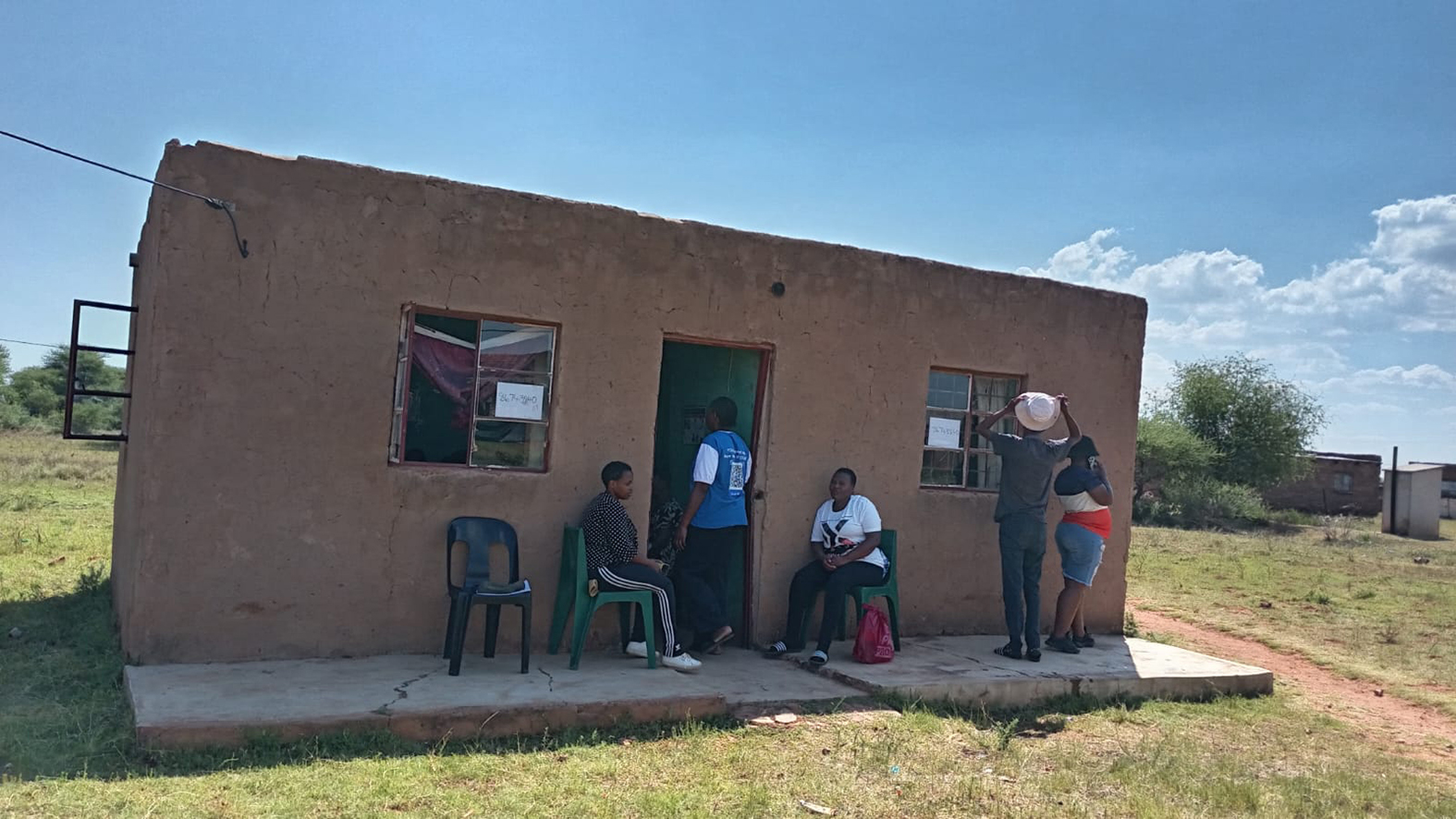
The image of a two-room voting station in this story raises the most uncomfortable question: Are the politicians asking the voters to believe in a future that the voters’ immediate surroundings may give them little reason to believe in?
That tension is not necessarily about dishonesty. A politician may sincerely intend to improve people’s lives. It is about the distance between a political promise and the material circumstances in which that promise must compete for credibility.
Tight squeeze and soaring heat
This was a voting station on Wednesday in Greater Taung in North West. Party agents complained that they could not monitor compliance with voting rules because the space was squeezed. Temperatures in Taung on the day hit 21ºC by 7am, when the voting stations opened, and rose to 38ºC by 4pm.
For the reader’s benefit, the two-room RDP-sized building has brown plastered walls that are cracked and scarred. The flat roof has no ceiling-high grandeur – only a rough, uneven edge. Two small windows, their frames worn and chipped, flank a narrow doorway. A handwritten voting district number, scribbled on ordinary lined paper, is displayed behind one of the windowpanes.
There is little about the building to announce the importance of what is taking place inside. Locals say it is an abandoned spot where nyaopes hang out all day for a puff.
The electoral authorities might look at this station and see an achievement. They could argue that they brought the election to people who might otherwise have to travel considerable distances to vote.
A voting station does not have to be beautiful. It has to be accessible, secure and capable of protecting the secrecy and integrity of the ballot. And that is a legitimate argument.
But that creates a second, deeper question: What does it mean when the machinery of democracy can reach a community, while other forms of government service may be much less visible?
There is an important distinction between the state that organises elections and the state that delivers public services. They have different responsibilities. The photograph nevertheless places those responsibilities in the same frame.
Material comfort at the other end
In contrast, a video circulating on social media shows a voting station at Hoërskool Hans Moore in Ward 27, Ekurhuleni, in Northmead, Benoni. The picture could hardly be more different. Under a bright morning sun, a long, snaking queue of voters stretches along a paved road outside a school enclosed by sturdy metal fencing and gates. Towering, leafy trees provide patches of shade, while neat buildings, maintained grounds and parked cars complete the suburban setting.
The voters are overwhelmingly white, a striking feature of the crowd. Men and women, young adults, middle-aged residents and pensioners stand patiently in line, some chatting in small groups, others checking their phones. Many wear shorts, T-shirts, sandals and comfortable shoes. An elderly person sits on a mobility scooter, while others have brought portable chairs to ease the long wait.
The camera sweeps along the road, revealing more voters standing beside the school fence, their shadows stretching across the tar and paved surfaces. The queue continues through the school gates and across the grounds.
There is no scrambling for space. The voters occupy an expansive, orderly environment, surrounded by the visible infrastructure of an established suburb.
Here, democracy unfolds against a backdrop of relative material comfort.
Cruel irony of democracy
The cruel irony of South Africa’s democracy is that those who benefited from apartheid have, in many respects, gained a lot more post-apartheid.
They entered democracy with property, accumulated wealth, established infrastructure and access to better opportunities. Political liberation did not take those advantages away. Instead, three decades of democracy allowed inherited wealth and property ownership to continue generating economic benefits.
For many historically disadvantaged South Africans, the promised transformation has been painfully slow. That is what makes the contrast between Benoni and Taung so politically revealing.
In Benoni, voting can be an act of preservation. Residents have property values, neighbourhood infrastructure and established living standards they want protected. They have tangible reasons to care deeply about who governs them.
In Taung, voting may be an act of hope. But hope becomes increasingly difficult to sustain when the physical environment in which people cast their ballots resembles the deprivation they have been voting to escape for 32 years.
Why should a citizen remain excited about an election when the evidence of previous elections offers so little encouragement?
Voter apathy is the accumulated disappointment of citizens who were promised that political freedom would lead to economic and social freedom.
- A two-room voting station in Greater Taung, North West, was cramped and temperatures rose from 21ºC at 7am to 38ºC by 4pm on election day.
- The building in Taung is described as a small, cracked plastered structure with worn windows and a handwritten district number, located in an area known for drug users.
- In contrast, a voting station at Hoërskool Hans Moore in Benoni featured a long, orderly queue in a spacious, shaded suburban environment with maintained grounds and infrastructure.
- The article highlights the disparity between post-apartheid communities where historically advantaged voters in places like Benoni have preserved wealth and infrastructure, while communities like Taung face ongoing deprivation.
- Voter apathy is linked to the slow progress in transforming living conditions for historically disadvantaged South Africans despite political liberation over the past 32 years.


