


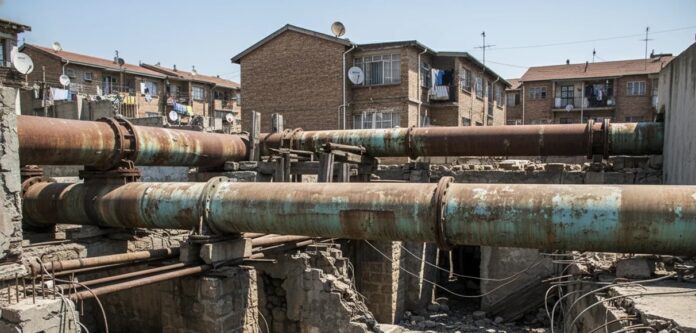
South Africa needs an estimated R400-billion to repair and upgrade its failing water and sanitation infrastructure, a scale of investment that highlights the depth of a crisis threatening basic service delivery, economic activity and public health.
The warning comes from Minister of Water and Sanitation Pemmy Majodina, who says decades of under-investment, poor maintenance, and weak municipal capacity have left much of the country’s water system in a state of advanced deterioration. The bulk of the problem sits at the municipal level, where aging pipes, failing treatment works, and leaking networks are struggling to meet rising demand.
The R400-billion figure reflects a nationwide maintenance and refurbishment backlog, not a single project in a single province, according to the department. It includes repairs to bulk water pipelines, wastewater treatment plants, reservoirs, and reticulation systems that are essential to deliver potable water.
Against this financial need, government funding remains sharply constrained. Only R26-billion has been allocated to the water sector in the 2025/26 financial year, which is a fraction of what is required to stabilise and modernise infrastructure. The gap has raised concerns that systems already rated as “poor” or “critical” could deteriorate further without urgent intervention.
Official Blue Drop and Green Drop assessments for 2024/2025 show that approximately 75% of water services authorities are operating infrastructure that fails to meet acceptable standards.
Many systems were built decades ago and have not received routine maintenance, leading to frequent pipe bursts, pump failures, and treatment breakdowns. Majodina warned in December last year that some networks were approaching “system collapse” unless consumption is managed and infrastructure repairs accelerated.
High levels of non-revenue water (water lost through leaks, theft or poor billing) continue to drain municipal finances. The latest Blue Drop assessments by the Department of Water and Sanitation (DWS) show that 47% of municipal water in South Africa is classified as non-revenue water, compared with an international average of 30%, meaning nearly half of the treated supply never generates revenue for upkeep and repairs.
Rapid urbanisation growth has added further pressure to networks that were never designed to serve today’s volumes.
In response to immediate risks, the DWS has implemented soft water restrictions, operational load-shifting between supply systems, and emergency interventions such as tanker deliveries in hard-hit areas.
While these measures help avert total shutdowns, Majodina says these are short-term solutions that do not address the underlying infrastructure decay.
Majodina has called on the private sector, particularly mining companies, to partner with the government and municipalities on infrastructure projects.
Mining operations are among the largest water users and, in some regions, already co-fund pipelines and treatment upgrades that serve both industry and communities.
The water crisis has become a growing political flashpoint, fuelling service-delivery protests and public frustration.
In the State of the Nation Address on Thursday, President Cyril Ramaphosa acknowledged water shortages as one of the country’s most pressing challenges, alongside crime and infrastructure failure, signalling that stabilising basic
services is a national priority. – ESG Now
- South Africa needs an estimated R400-billion to repair and upgrade its failing water and sanitation infrastructure, a scale of investment that highlights the depth of a crisis threatening basic service delivery, economic activity and public health.
- The warning comes from Minister of Water and Sanitation Pemmy Majodina, who says decades of under-investment, poor maintenance, and weak municipal capacity have left much of the country’s water system in a state of advanced deterioration.
- The bulk of the problem sits at the municipal level, where aging pipes, failing treatment works, and leaking networks are struggling to meet rising demand.
- The R400-billion figure reflects a nationwide maintenance and refurbishment backlog, not a single project in a single province, according to the department.
- It includes repairs to bulk water pipelines, wastewater treatment plants, reservoirs, and reticulation systems that are essential to deliver potable water.


