


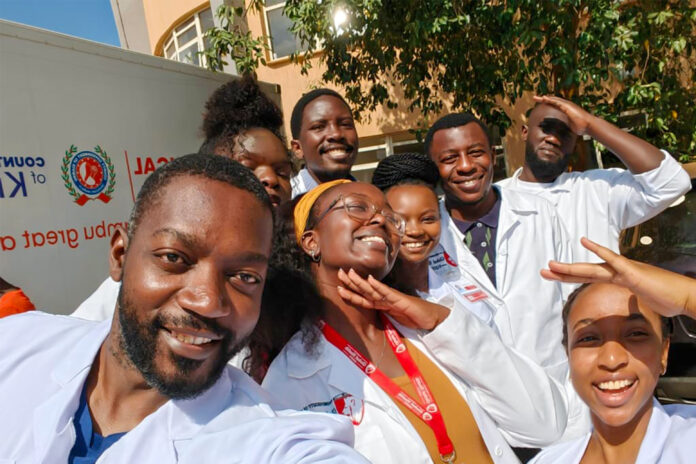
When healthcare engineer Lisa Mutheu joined the East Africa Biodesign fellowship, she anticipated a year of clinical rotations, design challenges, and long hours spent shaping early-stage medical concepts.
Instead, she encountered a quieter but urgent emergency unfolding in neonatal wards across the continent.
“There’s a problem with oxygen delivery to mostly preterm babies in Africa. If they’re given too much oxygen, they end up getting blind.
If they don’t get enough, they end up dying. And there’s not enough being done around this,” she told Bird in an interview.
The fellowship is a 10-month program that brings together Kenya’s Kenyatta University, the University of Global Health Equity, the University of Rwanda, and Stanford’s Byers Center for Biodesign.
Participants are immersed in hospital environments across East Africa to understand gaps in patient care and develop technologies that fit local realities.
More kids develop blindness
Mutheu, a trained control systems engineer specializing in control and instrumentation, is part of a team now spinning out of the fellowship to develop a locally designed oxygen regulation solution that can help nurses and clinicians keep oxygen levels within safe limits.
The practicing biomedical engineer and medtech innovator holds a degree from Jomo Kenyatta University of Agriculture and Technology.
She works alongside her teammate, Joan Aluoch Melissa, a trained geospatial engineer who has transitioned into clinical engineering.
Melissa earned a Bachelor of Science in Geospatial Engineering and Space Technology from the University of Nairobi and a Clinical Engineering certification from Materialise Mimics in Belgium.
After months of observing nurses and neonatologists, the two found that while more premature babies across the continent are surviving, many facilities still lack the equipment needed to deliver oxygen safely.
“We’re having a lot more children developing blindness or neurodevelopmental disorders later in life. Very few hospitals actually screen for retinopathy of prematurity, so it ends up being missed,” she explained.
Retinopathy of Prematurity (ROP) is an eye disease that affects premature babies, where abnormal blood vessels grow in the retina and can lead to vision impairment and blindness if not treated.
Unregulated oxygen crisis
As neonatal units across Kenya and the wider continent rapidly expand access to oxygen, a critical tool for keeping extremely premature babies alive, Mutheu and her partner see the ‘unregulated oxygen’ crisis as urgent and growing.
“If it is not being given well, it ends up being a bad thing. It’s a problem right now, and it’s going to be an even bigger problem in the future if we don’t do something about it,” explained Mutheu.
The team has spent months validating the problem in Kenyan hospitals and gathering insights from nurses and neonatologists about daily challenges in managing oxygen safely.
Currently, validation of the problem is ongoing in Rwanda.
They now want to start creating a practical and affordable oxygen regulation solution that will ensure that more premature babies survive without preventable disability.
“We’re just starting with prototyping. We have our concepts; now we want to start building the solution,” said Mutheu.
Although the device is designed with preterm infants in mind, she believes the technology could eventually support adult care as well.
A recent population-based study has found that as more premature babies survive in South Africa, cases of ROP may be rising.
The research tracking 378 premature infants across five public hospitals in Cape Town found that nearly half of babies weighing under one kilogram developed ROP.
Prematurity key risk factor
By contrast, only about a quarter of those weighing more than one kilogram showed signs of the disease.
Babies with extremely low birth weight were the most vulnerable, with the risk increasing for every 100 grams lost.
On average, the infants weighed just 883 grams at birth, and three in every ten screened were diagnosed with ROP.
“This study confirmed that prematurity, especially birth weight, is a key risk factor for developing ROP in South African preterm infants.
It also demonstrated the increased risk of ROP in extremely low birth weight infants,” the study, published in the United States National Library of Medicine in July 2025, noted.
All five units use blended oxygen and maintain target oxygen saturation between 90% and 95%, as per World Health Organization guidelines.
The research led by the University of the Western Cape, the South African Medical Research Council, the University of Cape Town, and Stellenbosch University analyzed data from the Retinopathy of Prematurity South African register, which collects information on infants screened for ROP in five public neonatal units from May 1, 2022, to January 31, 2023.
Managing oxygen safely
Similar patterns have been observed in Botswana, where 54.5% of infants weighing 1 000 grams or less developed ROP; in Ethiopia, where 85.7% of infants under 1 000 grams developed the condition; and in Uganda, where babies under 1 500 grams were 90% more likely to develop ROP than those weighing more.
The World Health Organisation’s standards of care for small and sick newborns recommend the use of blended oxygen, pulse oximeters, and continuous positive airway pressure to manage oxygen safely in preterm infants.
According to the publication, oxygen therapy in most parts of Africa is often poorly managed.
A 2022 survey of 49 African countries found that only 49% had target oxygen saturation protocols, 33% reported available pulse oximeters, and 63% had continuous positive airway pressure.
The survey listed in the study also found that only 12% of intensive care units met a nurse-to-patient ratio of one to three.
- When healthcare engineer Lisa Mutheu joined the East Africa Biodesign fellowship, she anticipated a year of clinical rotations, design challenges, and long hours spent shaping early-stage medical concepts.
- Instead, she encountered a quieter but urgent emergency unfolding in neonatal wards across the continent.
- “There’s a problem with oxygen delivery to mostly preterm babies in Africa.
- If they’re given too much oxygen, they end up getting blind.
- If they don’t get enough, they end up dying.


