


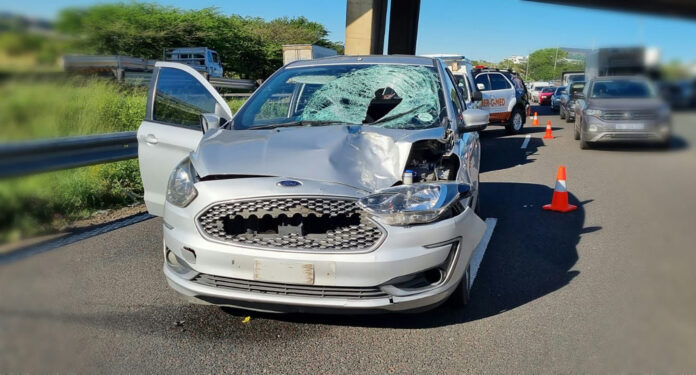
Every day, more than 3 000 people leave home somewhere in the world and never return because of a road crash. For many, that final journey is not a long-distance trip but an ordinary walk to school, work, public transport or the local shops.
Approximately 1.16 million people die on the world’s roads every year, yet we continue to think of road safety primarily as a transport issue rather than one of the world’s largest preventable public health failures.
That distinction matters.
The latest figures released by the World Health Organisation (WHO), showing a 21% decline in global road traffic deaths between 2011 and 2025, deserve to be celebrated. They demonstrate that safer roads, stronger legislation and evidence-based policies save lives.
But they also expose an uncomfortable truth: while much of the world is making steady progress, Africa is moving in the opposite direction.
If we are serious about preventing injury and saving lives, road safety can no longer sit on the margins of public health discussions. It belongs at their centre.
It also belongs at the centre of everyday conversations because road safety is fundamentally local. Nearly half (45%) of all road fatalities in South Africa are pedestrians – one of the highest proportions in the world, according to the Road Traffic Management Corporation’s 2025 State of Road Safety Report.
International studies consistently show that many pedestrians are struck close to home while carrying out ordinary daily activities, such as walking to school, work or public transport.
Progress is possible, but not guaranteed
The WHO’s latest report offers genuine reasons for optimism. Road traffic deaths have declined globally despite increasing populations, growing urbanisation and rising numbers of vehicles.
But global averages can conceal profound inequalities. Road traffic crashes still claimed an estimated 1.16 million lives in 2025, making road traffic injuries the leading cause of death among children and young people aged 5-29 years.
Millions more survive with life-changing injuries that place enormous strain on families, healthcare systems and national economies.
Perhaps the most sobering finding is that progress has not been shared equally. While the WHO European Region achieved a 36% reduction in road traffic deaths between 2011 and 2025, the WHO African Region experienced a 17% increase over the same period.
This is not simply evidence that Africa is falling behind. It represents hundreds of thousands of families experiencing tragedies that countries elsewhere have increasingly learned to prevent.
The gap is no longer about knowing what works. It is about implementing what works. South Africa has the evidence. What it lacks is consistent implementation.
The Road Traffic Management Corporation was established to coordinate South Africa’s fragmented road traffic system, strengthen enforcement, generate the evidence needed for action and lead a national effort to make roads safer. Yet the environments in which most pedestrians are injured or killed are ultimately shaped by municipalities, through street design, lighting, sidewalks, safe crossings, speed management and local enforcement. This is where road safety becomes a community health issue rather than simply a transport issue.
Every year that proven interventions are delayed, more South Africans lose their lives unnecessarily. In public health, delayed implementation is measured not in months, but in lives lost.
Roads reflect public health choices
One of the biggest mistakes we continue to make is treating road safety as solely a transport issue.
Every road crash extends far beyond the collision itself. It fills emergency departments, stretches trauma services, increases long-term disability, affects mental health, disrupts households and removes productive members from the workforce. The consequences ripple through families, communities and entire economies.
Road safety is therefore inseparable from public health.
Public health is not produced by health departments alone. It is produced by every decision that shapes the environments in which people live, travel and work.
Road safety also intersects directly with sustainable development. Safer roads encourage walking, cycling and public transport, contributing to healthier populations, cleaner air and more liveable cities. Unsafe transport systems discourage active mobility and disproportionately affect pedestrians, cyclists and motorcyclists, who remain among the world’s most vulnerable road users.
Protecting lives on our roads is therefore about far more than reducing crashes. It is about creating healthier, safer and more equitable societies.
Designing systems that expect human error
For decades, road safety campaigns focused primarily on changing individual behaviour. Education remains important, but education alone cannot eliminate road deaths.
The Safe System approach, reaffirmed in the recently adopted Political Declaration on Improving Global Road Safety by the United Nations General Assembly, fundamentally changed this way of thinking.
Rather than asking why people make mistakes, it asks why our transport systems allow ordinary human mistakes to become fatal events.
People will always make errors. They will become distracted, misjudge distances or make poor decisions. The responsibility therefore extends far beyond individual road users. Governments, engineers, urban planners, vehicle manufacturers, law enforcement agencies, healthcare providers and communities all share responsibility for designing transport systems that ensure inevitable human mistakes do not become preventable deaths.
This means safer roads, safer vehicles, appropriate speed management, stronger legislation, greater use of helmets and seatbelts, better protection for vulnerable road users and effective post-crash trauma care.
The evidence is compelling: countries that adopt comprehensive Safe System approaches save lives.
Africa cannot afford to fall further behind
Africa is urbanising rapidly. Cities are expanding, motorcycle use is increasing and transport systems are evolving faster than supporting infrastructure in many parts of the continent.
These changes create both opportunity and risk. As mobility continues to evolve through ride-hailing services, delivery platforms and emerging technologies, safety must keep pace with innovation. Failing to do so will place even greater pressure on already overstretched health systems while widening existing social inequalities.
Road traffic injuries are not an inevitable consequence of development. They are preventable outcomes that reflect policy choices.
Every road fatality begins long before the collision. It begins in the policy decisions that shaped the road, the vehicle and the systems surrounding it.
This is why road safety demands collective responsibility.
Governments cannot solve this challenge alone. Neither can transport departments, health ministries or law enforcement agencies acting in isolation.
This whole-of-society philosophy is increasingly shaping international thinking on road safety, including discussions that will take place at the Safety 2026 – The 16th World Conference on Injury Prevention and Safety Promotion co-organised with the World Health Organization in Cape Town from September 1 to 4 this year. The focus is no longer simply on understanding why crashes occur, but on ensuring that proven solutions are implemented.
• Dr Wolvaardt is the founder of the Foundation for Professional Development, and has recently stepped down as managing director.
• Seoka is a journalism intern at FPD
- Every day, more than 3 000 people leave home somewhere in the world and never return because of a road crash.
- For many, that final journey is not a long-distance trip but an ordinary walk to school, work, public transport or the local shops.
- Approximately 1.16 million people die on the world’s roads every year, yet we continue to think of road safety primarily as a transport issue rather than one of the world’s largest preventable public health failures.
- That distinction matters.
- The latest figures released by the World Health Organisation (WHO), showing a 21% decline in global road traffic deaths between 2011 and 2025, deserve to be celebrated.


