


Twenty years ago, an HIV-positive diagnosis was widely feared as a death sentence. Today, medicine has transformed that prognosis while prevention is increasingly putting another powerful weapon into people’s hands: choice.
A major South African programme has now offered fresh evidence of what can happen when young women are given practical tools and support to take charge of their sexual health.
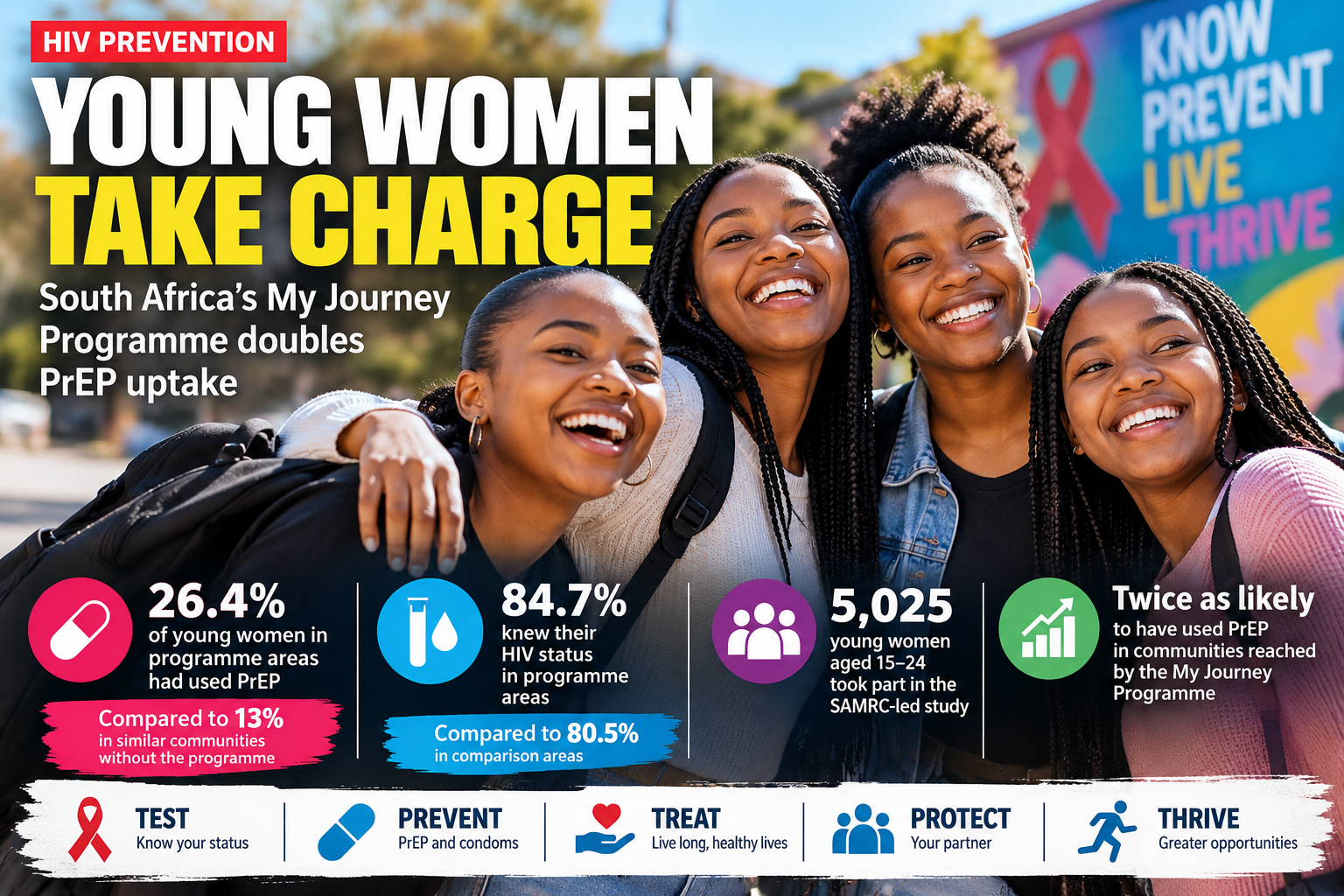
Research led by the South African Medical Research Council (SAMRC) and published in The Lancet Regional Health – Africa found that young women in communities reached by the My Journey Programme were twice as likely to have used HIV pre-exposure prophylaxis (PrEP) as those in comparable communities where it was not implemented.
The HERStory 3 study surveyed 5,025 adolescent girls and young women aged between 15 and 24 across 24 subdistricts in eight provinces. Participation exceeded 97%, while researchers determined participants’ HIV status through laboratory testing.
Prevention becomes personal
Researchers found that 26.4% of young women in programme areas had used PrEP, compared with just 13% in comparison areas.
Knowledge of HIV status was also higher, at 84.7% compared with 80.5%. However, HIV prevalence was 9.5% in programme communities and 10.4% in comparison areas, a difference researchers found was not statistically significant.
Lead author and SAMRC Health Systems Research Unit principal investigator, Dr Kim Jonas, said the results showed the difference that access could make.
“Where the My Journey Programme was implemented, twice as many young women had used PrEP and more knew their HIV status,” Jonas said. “These findings show that young women are willing to use effective HIV prevention tools when they are accessible.”
The findings come against a formidable global backdrop.
According to UNAIDS estimates, 41-million people were living with HIV worldwide in 2025, with 32.1-million accessing antiretroviral treatment. About 1.2-million people acquired HIV during the year and 570,000 died from Aids-related illnesses.
Yet the transformation over two decades has been dramatic. Aids-related deaths have fallen by 73% from their 2004 peak.
READ MORE: SADC region continues to lead globally in HIV response
Young women remain vulnerable
The gains have not eliminated the danger, particularly for young South African women.
UNAIDS said in June 2025 that adolescent girls and young women aged between 15 and 24 accounted for an estimated third of new HIV infections in South Africa, equivalent to about 1,057 infections each week.
The My Journey findings also reveal the challenge of turning initial uptake into sustained prevention.
Among sexually active young women living without HIV, 22.2% in programme areas had previously used PrEP. But only 7.1% reported using it at the time of the survey.
“Initiating PrEP is only part of the prevention journey,” Jonas said.
“The next challenge is ensuring that young women can continue using prevention methods that best fit their lives, including long-acting options delivered through youth-friendly services.”
That challenge comes as new prevention technologies expand the choices available to women, including lenacapavir, a long-acting injectable PrEP administered twice a year.
READ MORE: Six-monthly anti-HIV jab could be in 360 clinics by February 2026
Funded by the Global Fund to Fight AIDS, Tuberculosis and Malaria since 2016, My Journey combines HIV testing, condoms and PrEP with prevention education, life skills, school-retention initiatives and economic-strengthening support delivered through schools and community Safe Spaces.
SAMRC chief scientific officer Prof Glenda Gray said medical interventions alone could not address all the forces that leave young women vulnerable.
“We need stronger integration of economic empowerment and structural interventions within prevention programmes if we are to make meaningful in-roads into addressing the underlying drivers of HIV vulnerability, including poverty, educational disruption and unequal gender relations,” Gray said.
That is where the findings also speak beyond government and the health sector.
For companies, foundations and other potential sponsors, programmes such as My Journey demonstrate what sustained investment can place in a young person’s hands: knowledge, prevention and greater agency over their health.
HIV has not disappeared, and neither has the danger.
But the journey from fear to treatment, and increasingly from vulnerability to prevention, shows what becomes possible when scientific advances are matched by access, personal responsibility and sustained investment.
Knowing your status, protecting your partner, accessing treatment or prevention and caring for your body can turn fear into informed action.
- The My Journey Programme in South Africa led to twice as many young women using HIV pre-exposure prophylaxis (PrEP) compared to similar communities without the programme.
- The HERStory 3 study surveyed 5,025 girls and women aged 15-24 and found 26.4% in programme areas had used PrEP, versus 13% in comparison areas.
- The study showed higher knowledge of HIV status in programme areas (84.7%) compared to non-programme areas (80.5%), but no significant difference in HIV prevalence.
- Sustained use of PrEP remains a challenge, with only 7.1% of sexually active young women currently using it despite 22.2% having previously used it.
- The My Journey Programme integrates HIV testing, condoms, PrEP, prevention education, life skills, school retention, and economic support, funded by the Global Fund to Fight AIDS, Tuberculosis and Malaria since 2016.


