


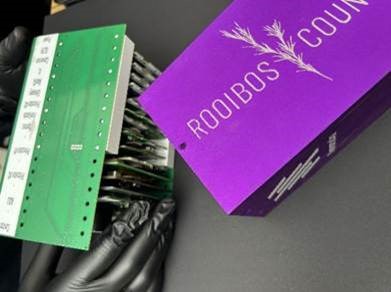
South Africa’s rooibos seeds have received NASA approval for flight, bringing a homegrown space research project closer to its planned journey to the International Space Station (ISS).
A total of 17,346 rooibos seeds, weighing approximately 74.2g, are expected to leave for the United States within the next week, where preparations will continue ahead of their proposed launch aboard the Cygnus NG-25 commercial resupply mission.
Judi Sandrock, co-founder of MaxIQ Space, confirmed through the project team that the seeds have already been packed into their containers and approved by NASA for flight.
The remaining checks concern electronic components in other school and university experiments travelling as part of the wider payload.
According to Sandrock, NASA needs to assess these components to ensure they meet the space agency’s safety requirements, including restrictions on attempts to communicate through technologies such as Wi-Fi and Bluetooth.
MaxIQ Space has been engaging with NASA for the past 18 months to ensure the experiments meet the necessary safety standards.
Once the code for the other experiments receives final approval, the Nanolab carrying the research will be transported to the US. This is expected to happen soon.
Why are rooibos seeds going to space?
The rooibos experiment is part of an initiative conceived by the South African Rooibos Council (SARC) and developed in collaboration with MaxIQ Space.
The seeds are scheduled to travel to the ISS aboard the Cygnus NG-25 mission, currently planned for December 2026 or January 2027.
The launch was initially expected to take place in October but was rescheduled following changes to the Voyager and NASA flight schedules, including adjustments to crew and resupply arrangements.
The project team cautions that the new launch window is not guaranteed, as space missions can be affected by technical and operational changes.
Once aboard the ISS, the seeds are expected to spend between four and six weeks exposed to microgravity and space radiation before returning to Earth for further research.
The experiment aims to investigate whether these conditions affect the seeds’ germination, growth, resilience and eventual yield.
Three seed groups will be tested
The 17,346 seeds have been divided into three groups to help researchers compare how different treatments respond to the conditions of space.
The first group consists of untreated seeds, which have been left in their natural state.
The second group has undergone scarification, a process in which the outer seed coat is lightly scratched to help water and air penetrate and support germination.
The third group has also been scarified but receives an additional protective agricultural coating, which is intended to guard against soil-borne diseases and pests when the seeds are planted.
For each group sent into space, a matching control batch will remain on Earth. This will allow researchers to compare the space-exposed seeds with those that have not experienced microgravity and space radiation.
The comparison will help researchers investigate whether exposure to space conditions makes a measurable difference to how the seeds develop.
ALSO READ: Rooibos’ curious mission to space a boost for STEM education
The research will continue in South Africa after the seeds return from the ISS. Schools in the Cederberg region, where rooibos naturally grows, and Parklands College will participate in planting the space-exposed seeds alongside their Earth-based control batches.
Over 18 months, learners and researchers will monitor germination, growth patterns and plant development.
The project also aims to give learners practical experience in science, technology, engineering and mathematics (STEM), connecting classroom learning with a real research experiment.
Dawie de Villiers, director of the South African Rooibos Council, previously described the mission as an opportunity to learn more about the indigenous plant.
“The scientific objective is to explore what will happen to the rooibos seeds when they are exposed to conditions beyond Earth, opening up new opportunities to learn more about this uniquely South African plant,” he said.
For rooibos seed technician Cyril Ngqwala, preparing the seeds has brought together traditional seed knowledge and space research.
“Working with the seeds from preparation through to assembling the Nanolab has been an incredible experience,” he said.
The project is set to mark the first time seeds from a South African indigenous plant have been sent into space for this type of research.
ALSO READ: Rooibos reaches for the stars in trip to International Space Station
- A total of 17,346 South African rooibos seeds weighing approximately 74.2g have been approved by NASA for flight to the International Space Station (ISS) aboard the Cygnus NG-25 mission, planned for December 2026 or January 2027.
- The seeds will be divided into three groups: untreated, scarified, and scarified with an additional protective agricultural coating, with matching control batches remaining on Earth for comparison.
- After spending four to six weeks in space exposed to microgravity and radiation, the seeds will return to Earth for further germination and growth research involving schools in the Cederberg region and Parklands College.
- NASA's approval process included checking electronic components of other school and university experiments to meet safety requirements, such as restrictions on Wi-Fi and Bluetooth communication attempts.
- The project, developed by the South African Rooibos Council and MaxIQ Space, aims to combine indigenous plant knowledge with space research and provide practical STEM experience to learners over an 18-month period after the seeds return.
South Africa’s rooibos seeds have received NASA approval for flight, bringing a homegrown space research project closer to its planned journey to the International Space Station (ISS).
A total of 17,346 rooibos seeds, weighing approximately 74.2g, are expected to leave for the United States within the next week, where preparations will continue ahead of their proposed launch aboard the Cygnus NG-25 commercial resupply mission.
Judi Sandrock, co-founder of MaxIQ Space, confirmed through the project team that the seeds have already been packed into their containers and approved by NASA for flight.
The remaining checks concern electronic components in other school and university experiments travelling as part of the wider payload.
According to Sandrock, NASA needs to assess these components to ensure they meet the space agency’s safety requirements, including restrictions on attempts to communicate through technologies such as Wi-Fi and Bluetooth.
MaxIQ Space has been engaging with NASA for the past 18 months to ensure the experiments meet the necessary safety standards.
Once the code for the other experiments receives final approval, the Nanolab carrying the research will be transported to the US. This is expected to happen soon.
The rooibos experiment is part of an initiative conceived by the South African Rooibos Council (SARC) and developed in collaboration with MaxIQ Space.
The seeds are scheduled to travel to the ISS aboard the Cygnus NG-25 mission, currently planned for December 2026 or January 2027.
The launch was initially expected to take place in October but was rescheduled following changes to the Voyager and NASA flight schedules, including adjustments to crew and resupply arrangements.
The project team cautions that the new launch window is not guaranteed, as space missions can be affected by technical and operational changes.
Once aboard the ISS, the seeds are expected to spend between four and six weeks exposed to microgravity and space radiation before returning to Earth for further research.
The experiment aims to investigate whether these conditions affect the seeds’ germination, growth, resilience and eventual yield.
The 17,346 seeds have been divided into three groups to help researchers compare how different treatments respond to the conditions of space.
The first group consists of untreated seeds, which have been left in their natural state.
The second group has undergone scarification, a process in which the outer seed coat is lightly scratched to help water and air penetrate and support germination.
The third group has also been scarified but receives an additional protective agricultural coating, which is intended to guard against soil-borne diseases and pests when the seeds are planted.
For each group sent into space, a matching control batch will remain on Earth. This will allow researchers to compare the space-exposed seeds with those that have not experienced microgravity and space radiation.
The comparison will help researchers investigate whether exposure to space conditions makes a measurable difference to how the seeds develop.
ALSO READ: Rooibos’ curious mission to space a boost for STEM education
The research will continue in South Africa after the seeds return from the ISS. Schools in the Cederberg region, where rooibos naturally grows, and Parklands College will participate in planting the space-exposed seeds alongside their Earth-based control batches.
Over 18 months, learners and researchers will monitor germination, growth patterns and plant development.
The project also aims to give learners practical experience in science, technology, engineering and mathematics (STEM), connecting classroom learning with a real research experiment.
Dawie de Villiers, director of the South African Rooibos Council, previously described the mission as an opportunity to learn more about the indigenous plant.
“The scientific objective is to explore what will happen to the rooibos seeds when they are exposed to conditions beyond Earth, opening up new opportunities to learn more about this uniquely South African plant,” he said.
For rooibos seed technician Cyril Ngqwala, preparing the seeds has brought together traditional seed knowledge and space research.
“Working with the seeds from preparation through to assembling the Nanolab has been an incredible experience,” he said.
The project is set to mark the first time seeds from a South African indigenous plant have been sent into space for this type of research.
ALSO READ: Rooibos reaches for the stars in trip to International Space Station


