


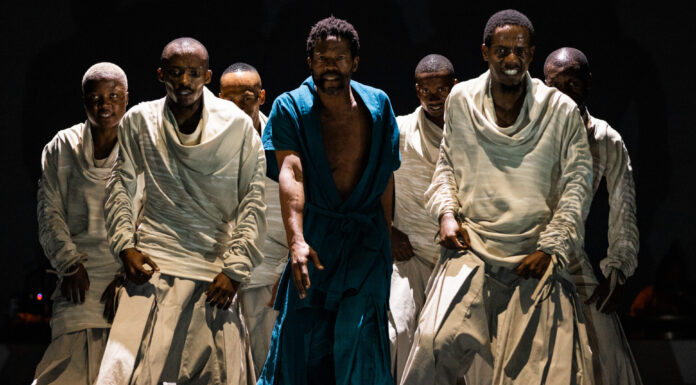
South African choreographer Gregory Maqoma is not interested in easy answers. With his latest production, Genesis: The Beginning and End of Time, the acclaimed artist leans fully into complexity, crafting a work that refuses simplicity in both form and meaning.
In an exclusive interview with Sunday World, Maqoma opened up about the thinking behind what he describes as one of his most expansive works yet.
Described as a “dance opera”, Genesis merges movement, live music and text into a layered theatrical experience. For Maqoma, this was not a stylistic choice but a necessity.
“The story demanded a language that could hold multiple truths at once,” he explained.
“Dance alone was not enough, and neither were music or text on their own.”
In this hybrid form, movement carries what cannot be spoken, while music and text hold emotional and intellectual weight.
The result is a production that reflects what Maqoma calls “the complexity of our existence”.
At the heart of Genesis lies a deeply personal yet universal question: what does it mean to begin again when history lives inside the body?
“We often speak of renewal as if we can simply start over,” he told Sunday World this week. “But we carry everything with us: violence, memory, resistance and hope.”
It’s a theme that resonates in a world grappling with instability. Instead of providing solace, Maqoma questions the notion of a fresh start.
“Starting over is not an erasure. It is a confrontation,” he says.
“We inherit broken systems and unresolved histories. Renewal is about acknowledging that weight and choosing to move through it consciously.”
The production builds on the introspective nature of his earlier works, including Cion and Exit/Exist, but shifts the lens outward.
“Cion was about grief. Exit/Exist was deeply personal, almost a negotiation with self and land,” he reflects.
“Genesis becomes more collective. It asks not just ‘Who am I?’ but ‘Who are we becoming?’”
That evolution is also shaped by the intellectual influence of figures such as Steve Biko, Aimé Césaire and Frantz Fanon, whose ideas echo through the work’s interrogation of identity, history, and liberation.
Collaboration plays a central role in bringing Genesis to life, but Maqoma is clear that leadership does not mean control.
“Clarity comes from intention, not control. My role is to hold the centre, to ensure every contribution speaks to the same heartbeat.”
As with much of his work, the body becomes a living archive on stage.
“Memory lives in the body; it is not abstract.
“The dancers carry histories through gestures, rhythms, and tension. Identity becomes fluid, constantly rewritten,” he explains.
For audiences, Maqoma is less concerned with immediate understanding than with emotional impact.
“I’m interested in what the body understands before the mind catches up,” he says. “If you feel something deeply, the intellectual engagement will follow.”
That emotional urgency is what makes Genesis feel timely. In an era marked by political, social, and spiritual fractures, this work confronts the discomfort of rebuilding.
“It asks how we move forward and whether we are willing to confront what we are rebuilding from,” he says.
After decades at the forefront of contemporary dance, Maqoma admits the biggest challenge is staying honest.
“To remain truthful in a world that demands repetition is difficult,” he says. “The work must continue to evolve beyond expectation.”
With Genesis, that evolution is clear. It marks a shift from proving to listening – to the work, to collaborators, and to the moment itself.
“This is not a conclusion,” he says. “It is an opening.”
- South African choreographer Gregory Maqoma is not interested in easy answers.
- With his latest production, Genesis: The Beginning and End of Time, the acclaimed artist leans fully into complexity, crafting a work that refuses simplicity in both form and meaning.
- In an exclusive interview with Sunday World, Maqoma opened up about the thinking behind what he describes as one of his most expansive works yet.
- Described as a “dance opera”, Genesis merges movement, live music and text into a layered theatrical experience.
- For Maqoma, this was not a stylistic choice but a necessity.


