


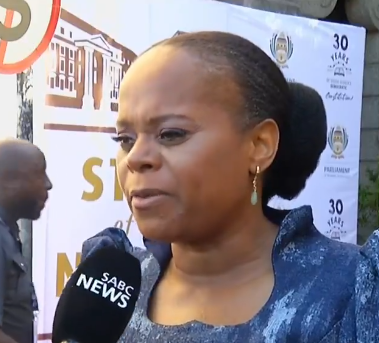
The steps of Cape Town City Hall are once again transformed into a fashion runway of symbolism as South Africa gathers for the 2026 State of the Nation Address (SONA).
While President Cyril Ramaphosa prepares to deliver the speech in the National Assembly, outside the historic venue the conversation is already underway about identity, intention and the power of supporting local.
Hosting the red carpet is media personality Thami Dish, whose sharp eye for style and substance has turned fashion commentary into a deeper economic dialogue.
Proudly South African vibe
And standing firmly behind that message is Proudly South African’s chief marketing officer, Happy Ngidi, who has been vocal about redirecting consumer spending toward local designers and manufacturers.
But it was the arrival of Limpopo Premier, Dr Phophi Ramathuba, that crystallised the moment. Standing beside her on the red carpet, Thami Dish couldn’t help but note the elegance of her look.
One might expect that a leader from a province so rich in cultural heritage would arrive in something boldly multicoloured, vibrant and layered in traditional hues. Instead, Ramathuba chose something strikingly refined and understated.
“Good afternoon,” she greeted warmly, before complimenting Dish in return.
“You also look stunning today. Very proud. I don’t know who’s getting married, but you look stunning.”
With characteristic humour, she added: “You and I are getting married. We’re getting married in Limpopo, you know?”
The light-hearted exchange set the tone, but the substance quickly followed.
Dish posed the now-defining SONA fashion question: Are you wearing local?
“Yes,” Ramathuba responded without hesitation. “My seamstress, a lady who designed all my dresses, it’s Azwhi from Polokwane. And I always believe in the talent that we have, not just in the country, but in my province, in my whole province.”
For the premier, her wardrobe is intentional economic participation.
“Everything that I wear, you must look at it, you’ll see that the ladies around Polokwane are empowered. They always make sure that their premier looks good.”
On a night when cameras beam images across the country, her look carried Limpopo with it. Stitched, fitted and finished at home.
Ramathuba spoke candidly about why fashion matters in politics.
“Fashion is quite important because it’s a statement on its own,” she explained.
“Before people can even listen to what you are saying, they first look at what you are wearing. Unfortunately, that is the reality of it.”
You are what you wear
She admitted that if it were purely personal preference, appearances might not dominate her priorities. But leadership, she said, requires strategic presentation.
“If you don’t look good, no matter how good the message is, nobody listens to your message. They begin to focus on that. Therefore, if you do not look good, you distract. And you give your detractors more time to talk about you, not to talk about the work that you do.”
Ngidi, speaking earlier on the carpet, framed the broader economic stakes.
“This economy is not going to turn itself around,” said the Proudly SA CMO. “Not with the pressure of e-commerce platforms like Shein and Temu. The battle is real, and we have a responsibility to walk the journey with our creatives in South Africa.”
Ramathuba echoed that sentiment emphatically.
“This whole thing of people saying they will get the Shein of the day, the Temu — for me, I’m not supporting that. I’m fully saying, let’s deal with our own.”
“I’ll back local, not Shein.”
Part of local economic ecosystem
For her, fashion is not frivolous. It is economic infrastructure.
“That is one industry, if we really want to grow our economy, let’s focus on fashion,” she said. “Especially those of us who are public figures. If wherever we go we need to look good and for us to look good, somebody else would have helped us to be able to support their families.”
Beyond the red carpet moment, the premier hinted at a bigger vision.
“Limpopo, that’s where you will find the true different cultures in our country. The only province, by the way,” she said proudly.
“If you want to see a province where you will find the Vhavenda, the Batonga, the Balobedu, the Batsonga, the Batswana, the amaNdebele, and the Basotho, you will find them. The original, true.”
With such cultural diversity, Ramathuba sees potential for Limpopo to emerge as a fashion hub rooted in authentic heritage.
“Therefore, if you are to bring all their fashion…” she began, teasing what sounded like plans already underway. “When I invite you next month…”


