
For Qhawekazi Mdikane, the executive head of brand marketing at Momentum, what should have been a simple administrative task turned into a sobering, deeply personal wake-up call about retirement, family, and financial planning.
When Mdikane recently helped her mother transition into a retirement village, she assumed sorting out her mother’s finances would be quick and straightforward: a few calls, a handful of documents, and done within an afternoon.
A daunting task
She couldn’t have been more wrong.
What followed were two full days away from work, spent side by side with her mother, calling insurers, requesting policy documents, confirming beneficiaries, and piecing together over a decade’s worth of financial decisions.
“We were essentially reconstructing her financial life from the past 10 to 15 years,” she reflects.
At one point, her mother turned to her and said, “I’m so glad you’re here. I wouldn’t know what I was doing.”
That moment hit hard.
For Mdikane, who works in the financial services space, the realisation was uncomfortable: even those immersed in the industry are not immune to oversight, delays, or the sheer complexity of managing long-term financial decisions.
Retirement is often painted as a dream: sunset walks on the beach, travel, and carefree living. But Mdikane says the reality is far more grounded and often far more demanding.
Sometimes retirement looks like navigating call centres with hearing challenges. Sometimes it’s adult children stepping in to help parents manage paperwork. Sometimes it’s confronting decisions made decades ago that no longer fit current realities.
Her mother, despite doing many things right, maintaining insurance policies through career shifts, divorce, and into retirement, still faced challenges. Some policies were outdated. Others required complex engagement with insurers.
Accessibility
And then there were the practical barriers.
With deteriorating hearing in one ear, her mother struggled with long phone calls. She preferred physical documents, yet most communication had shifted to digital platforms.
“It took both of us, sitting together, making notes, answering verification questions, and working through each step,” Mdikane says. “I had to block out two full days. It took all of them.”
The experience highlighted a critical gap in the financial services sector: accessibility.
While the industry prides itself on protecting futures and building wealth, Mdikane questions whether systems are truly designed for real people, especially older clients.
“Not everyone is comfortable with digital platforms or automated systems. Many people still want something simple, a printed document, a clear explanation, or a human conversation,” she says.
Financial advice
At the same time as helping her mother, Mdikane found herself entering a new life phase, her daughter starting Grade 1, a new home, and approaching milestone birthdays.
These moments, she realised, should have triggered a financial review long ago.
So she did what many people postpone: she sat down with a financial adviser.
What she expected to be a quick session turned into a deep and often confronting conversation about her life, her responsibilities, and her family’s future.
“I was asked questions I hadn’t fully considered,” she says. “What happens to my daughter if something happens to me? How long would my family be secure? What does my estate plan look like today?”
For Mdikane, the experience reaffirmed the true value of financial advice, not as a sales tool, but as a means of helping people fully understand their lives and prepare for the unexpected.
Creating a life folder
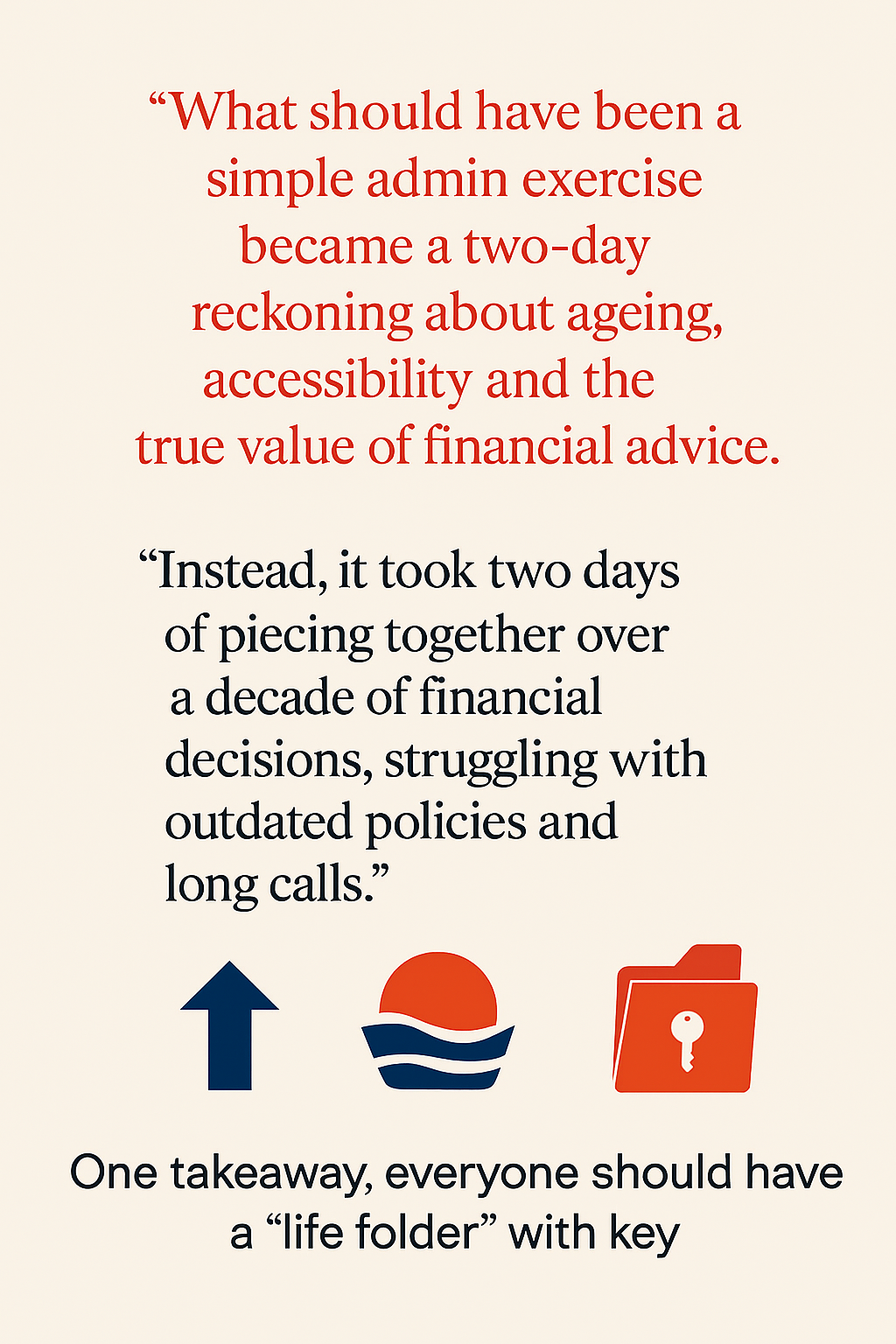
One practical takeaway from her experience is something she now strongly advocates for: creating a “life folder”.
“It’s essentially a financial emergency kit,” she explains.
A life folder is a single, organised place, physical, digital, or both, that contains key information: policy documents, beneficiary details, a will, contact information for advisers, identification documents, and even medical information.
Most importantly, it should be accessible to someone you trust.
“It ensures that if someone needs to step in, they can understand your financial life without starting from scratch,” she says.
Financial planning a partnership
Ultimately, Mdikane believes financial planning is a partnership.
The industry has a responsibility to simplify and humanise its systems. But individuals also need to stay engaged, reviewing decisions, asking questions, and keeping their financial lives up to date.
“Life moves fast, and our financial decisions need to keep pace,” she says.
Her two-day experience with her mother was more than an administrative exercise. It was a reminder that behind every policy, every document, and every plan are real people, real families, and real life moments.
- Qhawekazi Mdikane, a financial marketing executive, struggled for two days helping her mother organize retirement financials, revealing the complexity and challenges even industry insiders face.
- Managing her mother’s outdated insurance policies highlighted issues such as accessibility barriers, especially for older clients who prefer physical documents and human interaction over digital platforms.
- Mdikane's personal experience prompted her to seek financial advice herself, leading to deeper understanding and planning for her family’s future security.
- She advocates for creating a “life folder”—a comprehensive, accessible collection of key financial and personal documents to aid trusted individuals in emergencies.
- Mdikane emphasizes that financial planning is a partnership requiring both industry simplification and individual engagement to keep plans current amid life’s changes.
For Qhawekazi Mdikane, the executive head of brand marketing at Momentum, what should have been a simple administrative task turned into a sobering, deeply personal wake-up call about retirement, family, and financial planning.
When Mdikane recently helped her mother transition into a retirement village, she assumed sorting out her mother’s finances would be quick and straightforward: a few calls, a handful of documents, and done within an afternoon.
What followed were two full days away from work, spent side by side with her mother, calling insurers, requesting policy documents, confirming beneficiaries, and piecing together over a decade’s worth of financial decisions.
“We were essentially reconstructing her financial life from the past 10 to 15 years,” she reflects.
At one point, her mother turned to her and said, "I'm so glad you’re here. I wouldn’t know what I was doing.”
For Mdikane, who works in the financial services space, the realisation was uncomfortable: even those immersed in the industry are not immune to oversight, delays, or the sheer complexity of managing long-term financial decisions.
Retirement is often painted as a dream: sunset walks on the beach, travel, and carefree living. But Mdikane says the reality is far more grounded and often far more demanding.
Sometimes retirement looks like navigating call centres with hearing challenges. Sometimes it’s adult children stepping in to help parents manage paperwork. Sometimes it’s confronting decisions made decades ago that no longer fit current realities.
Her mother, despite doing many things right, maintaining insurance policies through career shifts, divorce, and into retirement, still faced challenges. Some policies were outdated.
“It took both of us, sitting together, making notes, answering verification questions, and working through each step,” Mdikane says. “I had to block out two full days. It took all of them.”
While the industry prides itself on protecting futures and building wealth, Mdikane questions whether systems are truly designed for real people, especially older clients.
“Not everyone is comfortable with digital platforms or automated systems.
At the same time as helping her mother, Mdikane found herself entering a new life phase, her daughter starting Grade 1, a new home, and approaching milestone birthdays.
So she did what many people postpone: she sat down with a financial adviser.
What she expected to be a quick session turned into a deep and often confronting conversation about her life, her responsibilities, and her family’s future.
“I was asked questions I hadn’t fully considered,” she says. “What happens to my daughter if something happens to me? How long would my family be secure? What does my estate plan look like today?”
For Mdikane, the experience reaffirmed the true value of financial advice, not as a sales tool, but as a means of helping people fully understand their lives and prepare for the unexpected.
One practical takeaway from her experience is something she now strongly advocates for: creating a “life folder”.
“It’s essentially a financial emergency kit,” she explains.
A life folder is a single, organised place, physical, digital, or both, that contains key information: policy documents, beneficiary details, a will, contact information for advisers, identification documents, and even medical information.
Most importantly, it should be accessible to someone you trust.
“It ensures that if someone needs to step in, they can understand your financial life without starting from scratch,” she says.
Ultimately, Mdikane believes financial planning is a partnership.
“Life moves fast, and our financial decisions need to keep pace,” she says.
Her two-day experience with her mother was more than an administrative exercise. It was a reminder that behind every policy, every document, and every plan are real people, real families, and real life moments.