


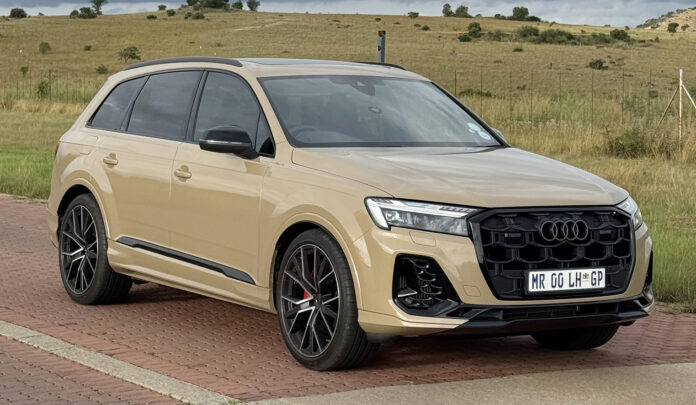
I recently spent a few days behind the wheel of Audi’s flagship family SUV, the Audi Q7 55 TFSI Black Edition, courtesy of Audi South Africa’s public relations team.
I first encountered the vehicle when it was launched in Cape Town in March 2025, but living with it for several days offered the chance to get to know the car far better than the fleeting impressions of a media launch.
The Q7 first appeared in concept form as the Audi Pikes Peak quattro in 2003 before the production version debuted at the Frankfurt Motor Show in 2005, marking Audi’s entry into the large luxury SUV segment.
My test unit arrived finished in Sakhir Gold Metallic—a colour so striking it almost gives the impression that it belongs in a government motorcade. Complementing the dramatic paintwork were massive 22-inch Audi Sport five-V-spoke star wheels.
As a Black Edition model, it features distinctive styling elements, including black exterior mirror housings, black roof rails and privacy glazing for the rear windows. The darkened trim contrasts beautifully with the gold bodywork, giving the SUV a bold and commanding road presence.
Under the bonnet sits a 3.0-litre V6 turbocharged petrol engine with direct fuel injection, producing 250kW of power and 500Nm of torque. Inside, the Q7 delivers exactly what buyers expect from a premium family SUV—space, versatility, and comfort.
The vehicle is configured as a seven-seater, offering generous headroom and elbow room in both the front and rear rows. The luggage compartment offers 867 litres of space with the seats up and a massive 1 993 litres when the rear seats are folded down.
This makes the Q7 perfectly suited for long family holidays, sports gear or even a weekend trip to the countryside. On the road, the Q7 delivers the kind of refined driving experience one expects from a large Audi SUV.
The combination of suspension, steering and braking systems creates a confident and composed ride, whether cruising on highways or navigating uneven surfaces.
However, the vehicle’s considerable size and weight do become noticeable on tighter, twistier roads. While driving through the winding routes of Kromdraai in the Cradle of Humankind near Mogale City, the Q7 occasionally felt heavy when pushed through sharp bends.
The electronically controlled adaptive air suspension helps compensate for this by adjusting ride height and damping. While exploring gravel and farm roads, I was able to raise the ride height by up to 90mm. On highways, the system automatically lowers the body by up to 30mm to improve stability and efficiency.
In off-road situations, the “Lift” function can further increase ground clearance by up to 60mm. The Audi virtual cockpit provides a detailed surroundings display, showing nearby
vehicles such as cars, trucks, and motorcycles, as well as lane-change warnings, distance alerts, intersection assist, and even traffic-light information in full-HD clarity.
Verdict: The Audi Q7 remains an impressive blend of luxury, sportiness, and practicality. In South Africa’s premium large SUV segment, the Q7 faces formidable competition from rivals such as the BMW X5, Mercedes-Benz GLE, Volvo XC90 and Land Rover Discovery.
Since its launch last year, Audi South Africa has sold 61 units locally. Buyers should note, however, that a new generation of the Q7 is expected to arrive in the first quarter of 2027. Pricing for the Audi Q7 55 TFSI Black Edition starts at R1 987 900 and includes an optional five-year/100,000km Audi Freeway Plan.


