Two major Chinese companies have joined forces in a move that could boost South Africa’s shift toward cleaner energy and electric mobility.
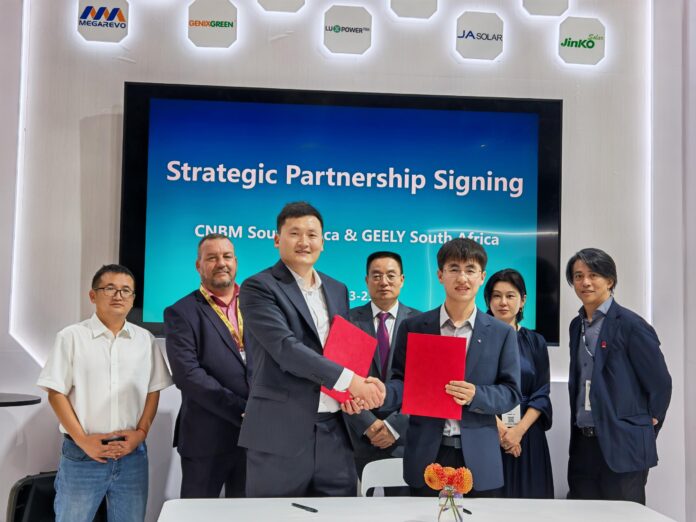
China National Building Materials Group subsidiary CNBM South Africa, and Zhejiang Geely Holding Group subsidiary Geely Auto South Africa, signed a strategic cooperation agreement on 25 March at the Future Energy Storage Exhibition.
The deal signals a growing push by global players to position the country as a key market in the transition to renewable energy and new energy vehicles (NEVs).
Building an integrated energy ecosystem
The two companies say the partnership will focus on building an integrated energy ecosystem that combines electric vehicles, solar power, battery storage and charging infrastructure, all critical components for reducing reliance on fossil fuels.
CNBM South Africa brings expertise in photovoltaic (solar) systems and energy storage, along with established engineering and distribution capabilities in the local market. Geely, on the other hand, is betting on its expanding portfolio of new energy vehicles and vehicle-to-grid (V2G) technology, which allows cars to feed electricity back into the grid.
Aligns with SA’s energy transition ambitions
The collaboration will also prioritise localisation, with both companies committing to developing supply chains within South Africa and the broader Southern African region.
This aligns with the country’s energy transition ambitions, as government and industry look to diversify energy sources, reduce load-shedding pressures and create new industrial opportunities.
Unlocking investment, accelerating infrastructure development
The agreement outlines cooperation across the full value chain, from jointly developing EV charging networks to rolling out integrated solar-storage-charging solutions that could support both households and businesses.
Industry observers say such partnerships could play a key role in unlocking investment and accelerating infrastructure development, particularly as South Africa seeks to balance energy security with climate commitments.
The move also reflects a broader trend of Chinese investment across Africa’s energy and mobility sectors, with companies increasingly offering bundled solutions that combine power generation, storage and transport.
Regional hub for clean energy, electrified mobility
For South Africa, the success of this partnership will likely depend on how effectively it translates into local jobs, skills development and competitive supply chains – key pillars of a just energy transition.
If executed well, the collaboration could help position the country as a regional hub for clean energy and electrified mobility.