


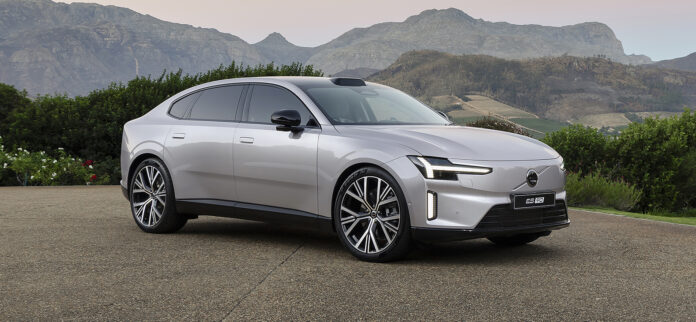

Volvo Cars South Africa (Volvo SA) is stepping up its fight in the country’s premium vehicle
segment with the launch of its new fully electric flagship sedan, the Volvo ES90.
The Swedish automaker unveiled the ES90 during a media launch in KwaZulu-Natal, where I and other motoring journalists were given the opportunity to experience the new electric sedan on a scenic route stretching roughly 500km across the province.
The launch drive began in Ballito and took us through urban streets, highways, and rolling hills in the KZN Midlands.
Over two days behind the wheel, the ES90 demonstrated that it has the credentials to challenge established rivals, such as the BMW i5 and Mercedes-Benz EQE Sedan, in the growing electric executive sedan segment.
Volvo’s move into this space is rooted in a long heritage of premium sedans. This year marks 70 years since Volvo introduced its first sedan, the Volvo Amazon, in 1956. Over the decades, the brand expanded its sedan lineage with models such as the Volvo 164 in 1964, the 760 in 1982, and the 960 in 1990 before launching the S90 in 1997.
The latest ES90 now represents the electric evolution of that lineage. The ES90, built on Volvo’s SPA2 dedicated electric architecture that it shares with the EX90 SUV, introduces an advanced 800-volt electrical system designed for faster charging and improved efficiency.
The vehicle is powered by a 92kWh battery pack, delivering a claimed driving range of up to 755km on the Worldwide Harmonised Light-Duty Vehicles Test Procedure cycle and energy consumption of around 15.9kWh/100km.
During the launch drive, however, most vehicles displayed an estimated real-world range closer to 500km, which remains competitive for long-distance travel.
Using a compatible DC fast charger, the ES90 can charge from 10% to 80% in about 25 minutes, helping minimise downtime during longer journeys.
On the road, the ES90 delivers the smooth and refined driving experience expected of a premium electric sedan. The rear-mounted electric motor produces 245kW of power and 480Nm of torque, enabling the car to accelerate from 0-100km/h in 6.6 seconds.
The rear-wheel drive configuration prioritises comfort and stability, while the self-leveling air suspension contributes to a composed ride over varying road conditions.
Inside, the ES90 offers generous space thanks to a 3 102mm wheelbase, with overall dimensions measuring 5 000mm in length and 2 120mm in width including mirrors. The luggage compartment provides 446 litres of cargo capacity, expanding to 1 427 litres with the rear seats folded, while an additional 27-litre front storage compartment adds extra practicality.
Volvo’s reputation for safety remains central to the ES90. The sedan is equipped with a comprehensive suite of driver-assistance systems, including adaptive cruise control, lane-keeping assist, blind-spot monitoring, collision avoidance technology and driver monitoring systems.
Buyers can choose from three trim levels: Core, Plus, and Ultra, each adding additional comfort and technology features. The entry-level Core model already includes a panoramic roof, heated seats, four-zone climate control and a heads-up display.
Plus models add enhanced comfort features and additional driver assistance technology, while the range-topping Ultra introduces luxuries such as soft-close doors, massage front seats, laminated glass and a 360-degree camera system.
Inside the cabin, the ES90 feels more like a Scandinavian lounge than a traditional car
interior. The wood trim, ambient lighting options and a 1,610-watt Bowers & Wilkins sound system with 25 speakers create a premium atmosphere.
My only gripe was a slight reflection from the head-up display unit on the windscreen, which occasionally appeared blurry. Pricing starts at R1 590 000 for the Core, R1 655 000 for the Plus and R1 795 000 for the Ultra.
Volvo SA has initially secured 40 units for the South African market this year, and the brand will be hoping the ES90 proves that premium sedans still have a place in a market increasingly dominated by SUVs.
- Volvo Cars South Africa (Volvo SA) is stepping up its fight in the country’s premium vehicle segment with the launch of its new fully electric flagship sedan, the Volvo ES90.
- The Swedish automaker unveiled the ES90 during a media launch in KwaZulu-Natal, where I and other motoring journalists were given the opportunity to experience the new electric sedan on a scenic route stretching roughly 500km across the province.
- The launch drive began in Ballito and took us through urban streets, highways, and rolling hills in the KZN Midlands.
- Over two days behind the wheel, the ES90 demonstrated that it has the credentials to challenge established rivals, such as the BMW i5 and Mercedes-Benz EQE Sedan, in the growing electric executive sedan segment.
- Volvo’s move into this space is rooted in a long heritage of premium sedans.


