
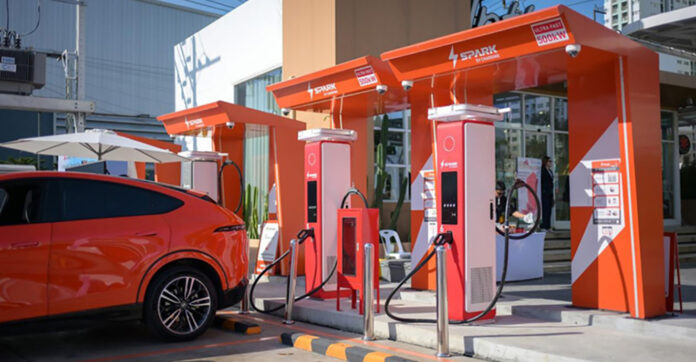
Global technology giant Huawei is planning to introduce ultrafast charging infrastructure for electric vehicles (EVs) in South Africa, signalling a major boost for the country’s transition to cleaner mobility.
This was revealed during the 2026 Africa Energy Indaba in Cape Town earlier this month, where Huawei outlined its ambition to deploy so-called “mega” chargers capable of significantly reducing charging times.
Speaking to Sunday World, the company said the move forms part of its broader commitment to sustainable energy and mobility solutions.
“This is part of Huawei’s broader commitment to supporting the country’s energy transition and sustainable mobility,” the company said. “We are mindful of the evolving energy and mobility landscape in South Africa, as well as the growing demand for more efficient transport solutions.”
Huawei added that its ultra-fast charging technology is designed to deliver faster, more reliable, and more energy-efficient charging, addressing one of the biggest barriers to EV adoption – charge time.
The push for faster charging also comes at a time when global fuel prices are climbing due to geopolitical tensions in the Middle East, with the ongoing Iran conflict disrupting oil supply and driving petrol costs higher – a trend that is increasingly nudging consumers toward electric and hybrid vehicles.
While details on rollout timelines and project scope remain under discussion, Huawei confirmed it is engaging local partners to build a viable EV charging ecosystem.
The announcement comes as momentum builds in South Africa’s EV infrastructure space.
Energy and logistics players Zimi and Zero Carbon Holdings (CHARGE Holdings) have signed a three-year agreement to roll out electric freight operations along the busy N3 corridor between Johannesburg and Durban.
The initiative will provide dedicated charging capacity of up to 500kWh per station per day for fleet operators, with peak charging exceeding 300kW.
The first two off-grid, solar-powered charging stations – CHARGE N3 Tugela in KwaZulu-Natal and CHARGE N3 Roadside in the Free State – are expected to launch in May.
Zimi CEO Michael Maas said reliable charging infrastructure remains critical for scaling electric logistics. “Working with CHARGE allows us to deploy electric delivery vehicles on one of the country’s busiest freight routes while ensuring predictable charging access,” he said.
CHARGE Holdings co-founder Andries Malherbe added that renewable-powered infrastructure could unlock long-distance electric freight while improving energy resilience.
Further accelerating the shift, Chinese automaker BYD announced in October last year plans to install between 200 and 300 public charging stations across South Africa, alongside future ultra-fast 1MW charging solutions.
These infrastructure investments come as automakers ramp up their EV offerings locally. Lexus has introduced its first electric model, the RZ, while Volvo has just unveiled the ES90 and is preparing to launch the EX60 in the coming months.
BMW is also expected to roll out new electric models, including the iX3, with Mercedes-Benz set to introduce the GLC EV. South Africa’s best-selling brand, Toyota, is also gearing up for its EV push with the bZ4x BEV.
Together, these developments point to a rapidly evolving EV landscape in South Africa – one where faster charging and stronger infrastructure could finally accelerate mainstream adoption.


