


South Africa’s transition to electric mobility is no longer confined to passenger cars and compact SUVs. The country’s medium and heavy commercial vehicle sector – the backbone of trade, construction and logistics – is now entering the new-energy era.
From the trucks that deliver food to supermarket shelves to the rigs transporting mining equipment across provinces, heavy commercial vehicles quite literally move the economy. As global manufacturers accelerate the rollout of battery-electric trucks, local industry leaders are warning that policy bottlenecks could stall South Africa’s progress.
According to the Automotive Business Council, Naamsa, 22 738 heavy trucks and buses were sold in South Africa between January and December 2025, reflecting a 3% decline compared to 2024. Medium truck and bus sales reached 8 151 units, up 5.6% year-on-year.
These numbers matter. The automotive sector contributes 5.2% to South Africa’s GDP – 3.2% from manufacturing and 2% from retail – and accounts for 22.6% of the country’s manufacturing output. Last year alone, vehicle exports reached 408 224 units, breaching the 400 000 mark for the first time ever.
Against this backdrop, industry executives believe the country cannot afford to fall behind in the global shift toward cleaner freight transport.
“With local demand being the driver for volumes, we need help to reduce the duties on completely built unit imports for a limited time, to bring the price down for fleet owners,” said Eric Parry, senior manager: sustainable solutions at Volvo Group Southern Africa.
Currently, heavy battery-electric trucks are imported into South Africa as fully built units, attracting import duties that significantly inflate pricing. For fleet operators, already operating on tight margins, the cost barrier remains steep.
“That way, we can stimulate demand and build volume. Volume allows us to invest locally,” Parry explained.
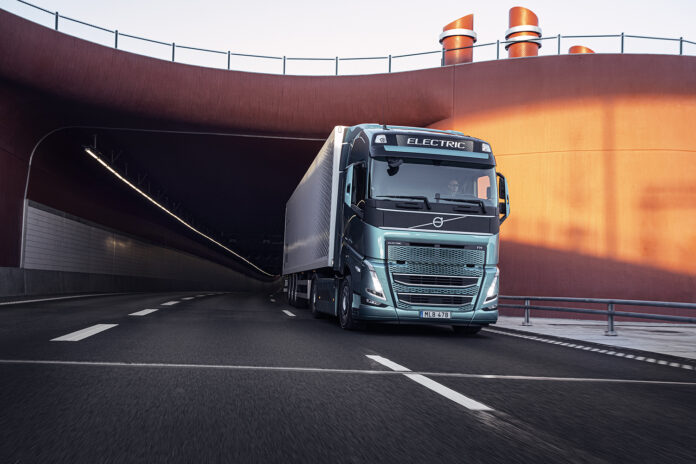
Volvo has already introduced 13 heavy-duty electric trucks in South Africa across its FH, FM and FMX ranges. Ten of these units are earmarked for customer operations, while three form part of a test and demonstration fleet. However, local assembly through completely knocked-down operations at Volvo’s KwaZulu-Natal plant will only become viable once volumes increase.
Daimler Truck Southern Africa (DTSA) echoed similar concerns. Olaf Petersen, vice president for sales and marketing at DTSA, noted that fleet operators are approaching electric trucks with cautious optimism.
“Adoption largely depends on operational requirements, such as route distances, payload capacity and charging infrastructure availability,” Petersen said.
Unlike passenger EVs, heavy electric trucks must prove themselves in demanding commercial environments where downtime equals lost revenue. As a result, most operators are piloting the technology before committing to large-scale fleet transitions.
Beyond tariff relief, manufacturers argue that regulatory reform is equally urgent. South Africa still operates under Euro 2 emissions standards, far behind global markets that have adopted Euro 6.
“Moving to Euro 6 is the first critical step, not only to meet sustainability targets but also to align with global product availability,” Petersen emphasised.
However, there is a silver lining. The African Continental Free Trade Area framework could unlock regional value chains for new-energy mobility. Parry believes the framework will eventually allow manufacturers to achieve economies of scale through local assembly.
DTSA’s vice president of manufacturing, Gladstone Mtyoko, said localisation of certain components such as wiring harnesses and body parts is possible in the future. Advanced technologies like battery assembling and electric powertrain modules, however, will require significant investment in skills, infrastructure and supply chains.
For a country striving to grow jobs and industrial capacity under the South African Automotive Masterplan 2035, the electric truck debate goes far beyond emissions.
It speaks to competitiveness, localisation and long-term economic positioning.


