
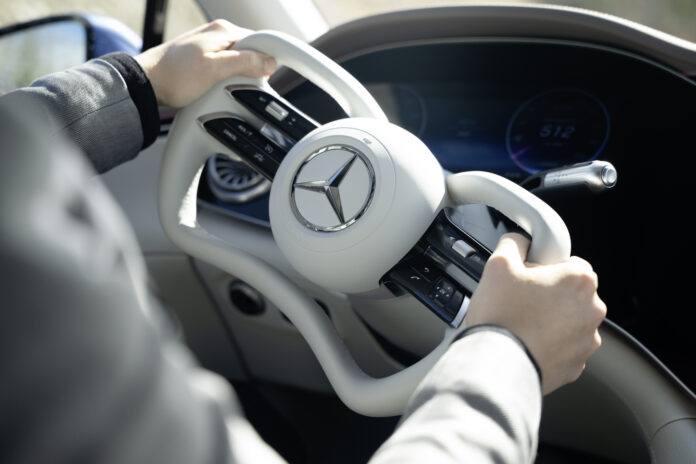

Steer-by-wire becomes reality in the new EQS | Mercedes-Benz EQS 580 4MATIC
Steer-by-wire becomes reality in the new EQS | Mercedes-Benz EQS 580 4MATIC | MANUFAKTUR black sparkling | Exclusiv Nappa macchiatobeige / spacegrey
Steer-by-wire becomes reality in the new EQS | Mercedes-Benz EQS 580 4MATIC
Mercedes-Benz is pushing the boundaries of in-car technology with the introduction of steer-by-wire in its flagship Mercedes-Benz EQS, a move the brand says redefines how drivers interact with their vehicles.
The system, set to be introduced shortly after the EQS’s market launch, eliminates the traditional mechanical link between the steering wheel and front wheels, replacing it with electronic signals. This allows for a more precise, intuitive and effortless steering experience, while also improving manoeuvrability and ride comfort.
Lexus showed the way
However, while Mercedes-Benz positions itself as the first German manufacturer to bring the technology to a production vehicle, the innovation is not entirely new to the market. Lexus has already led the way, introducing steer-by-wire in its recently launched all-electric Lexus RZ 550e F Sport, signalling a broader shift among premium brands towards next-generation steering systems.
In the EQS, steer-by-wire reduces steering effort and eliminates unwanted vibrations from uneven road surfaces. The system calculates tyre-road interaction digitally, maintaining the familiar steering feel expected from Mercedes-Benz while enhancing stability and agility.
The technology also enables a redesigned cabin experience. A flatter steering wheel opens up interior space, improves visibility of the driver display and makes entry and exit easier – reinforcing the brand’s focus on comfort and luxury.
Rear-axle steering
Driving dynamics have also been enhanced through integration with rear-axle steering. At higher speeds, the rear wheels turn in the same direction as the front wheels, improving stability, while at lower speeds they turn in the opposite direction for tighter manoeuvring.
Safety remains a key focus. Mercedes-Benz says the system has undergone more than a million kilometres of testing across simulations, test tracks and real-world conditions. A redundant system architecture ensures that even in the unlikely event of a failure, steering control can be maintained through rear-axle steering and electronic stability interventions.
Newly developed airbag structure
The introduction of steer-by-wire has also required a rethink of safety systems within the cabin. A newly developed airbag structure has been engineered to function without relying on a traditional steering wheel rim, maintaining the brand’s high safety standards.
The rollout of this technology forms part of Mercedes-Benz’s broader celebration of 140 years of automotive innovation, a milestone that underscores its continued investment in shaping the future of mobility in the electric era.
Visit SW YouTube Channel for our video content
- Mercedes-Benz introduces steer-by-wire technology in the new EQS 580 4MATIC, replacing the traditional mechanical steering link with electronic signals for improved precision, comfort, and manoeuvrability.
- The system reduces steering effort, eliminates vibrations from uneven roads, and digitally manages tyre-road interaction to maintain familiar steering feel and enhanced stability.
- Steer-by-wire enables a redesigned cabin with a flatter steering wheel that improves interior space, driver display visibility, and ease of entry and exit.
- Rear-axle steering integration enhances driving dynamics by adjusting rear wheel direction for stability at high speeds and tighter turning at low speeds.
- Safety is ensured through extensive testing, redundant system architecture, and a newly developed airbag structure adapted for the non-traditional steering wheel design.
Mercedes-Benz is pushing the boundaries of in-car technology with the introduction of steer-by-wire in its flagship Mercedes-Benz EQS, a move the brand says redefines how drivers interact with their vehicles.
However, while Mercedes-Benz positions itself as the first German manufacturer to bring the technology to a production vehicle, the innovation is not entirely new to the market. Lexus has already led the way, introducing steer-by-wire in its recently launched all-electric Lexus RZ 550e F Sport, signalling a broader shift among premium brands towards next-generation steering systems.
In the EQS, steer-by-wire reduces steering effort and eliminates unwanted vibrations from uneven road surfaces.
Safety remains a key focus. Mercedes-Benz says the system has undergone more than a million kilometres of testing across simulations, test tracks and real-world conditions. A redundant system architecture ensures that even in the unlikely event of a failure, steering control can be maintained through rear-axle steering and electronic stability interventions.