In an automotive market increasingly dominated by a wave of Chinese entrants, some legacy brands risk fading into the background.
One such brand is Mitsubishi Motors South Africa. Yet, if this week’s launch of the all-new Mitsubishi Destinator is anything to go by, the Japanese marque is quietly plotting a return to relevance.
I attended the national media launch of the new seven-seater family SUV in Muldersdrift, Gauteng, on Monday, where Mitsubishi made its intentions clear: this is not about chasing volume but about rebuilding loyalty.
“Mitsubishi is a brand people sometimes forget is still here,” admitted managing director Takalani Bruce Mukhola, who took the reins in January. “We are evolving and aiming for sustainable growth. The Destinator reflects that evolution.”
Mitsubishi’s legacy, anchored in nameplates like the Colt, Pajero and Lancer Evolution, is synonymous with durability and reliability. Now, the brand is attempting to translate that heritage into a modern family SUV offering.
Mukhola and his team are realistic about their positioning. Mitsubishi is not aiming to compete head-on with high-volume players but rather to carve out a niche centred around customer experience, loyalty and profitability. The numbers reflect this measured approach: in 2025, Mitsubishi sold approximately 1 800 vehicles, with plans to gradually increase that number in the coming years. The brand operates through 47 dealerships nationwide.
The Destinator effectively replaces the ASX and Eclipse Cross, repositioning Mitsubishi in the competitive mid-size SUV segment. Built in Indonesia for African markets, it is offered locally in two derivatives: the GLS and Exceed.
Even the entry-level the GLS is generously specified, featuring an 8-inch infotainment system with smartphone connectivity, rearview camera, parking sensors, electric parking brake with auto hold, and air vents across all three rows.
The Exceed derivative ups the ante with a host of safety and convenience features, including a 360-degree camera system, blind spot warning, rear cross-traffic alert, panoramic sunroof, power tailgate and wireless charging.
Under the bonnet sits a 1.5-litre turbocharged petrol engine producing 120kW and 250Nm, paired with a continuously variable transmission (CVT) driving the front wheels.
Despite the common criticism of CVTs, this one provides a relatively smooth and responsive performance during everyday driving. Mitsubishi claims a fuel consumption figure of 7.2l/100km, but the short launch route made it difficult to verify the figure under real-world conditions.
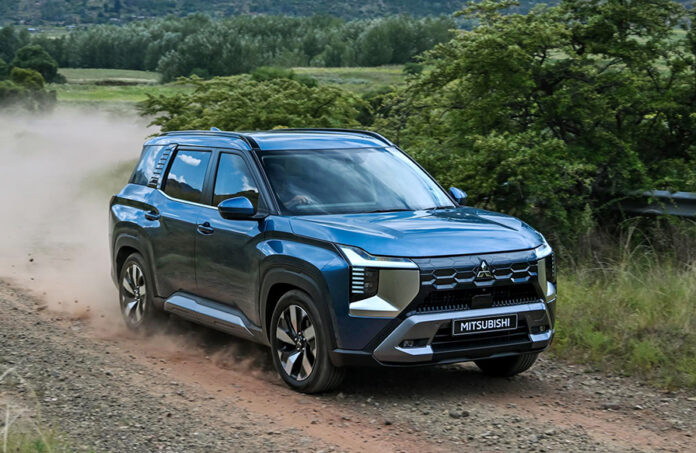
Visually, the Destinator positions itself squarely against rivals such as the Hyundai Alcazar, the Chery Tiggo 7 Pro Max, the Jetour X70 Plus, the Honda CR-V, and the Ford Territory. Its design incorporates Mitsubishi’s latest “Dynamic Shield” front-end treatment, complemented by a smoked grille and distinctive T-shaped LED lighting. From the rear, there are subtle echoes of the previous-generation Outlander – a nod to the brand’s design lineage.
Inside, the cabin offers three rows of seating with flexible configurations, along with an impressive 25 storage compartments aimed at family practicality. Higher-spec models feature a 12.3-inch infotainment display paired with a digital instrument cluster, as well as a Yamaha premium sound system.
However, it is behind the wheel where the Destinator’s character truly reveals itself – for better or for worse.
Our drive route included both tar and gravel sections, though the shared driving format – with four motoring scribe occupants per vehicle – inevitably limited extended seat time. On tarmac, the Destinator feels comfortable but notably soft.
There is a floaty sensation at speed, and through tighter bends around Kromdraai, the body tended to wallow more than expected.
Ride comfort is decent, particularly over gravel, where the softness works in their favour. However, there are trade-offs. The third-row seating is best suited to children rather than adults, and boot space becomes limited when all seven seats are in use – though it improves significantly with the third row folded flat.
One can’t help but feel that an all-wheel-drive option would have elevated the overall package, particularly for buyers seeking a more versatile family SUV.
Ultimately, the Destinator feels like a calculated re-entry into the segment – a product designed to test the waters rather than disrupt the market outright. It leans heavily on comfort, practicality and brand heritage, but faces stiff competition from polished rivals.
Pricing starts at R489 990 for the GLS and R569 990 for the Exceed. Both models come with a five-year/unlimited -kilometre warranty and a five-year/75 000km service plan, with service intervals set at 15 000km or 12 months.
For Mitsubishi, the Destinator may not be a knockout punch – but it could well be the first step in reminding South Africans why the brand mattered in the first place.
- Mitsubishi Motors South Africa is re-entering the mid-size SUV segment with the all-new seven-seater Mitsubishi Destinator, aiming to rebuild loyalty rather than chase high sales volumes.
- The Destinator replaces the ASX and Eclipse Cross, offering two variants (GLS and Exceed) with strong feature sets and a 1.5-litre turbo petrol engine paired with a CVT.
- Design-wise, it competes with models like the Hyundai Alcazar and Honda CR-V, featuring Mitsubishi’s “Dynamic Shield” look, three-row flexible seating, and advanced infotainment and safety options.
- The SUV offers comfortable ride quality, especially on rough roads, but exhibits softness in handling; the third row is best for children, and lack of an all-wheel-drive option limits versatility.
- Priced from R489,990, the Destinator comes with a five-year warranty and service plan, marking a cautious but promising move for Mitsubishi to regain relevance in the South African market.