
Mention Citroën to anyone who owned the French brand a decade ago, and you may trigger more than nostalgia – perhaps even a slight cringe. For many South Africans, the brand is still associated with its troubled period around 2016, when concerns over reliability and aftersales support ultimately led to its exit from the local market.
However, on Tuesday, amidst the picturesque scenery of Muldersdrift and the winding roads leading to Hartbeespoort Dam, there was a noticeable indication that Citroën is prepared to embark on a new chapter.
I attended the national media launch of the all-new Citroën Basalt, courtesy of Stellantis South Africa (Stellantis SA) – the global automotive group that has been quietly rebuilding the brand locally since taking over stewardship in 2019.
And the numbers suggest progress. According to Charl Timms, commercial director at Stellantis SA, Citroën’s local sales have grown from just 670 units in 2021 to 4 200 units in 2025. The ambition is clear: 6 500 units by the end of 2026.
However, rebuilding trust in a market as discerning as South Africa’s requires more than ambition. It requires action. “We consolidated our parts centre in Rosslyn, which carries parts worth R500-million,” Timms explained during the media launch. “Secondly, we’ve introduced a guaranteed mobility service for customers whose vehicles are not serviced within 48 hours or if their cars remain in a panel shop for up to 30 days.”
In other words, Citroën is not just selling cars again – it is attempting to rebuild confidence.
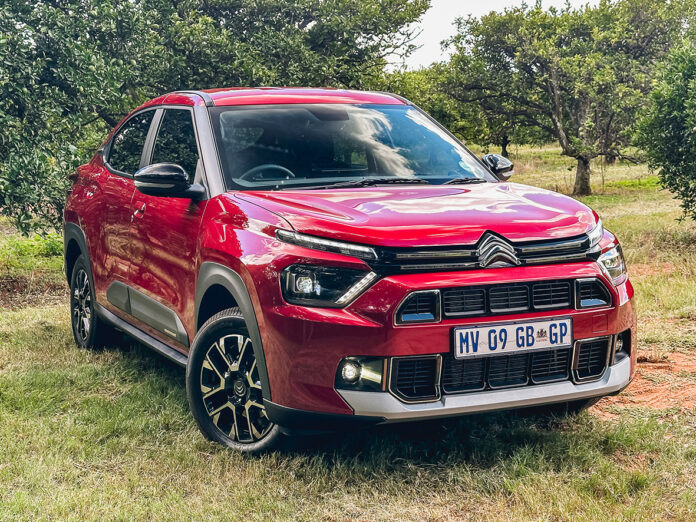
Produced at Stellantis’ Hosur plant in India, the Basalt arrives as an SUV coupé – a body style once reserved for premium marques such as BMW with its X6, Mercedes-Benz with the GLE Coupé, and even Lamborghini with the Urus. Now, that design language is filtering into the compact mainstream segment, and Citroën is among the brands betting that local consumers are ready for it.
At first glance, the Basalt makes a bold statement. Its sloping roofline and raised stance provide it a sense of flair that stands out in a segment often dominated by conservative design. It feels like a democratisation of a once-exclusive aesthetic – and, in that sense, a direct rival to newcomers such as the Tata Curvv.
Behind the wheel, the Basalt was more than just a styling exercise. Powered by a 1.2-litre turbocharged engine delivering 81kW and 205Nm, paired with a six-speed automatic transmission, it sits squarely in one of the country’s most competitive segments. Rivals include the Toyota Starlet Cross, the Suzuki Fronx, the Hyundai Venue, the Toyota Urban Cruiser, and the Omoda C5. Yet what stood out during the 120km launch route was its composure. The engine feels responsive enough for confident overtaking, while the ride – true to Citroën’s heritage – leans towards comfort rather than outright sportiness.
Inside, the Basalt continues this people-first approach. The cabin is spacious, with generous legroom and a practical five-seat layout. A 470-litre boot adds to its everyday usability, making it well-suited for both family duties and weekend escapes.
Technology is neatly integrated rather than overwhelming. A 10-inch touchscreen with wireless Apple CarPlay and Android Auto is paired with a 7-inch digital instrument cluster, creating a clean and intuitive driving environment.
Features such as automatic air-conditioning with rear vents, cruise control, keyless entry; and practical storage solutions further enhance its appeal as an everyday companion.
Safety has not been overlooked either. The Basalt comes with six airbags as standard, along with electronic stability control, hill hold assist, tyre pressure monitoring and Isofix child-seat anchors. It has also achieved a four-star NCAP safety rating in India.
“The Citroën Basalt introduces a distinctive attitude to the local SUV segment,” said Mmathapelo Khumalo, head of Citroën South Africa. “It combines a confident design with the comfort, technology, and everyday usability that define the Citroën brand.”
The question, however, is not whether the Basalt is a good car – it is whether it is good enough to restore faith in the badge. Timms believes it will be, with a target of 1 300 units to be sold by the end of 2026.
Pricing starts at R354 900 for the Basalt Plus and R369 900 for the Basalt Max, including a four-year/60 000km service plan and a five-year/100 000km warranty.
The Basalt leaves a strong first impression. However, for Citroën, the real test lies beyond the launch route – in showrooms, service bays, and, ultimately, in the lived experiences of South African motorists – because a comeback is not defined by a single model. It is earned over time!