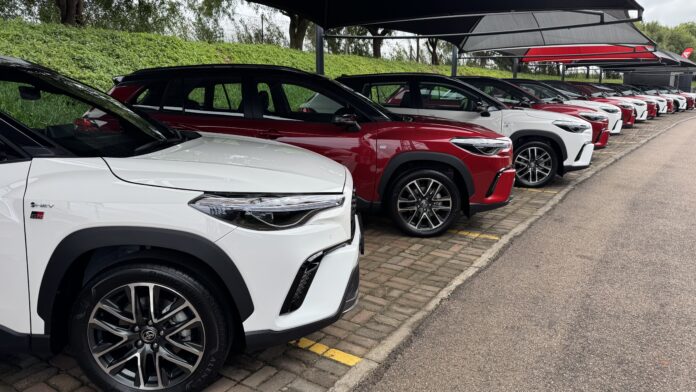
South Africa’s new vehicle market continued its strong recovery in March 2026, recording its best March performance in nearly two decades, even as warning signs emerge from a shifting global economic backdrop.
According to naamsa – the automotive business council – aggregate domestic sales reached 58,060 units in March, up 17.3% from the 49,500 vehicles sold in the same month last year. This marks the highest March total since 2007, underlining sustained consumer demand and improving market confidence.
Private buyers underpin recovery
The bulk of sales remained retail-driven, with dealerships accounting for 88.7% of total volumes, a clear indication that private buyers continue to underpin the recovery. Rental companies contributed 5.5%, while government and corporate fleets made up the remainder.
Passenger cars led the surge, rising 18.2% year on year to 39,370 units. Light commercial vehicles – including bakkies and minibuses – also posted strong growth, climbing 15.7% to 15,557 units. Medium and heavy commercial vehicle segments recorded gains of 14.0% and 14.5%, respectively, reflecting improved business activity and infrastructure-linked demand.
Drop in vehicle exports
However, vehicle exports painted a less optimistic picture, declining by 5.3% to 37,388 units, as global trade disruptions and geopolitical tensions continue to weigh on South Africa’s automotive export performance.
The global strain is already playing out in dramatic ways. In this week’s Reuters Auto File, it was reported that second-hand models from Lamborghini and Ferrari – bound for Dubai from Japan – are currently stranded at a port in Sri Lanka because vessels are unable to dock in the Middle East. The disruption stems from the Strait of Hormuz, one of the world’s most critical shipping corridors, now effectively out of bounds.
Tough time for luxury brands
Luxury brands are also feeling the pressure. Bentley is reportedly bracing for a hit to profits as the lucrative Gulf market becomes harder to access. While relatively small in volume, the region is highly profitable due to demand for bespoke, high-margin vehicles featuring custom finishes such as gold-leaf detailing and mother-of-pearl inlays.
Back home, domestic momentum is being supported by earlier interest rate cuts, easing inflation earlier in the year, and improved consumer and business confidence.
Standard Bank Vehicle and Asset Finance noted: “While we cannot share the absolute volumes, Standard Bank has had a 10.6% year-on-year growth (YTD 2025 vs 2026) on VAF applications. This includes both new and used cars.”
March’s performance also comes on the back of the recent South Africa Investment Conference, where government reaffirmed its commitment to infrastructure development, localisation and industrialisation.
Despite the positive momentum, risks are mounting. Rising tensions in the Middle East have driven sharp fuel price increases, expected to push up transport and logistics costs across the economy.
Looking ahead, Naamsa believes earlier interest rate cuts will continue to support demand. However, warning that global instability and rising costs could test the resilience of South Africa’s vehicle market in the months ahead.
- South Africa’s new vehicle market recorded its best March in nearly 20 years with domestic sales rising 17.3% to 58,060 units, driven primarily by private buyers.
- Passenger car sales jumped 18.2%, while light, medium, and heavy commercial vehicle segments also saw strong growth, reflecting improved consumer and business confidence.
- Vehicle exports declined 5.3% due to global trade disruptions and geopolitical tensions, including shipping difficulties linked to the Strait of Hormuz.
- Luxury car brands such as Bentley face profit pressures as access to the profitable Gulf market becomes more challenging amid regional instability.
- Despite positive domestic momentum supported by prior interest rate cuts and government infrastructure commitments, rising fuel prices and global instability pose risks to future market growth.
However, vehicle exports painted a less optimistic picture, declining by 5.3% to 37,388 units, as global trade disruptions and geopolitical tensions continue to weigh on
Luxury brands are also feeling the pressure. Bentley is reportedly bracing for a hit to profits as the lucrative Gulf market becomes harder to access. While relatively small in volume, the region is highly profitable due to demand for bespoke, high-margin vehicles featuring custom finishes such as gold-leaf detailing and mother-of-pearl inlays.
Back home, domestic momentum is being supported by earlier interest rate cuts, easing inflation earlier in the year, and improved consumer and business confidence.
March’s performance also comes on the back of the recent
Despite the positive momentum, risks are mounting.