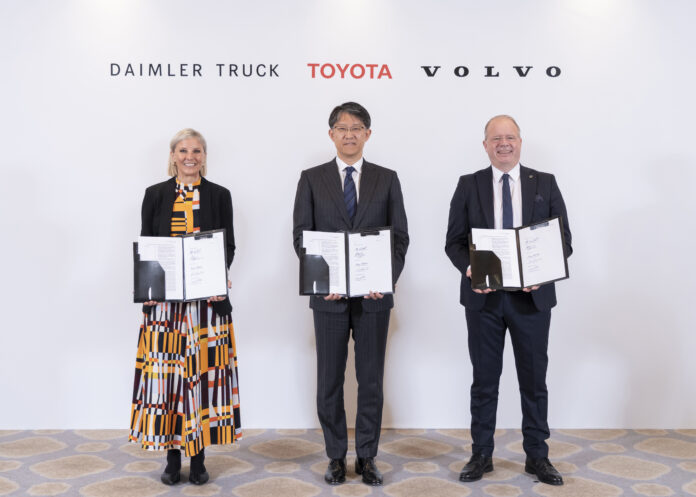
Japanese automotive giant Toyota Motor Corporation plans to increase its commitment to hydrogen mobility, through a fuel cell joint venture with Daimler Truck AG and Volvo Group.
The three global players have signed a non-binding agreement that will see Toyota become an equal shareholder in Cellcentric – a company focused on developing, producing and commercialising fuel cell systems for heavy-duty transport.
The three companies will continue to compete independently
The move signals a growing alignment among leading manufacturers around hydrogen as a key solution for decarbonising long-haul and heavy-duty transport, a segment where battery-electric solutions still face limitations.
Under the proposed structure, Toyota will invest in Cellcentric through a capital increase, joining Daimler Truck and Volvo Group as equal partners. Despite the collaboration, all three companies will continue to compete independently in their core commercial vehicle businesses.
Improving efficiency, durability, cost competitiveness
The partnership combines Daimler and Volvo’s deep expertise in commercial vehicles with Toyota’s more than three decades of fuel cell development, particularly in passenger cars. The aim is to accelerate the rollout of competitive hydrogen-powered systems for trucks and other heavy-duty applications.
Toyota and Cellcentric are also expected to jointly develop fuel cell unit cells, the core components of hydrogen systems, along with supporting architecture and control technologies. This is seen as critical to improving efficiency, durability and cost competitiveness.
Scale hydrogen technology globally
Industry leaders say the collaboration is a necessary step to scale hydrogen technology globally. Karin Rådström, CEO of Daimler Truck, described Toyota’s planned entry as a move that will help “further scale hydrogen technology”. Volvo Group CEO Martin Lundstedt emphasised the need for “critical mass” to accelerate the shift to net-zero transport.
Toyota CEO Koji Sato said the partnership aligns with the company’s long-standing ambition to help build a hydrogen society, adding that combining expertise across companies will enable the delivery of world-leading fuel cell systems.
Development of hydrogen infrastructure
Beyond technology, the partners also aim to support the development of hydrogen infrastructure by working with industry bodies and stakeholders across the value chain – a key hurdle in making hydrogen mobility viable at scale.
Founded in 2021, Cellcentric already employs more than 560 specialists and holds hundreds of patents in fuel cell technology. With Toyota on board, the joint venture is positioning itself as a global leader in hydrogen solutions for heavy transport.
While the agreement remains subject to regulatory approvals, it marks a significant step towards a cleaner, more diversified future for the global transport industry.
- Toyota plans to join Daimler Truck AG and Volvo Group as an equal shareholder in Cellcentric, a fuel cell joint venture focused on heavy-duty transport hydrogen solutions.
- The partnership aims to accelerate the development, production, and commercialization of hydrogen fuel cell systems, leveraging Toyota’s fuel cell expertise and Daimler and Volvo’s commercial vehicle experience.
- Despite collaboration in fuel cell technology, the three companies will continue to compete independently in their core vehicle businesses.
- The joint venture will also work to improve fuel cell efficiency, durability, cost competitiveness, and support hydrogen infrastructure development to scale hydrogen mobility globally.
- The agreement, pending regulatory approval, represents a major step towards decarbonizing long-haul heavy transport by advancing hydrogen as a key alternative to battery-electric solutions.
Japanese automotive giant Toyota Motor Corporation plans to increase its commitment to hydrogen mobility, through a fuel cell joint venture with Daimler Truck AG and Volvo Group.
Toyota and Cellcentric are also expected to jointly develop fuel cell unit cells, the core components of hydrogen systems, along with supporting architecture and control technologies.
Toyota CEO Koji Sato said the partnership aligns with the company’s long-standing ambition to help build a hydrogen society, adding that combining expertise across companies will enable the delivery of world-leading fuel cell systems.
While the agreement remains subject to regulatory approvals, it marks a significant step towards a cleaner, more diversified future for the global transport industry.