


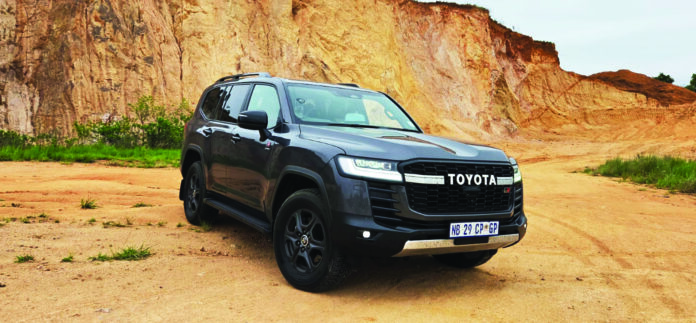
Few vehicles command as much respect on African roads as the Toyota Land Cruiser. For decades, this formidable SUV has built its reputation on durability, off-road capability and the ability to transport families across vast distances in comfort.
Toyota has introduced hybrid technology to its flagship Land Cruiser 300, combining a powerful twin-turbocharged petrol engine with electric assistance. But does electrification make this heavyweight SUV more economical?
I recently spent an extended period behind the wheel of the Land Cruiser 300 GR-S Hybrid — courtesy of Toyota South Africa Motors — putting it through two demanding road trips.
Road trip
My first journey took me across the border to Gaborone, Botswana, for a weekend event. The second was a family long-weekend holiday to KwaZulu-Natal, travelling through Clarens in the Free State before continuing to Ballito.
The journeys provided an opportunity to assess its performance, comfort, practicality and fuel consumption under everyday driving conditions.
Under the bonnet sits a 3.5-litre twin-turbocharged V6 petrol engine paired with Toyota’s self-charging hybrid system, producing a combined 341kW and 790Nm. Power reaches the wheels through a 10-speed automatic transmission.
Performance
Performance is impressive, particularly when overtaking on open highways. The V6 delivers effortless acceleration accompanied by a satisfying soundtrack that enthusiasts will appreciate.
However, the Land Cruiser’s considerable weight becomes apparent through tighter corners, where its substantial dimensions demand restraint. Selecting Sport mode improves responsiveness, although it cannot completely disguise the vehicle’s bulk.
Long-distance comfort is undoubtedly among its strongest attributes.
Spacious interior
The spacious seven-seat cabin comfortably accommodated my family, while the supportive seats and composed highway ride made lengthy journeys considerably less tiring.
Toyota’s adaptive cruise control, lane-keeping assistance and lane-departure warning systems were useful during extended highway driving.
A feature I especially appreciated was the refrigerated centre-console compartment, which kept refreshments chilled throughout our journeys.
Fuel efficiency
Fuel efficiency, however, remains the hybrid’s biggest question mark.
Toyota claims consumption of about 10 litres per 100km but my real-world experience returned between 12.6 and 12.8 litres/100km.
Interestingly, consumption improved slightly around coastal KZN, registering 12.6 litres compared with about 12.8 litres/100km at Gauteng’s higher altitude.
While respectable for such a large petrol-powered SUV, these figures suggest the hybrid system delivers relatively modest savings.
A plug-in hybrid configuration offering meaningful electric-only driving capability would arguably provide greater efficiency benefits, particularly during urban commuting.
Alternatively, a torquey diesel remains an attractive proposition for motorists prioritising fuel economy and long-distance touring. Fortunately, the GX-R and GR-S diesel derivatives remain available.
Beyond paved roads, the Land Cruiser retains serious off-road credentials, including selectable high- and low-range four-wheel drive, downhill assistance and Crawl Control.
Price
At R2 343 800, however, this hybrid faces competition from the Land Rover Defender, Mercedes-AMG GLE, BMW X5, Audi Q7 and, increasingly, capable Chinese alternatives such as the GWM Tank 500.
Toyota provides a three-year/100 000km warranty, nine-service/90 000km service plan and eight-year/160 000km hybrid battery warranty.
- The Toyota Land Cruiser 300 GR-S Hybrid features a 3.5-litre twin-turbocharged V6 petrol engine combined with a self-charging hybrid system, producing 341kW and 790Nm.
- Real-world fuel consumption ranged between 12.6 and 12.8 litres per 100km, exceeding Toyota's claimed average of about 10 litres per 100km.
- The vehicle's spacious seven-seat cabin offers comfort, with features such as a refrigerated centre-console compartment and advanced driver assistance systems.
- Off-road capabilities include selectable high- and low-range four-wheel drive, downhill assistance, and Crawl Control.
- The hybrid model is priced at R2 343 800, competing with luxury SUVs like the Land Rover Defender, Mercedes-AMG GLE, BMW X5, Audi Q7, and Chinese models like the GWM Tank 500.
Few vehicles command as much respect on African roads as the Toyota Land Cruiser. For decades, this formidable SUV has built its reputation on durability, off-road capability and the ability to transport families across vast distances in comfort.
Toyota has introduced hybrid technology to its flagship Land Cruiser 300, combining a powerful twin-turbocharged petrol engine with electric assistance. But does electrification make this heavyweight SUV more economical?
I recently spent an extended period behind the wheel of the Land Cruiser 300 GR-S Hybrid — courtesy of Toyota South Africa Motors — putting it through two demanding road trips.
My first journey took me across the border to Gaborone, Botswana, for a weekend event. The second was a family long-weekend holiday to KwaZulu-Natal, travelling through Clarens in the Free State before continuing to Ballito.
The journeys provided an opportunity to assess its performance, comfort, practicality and fuel consumption under everyday driving conditions.
Under the bonnet sits a 3.5-litre twin-turbocharged V6 petrol engine paired with Toyota’s self-charging hybrid system, producing a combined 341kW and 790Nm. Power reaches the wheels through a 10-speed automatic transmission.
Performance is impressive, particularly when overtaking on open highways. The V6 delivers effortless acceleration accompanied by a satisfying soundtrack that enthusiasts will appreciate.
However, the Land Cruiser’s considerable weight becomes apparent through tighter corners, where its substantial dimensions demand restraint. Selecting Sport mode improves responsiveness, although it cannot completely disguise the vehicle’s bulk.
Long-distance comfort is undoubtedly among its strongest attributes.
The spacious seven-seat cabin comfortably accommodated my family, while the supportive seats and composed highway ride made lengthy journeys considerably less tiring.
Toyota’s adaptive cruise control, lane-keeping assistance and lane-departure warning systems were useful during extended highway driving.
A feature I especially appreciated was the refrigerated centre-console compartment, which kept refreshments chilled throughout our journeys.
Fuel efficiency, however, remains the hybrid’s biggest question mark.
Toyota claims consumption of about 10 litres per 100km but my real-world experience returned between 12.6 and 12.8 litres/100km.
Interestingly, consumption improved slightly around coastal KZN, registering 12.6 litres compared with about 12.8 litres/100km at Gauteng’s higher altitude.
While respectable for such a large petrol-powered SUV, these figures suggest the hybrid system delivers relatively modest savings.
A plug-in hybrid configuration offering meaningful electric-only driving capability would arguably provide greater efficiency benefits, particularly during urban commuting.
Alternatively, a torquey diesel remains an attractive proposition for motorists prioritising fuel economy and long-distance touring. Fortunately, the GX-R and GR-S diesel derivatives remain available.
Beyond paved roads, the Land Cruiser retains serious off-road credentials, including selectable high- and low-range four-wheel drive, downhill assistance and Crawl Control.
At R2 343 800, however, this hybrid faces competition from the Land Rover Defender, Mercedes-AMG GLE, BMW X5, Audi Q7 and, increasingly, capable Chinese alternatives such as the GWM Tank 500.
Toyota provides a three-year/100 000km warranty, nine-service/90 000km service plan and eight-year/160 000km hybrid battery warranty.


